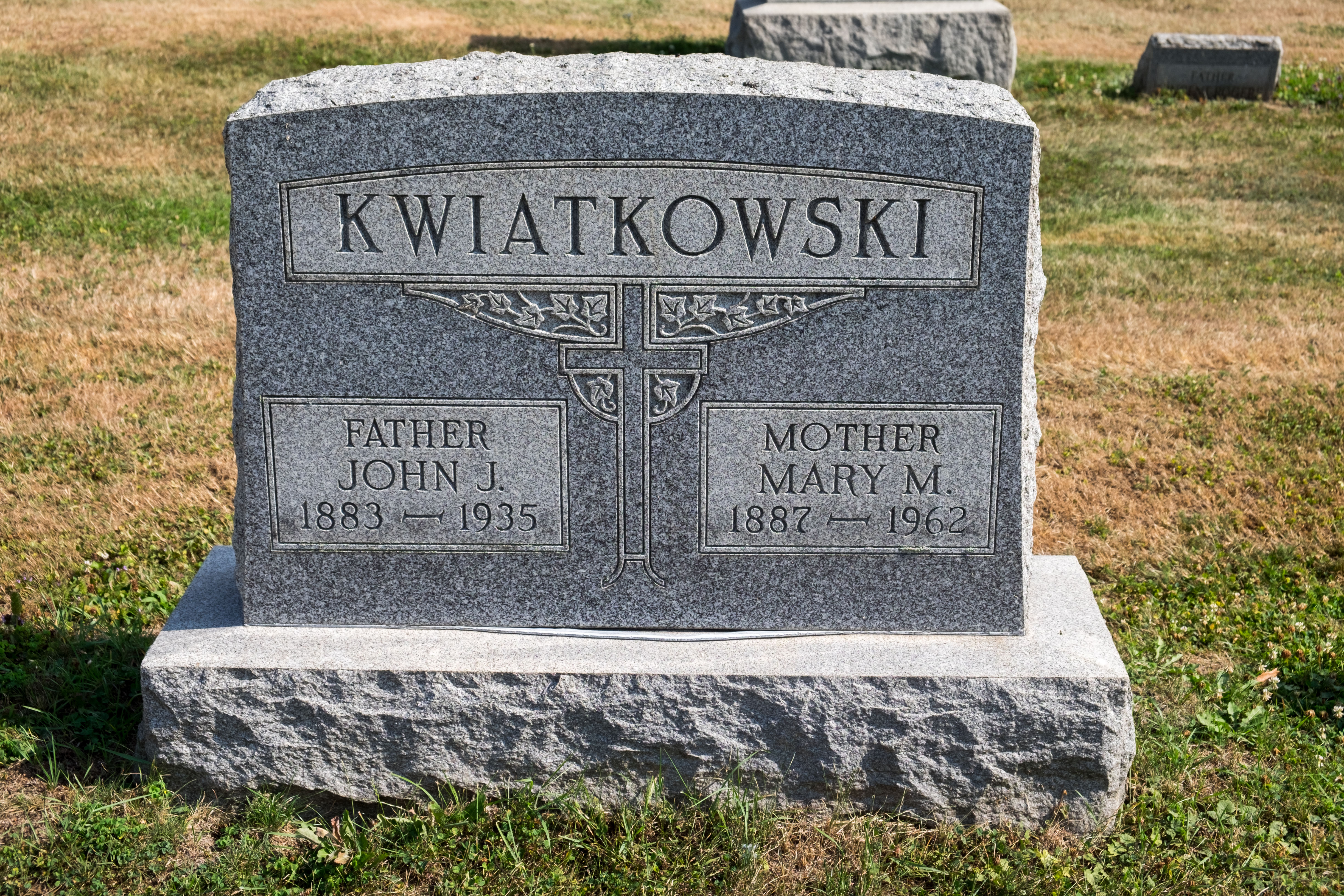
Since Bernie is the photographer, he naturally chose a cemetery with family in it. St. Bonaventure Cemetery in Allegany, New York is quite a large cemetery, and I found many family names among the Kwiatkowskis buried there, including my great grandfather and great-great grandmother (Bernie’s great-uncle and great grandmother), . The family relationships can get a bit confusing when I try to position myself and Bernie with the dead relative, but I did use the cousin finder, and I think I got it right. If you see any mistakes in family progression, please feel free to let me know so I can straighten it out.
Bernie’s grandparents’ tombstone (my great-granduncle and “Babci Mary”).Bernie’s namesake who died in WWII when his plane crashed, probably in Papua New Guinea (my first cousin twice removed).
The cemetery is named for a local university that students claim to be haunted. Who knows whether the stories are actually true. You can read themhere and decide for yourself. In the meantime, here’s one as a great companion to those late night readings. You may want to keep the light on.
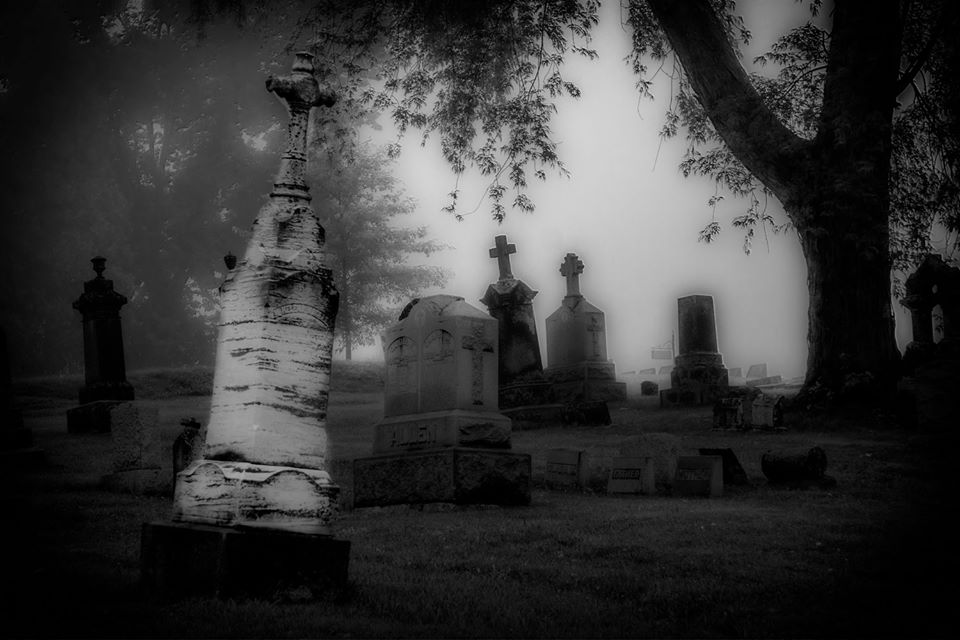
Happy October! I’m featuring cemetery photos from my cousin Bernie Kubiak this month. This one is from Chestnut Hill Cemetery in the village of Portville, New York (near Olean).
Photo by Bernie Kubiak
I don’t think we have any relatives buried here. You can find a complete listing of interments here.
The Duck, The Whole Duck, and Nothing but the Duck
Quack.
But seriously, my New York cousins from my dad’s generation are very Polish. I mean, many of them speak the language, and even if they don’t, they know a few words here and there and even understand much of the Polish dialogue. Even my father, who was separated from the family when he was just thirteen, can speak a few words. Not only that, but many of them are still staunchly Catholic as their grandparents from the old world would have wanted it, and even more still enjoy the good old Polish cuisine.
I myself grew up enjoying many culinary delights from the Old World. I ate things many of my American counterparts would never dream of touching. It’s too bad for them, though. They don’t know what they are missing out on. Beef tongue served the Bohemian way will always be my favorite. One of these days I’ll have to post that recipe as well.
The first thing John Woodgie, another of my New York cousins, suggested for this month’s Cousin Connection was another Polish recipe. I can’t blame him. Polish food is delicious. (By the way, you can get the best Polish food in the U.S. if you visit Chicago.) This particular recipe uses the whole dang duck! It’s one of John’s favorites. I’ve never had it, and like many of my counterparts, I’m a bit reticent to try it; but then I’ve had lots of strange foods in my life, and most of them are amazingly delicious.
First, a little about John and how we are related. John Woodgie is my family’s genealogical expert. He has been working on the Kwiatkowski family line for some time and has identified over 2100 family members. He links names while I am looking for stories. I am eager to connect faces and places with those names, linking each of us in a way that brings the past to life. But I’m just a dabbler compared to him.
Like Chuck Kwiatkowski, John also lives in Olean, NY. In fact, he tells me he’s only a mile away from Chuck. Olean is where my dad was born. I’ve only visited once, staying for just a couple of hours. I think this means I need to plan a trip up north to meet these guys in person sometime soon.
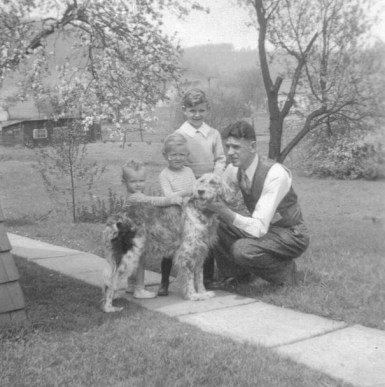
Joseph Woodgie with sons John, Louis and Steve with their dog Rags circa 1943. John is the little one.
I am related to John through his mother, who was daughter to my great-uncle Joseph Kwiatkowski. Like my dad, John’s father was also born in New York but he was a first generation American. Two of John’s uncles were born in Poland before the family immigrated.
John tells me that his grandfather on his mother’s side, Chuck‘s grandfather, Bernie‘s grandfather, and my dad’s grandfather were all brothers. There are plenty more where they came from, too. Their father, Joannes (“John”) Kwiatkowski, and his wife Catharina had a total of thirteen children. John’s Kwiatkowski grandparents had twelve children, and John is one of 41 grandchildren. Bernie’s grandparents had at least five children. I don’t know how many children Chuck’s grandparents had, but I know that my own great-grandparents also had a dozen children, and I am sure that my father probably has just as many first cousins as John Woodgie does. This means I have only touched the tip of the iceberg as far as my New York cousins go, although I have no intention of focusing all of my Cousin Connection efforts there. I still have three other grandparents to search through.
Of course, creating a new cousin chart for John was pretty easy. I just had to substitute a few names:
So about that duck.
Salomea, Frankie and Sophie Skała with their mother Maria Dynia-Skała circa 1910, Rzeszów Poland.
Joseph Kwiatkowski married Sophia Skała ,who was born in Zaczernie, Poland, in Olean, NY May 13, 1913. Sophie was John’s grandmother. She would make her duck soup almost every autumn. John says, “Grampa K would kill the ducks that he raised in their backyard along with chickens and pigeons.” Because the family relied on home-grown resources, they never went hungry. But there is more to it than that. The recipe frugally incorporates every edible component of the duck , including the blood. A goose can be used interchangeably with the duck in this recipe.
Sophie Kwiatkowski’s Duck soup is a regional recipe known as Czarnina (char-NEE-nah).The name is derived from the Polish word, czarny, for black. It refers to the dark color of the soup which comes from the blood in the recipe. The soup often has a sweet-sour flavor, a flavor I remember well from many of the European recipes I grew up on. I’ve never tried it, and I doubt I’ll ever have the opportunity to acquire a whole freshly slaughtered duck, but if I come across the concoction, I’ll be sure to give it a try.
Or maybe not. Legend has it that Polish suitors would receive Czarnina from their prospective in-laws. It was a way for the family to let a young man know that his advances would not be welcome. But John likes it, so it can’t be that bad.
Sophie Skała’s Czarnina
1 whole duck (gutted and feathers removed, reserve heart, neck and gizzard)
2 containers blood
1 medium onion
1 medium potato
1 carrot
1 medium apple
1 cup sour cream
sugar to taste
3 tbsp flour
In an 8 quart pot place duck, neck, heart, gizzard. Cut up onion, potato, carrot, apple into quarters and place them in a piece of cheese cloth. Tie cloth and place in pot.Cover with water to two inches of top of pot. Cook for two hours until duck is done.
Take duck and veggies of out the soup. Let soup cool to touch. In a bowl, mix blood and flour. Blend until smooth. Stir in sour cream and pour this into the soup. Stir until soup comes to a boil. Reduce heat and let simmer for about 1/2 hour.
While cooking you can make Kluski to add when soup is finished. Some people prefer to use Polish potato dumplings instead. I have also heard that Polish-Americans often use pre-made gnocchi found in the freezer section of their local grocery store.
You can find different versions online or in Polish cookbooks, but this is how John Woodgie’s Grandma Kwiatkowski made it, and it is his favorite. The others, he says, have too many ingredients.
I’ve been learning a lot about the workings of my Polish forbears from my New York cousins. Especially John. From both John and Chuck, I have gained new insights into the workings of my Polish-American cousins including changes in surnames and immigration patterns. I’m looking forward to learning more from them and sharing even more with my readers.
Stories From the Past is proud to present The Cousin Connection Project.
I grew up without cousins. Well, I did have cousins. I knew I had cousins. I had even met three of them. But I didn’t know them well, and I didn’t even live in the same state as any of them. I was well into my 40s by the time I started getting to know the rest of my cousins, and I still haven’t met most of them in person.
I met my midwestern cousins on my mother’s side when I moved to Chicago for graduate school. As I sat at Thanksgiving dinner with all those first cousins trying to figure out how my children were related to them and how our children were related to each other, my cousin Allen patiently explained the differences between first, second, third cousins, etc., and the numbers of removal. It was a bit confusing, but I retained enough of the information that I felt comfortable in exploring cousin relationships to others.
Thanks to Facebook, I have been able to connect with even more cousins I have never met in person. With their cooperation, I am getting to know them better one blog post at a time. When my newly discovered cousin Bernie posted a family recipe on Facebook, I decided the recipe would make a great blog post. I felt that I should also identify just how we were related, so with Bernie’s cooperation, and using Allen’s “formula” I created a chart showing my newly discovered relationship. Bernie was great, and the post was so personally rewarding that I offered to do it for all of my cousins on Facebook.
Between Bernie’s post and my next cousin post, I was contacted by a complete stranger named Diedre in Michigan. Diedre gave me some information indicating that we have common ancestors from early colonial America and the Netherlands (AKA Holland at the time). Much of Diedre’s information pointed to a probable family connection by removals with an old family friend in Utah. I could see that I could easily make cousin connections throughout the United States on a regular basis by connecting through common ancestors. I’ll go more into detail about those common ancestors in another cousin connection post, but suffice it to say I can see that I have plenty to keep busy.
Thanks to my U.S. immigrant ancestors, and the cousins I’ve already connected with, I can connect with my past in a completely new and exciting way. Next week I’m connecting with another New York cousin, our family genealogy expert, John Woodgie. After that, Diedre, and I still have plenty of ideas to keep me going well into the new year. This is very rewarding for me, so I am creating a database for these cousin connections, and I am calling it The Cousin Connection Project.
The Cousin Connection Project uses a surname and location database of most ancestors I have been able to identify. The database is organized alphabetically by surname, and should be pretty easy to identify links to common ancestors. If you come across a name, location, and date range that matches names, locations, and date ranges in your own family tree, you can contact me for a free consultation and a possible cousin connection post showing your relationship to me.
I am also including separate databases for Mary Davis Skeen and any other family lines for other historical biographies I decide to tackle in the future. The separate databases will make it easier to identify your own personal relation to other bygone figures. I have already checked Mary Davis and her husband William Skeen (who was from Pennsylvania), against my own family tree, and I have no reason at all to believe that there is a connection to myself (so far).
As the connections grow, I plan to include links to stories, recipes, and family traditions. This is exciting for me, a person who grew up without knowing most of my extended family, including three of my grandparents and most of my first cousins. Where before I felt that I had almost no extended family, suddenly the world is becoming my family. I know that we have often been told that the family of humankind is all related. Some of those estimates claim that we are related by as little as sixth cousins. Other, more scientific endeavors claim that everyone on the earth is related by at least fiftieth cousins. I don’t know how much truth there is to that claim, but I am pretty sure that I am related to enough amateur genealogists to keep my Cousin Connection Project alive for as long as I want to pursue it. Here’s to getting to know you!
This isn’t a William Faulkner novel, it’s reality. It’s also not like it sounds. When your family has deep roots in the same area where you were born and raised, it’s bound to happen, and it doesn’t take much digging to find family members marrying family members. They probably don’t even know they were doing it.
This case is different because my cousin on my grandfather’s side, married a cousin from my grandmother’s side. They are not related at all to each other, but it’s not totally coincidental that it happened. All of my New York cousins come from my great-great grandfather who was born in Poland. Their roots are not nearly as deep in American soil, and they know who most of them are, so the chances of marrying one of the Kwiatkowski cousins are pretty remote. My grandmother’s genealogy can be traced well into pre-revolutionary America though. They settled in Pennsylvania, a wild and untamed frontier, approximately two generations before my Chuck’s grandfather and my great-grandfather arrived with their parents from Poland. (more…)
Four months ago, I began making plans to revive this blog. I began reorganizing my schedule, but just one week later, my plans were thwarted by the news that we were moving back across the country for my husband’s job. He had about two weeks’ notice, which meant he had to fly out and get started looking for a place in Kentucky immediately. I was the lucky one who got the job of managing the logistics of moving the whole household, including my daughter and granddaughter. (more…)
Okay; Mary is not my grandmother. In fact, we’re only related by marriage. Since I came across the existence of Babci Mary from a cousin I’ve never met in person, I decided that this would be a great opportunity to get to know my cousin. By proxy, I’ve gotten to know my own family better.
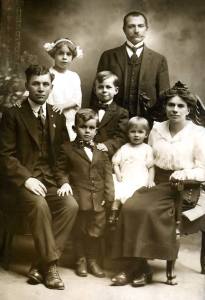
“Babci” Mary is the beautiful woman seated to the far right. Bernie’s mother is the little blonde seated next to her; his grandfather Joannes “John” is seated on the left. We have speculated that the man standing on the right is my great-grandfather Michael. Michael and Joannes were brothers.
Babci is a Polish word meaning grandmother. It is pronounced bob-chee with the emphasis on the last syllable, making the last consonant in the first syllable sound more like p.
I met my cousin Bernie on Facebook when I started this blog. Hoping to connect with other family researchers, I created a companion Stories From the PastFacebook group. Many researchers have joined the group, along with friends and childhood classmates. Thanks to my father’s familial connections on Facebook, I was further connected to many cousins from Southwestern New York and Northwestern Pennsylvania. Bernie is one of those cousins. (more…)
Warning: Despite my insistence that this blog is all about graveyards and dead people, it’s really about family history. This story is about part of my family, and it is part of my children’s history, so even though they are still alive to tell this story themselves, I’m going to tell it now to keep it from becoming untold.
My baby boy turns twenty this weekend. I haven’t been able to get him out of my mind because he lives nearly three hundred miles away. I have been too ill to travel for the last year or so. I’ve been having car problems too. So has Jake. I miss him terribly, but he promises to come and visit soon, and I can’t wait. Yes, this is the story of a boy and his sister. I’m getting to that–I promise.
But first, a little about a boy and his music. I usually begin my day by listening to uplifting music, and today was no different. I began by listening to “Bring Him Home” from Les Miserables, but that got me thinking of sons in general, which got me thinking of Jake. Again. And then I began wondering why I hadn’t listened to anything from Waiting for Compromise lately. In fact, I’ve been avoiding it.
You see, Jake is the lead singer in a band (Waiting for Compromise). Or am I supposed to say was? I don’t know. He is one of three extremely talented singer/songwriters. Two are brothers, and then there’s Jake. Jake moved to the other end of the state for a full-time job about a year and a half ago, and the two brothers have done a pretty good job of keeping their band going despite the fact that Jake is no longer around. In fact, they’ve even released their first album. Jake wasn’t able to be around for most of the recordings, so he doesn’t sing in many of them. But this one, “Morning’s Coming Soon,” brought me to tears:
Jake does sing in this one. He’s the crazy blonde always up front and in the middle. It’s not the song itself that makes me cry, but the video montage, the fact that the boys are separated, and the lyrics. They probably did it on purpose just to make me cry. Well, it worked, so I’ve been avoiding their music for a while. To be fair though, Jake tells me it makes him cry too. (more…)
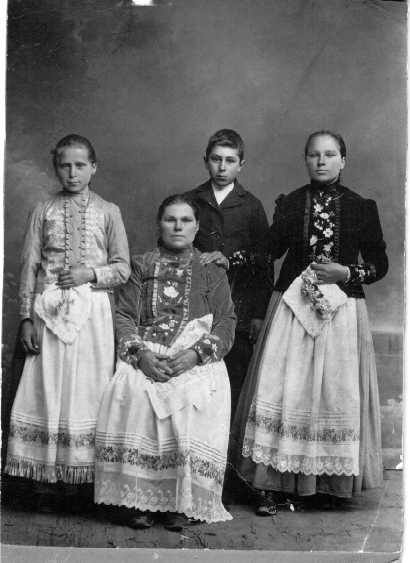
Just found this blog post today. I love it because it gives insight to Polish traditions and life in Poland from the prospective of a transplant. One of my New Year’s resolutions is to post weekly. Having three active blogs, this may seem difficult, but having access to great re-posts such as this one will make things a bit easier.
In Poland, Christmas Eve is a day first of fasting, then of feasting. The Christmas Eve feast begins at the appearance of the first star. There is no red meat served but fish, usually carp. The supper, which includes many traditional dishes and desserts, can sometimes last for over two hours. It is followed by the exchange of gifts. The next day, the Christmas Day, is often spent visiting friends and family. In Polish tradition, people combine religion and family closeness at Christmas. Although gift-giving plays a major role in the rituals, emphasis is placed more on the making of special foods and decorations.
As mentioned before on the night of Christmas Eve, so important is the appearance of the first star in remembrance of the Star of Bethlehem. On that evening, children watch the sky anxiously hoping to be the first to cry out, “The star has come!” Only after…
A few days ago I decided to change my screensaver on my PC. I thought I’d look up places where my ancestors lived and fill my screensaver scroll with interesting photos of those places to provide inspiration for my family search and for blog posts. You wouldn’t believe the stories I uncovered! Right here, in the good ol’ U S of A!
But first, a few shots from my past in the old world:
The photographs of the old world are amazing, but I do have ancestors from the colonial days in America too. My paternal grandmother was born in Potter County, Pennsylvania, and my grandfather, son of Polish immigrants, was born in Cattaraugus County, New York. The two counties share state borders, and from what I’ve heard, Grandma must have crossed the state line where she met my grandfather. I’ve actually driven through Cattaraugus County, and I even stopped in the City where my father and grandfather were born (probably the same city where my grandparents met, considering it is rural New York, and it really is more of a small town), so I really was more interested in seeing images from the Pennsylvania side. (more…)

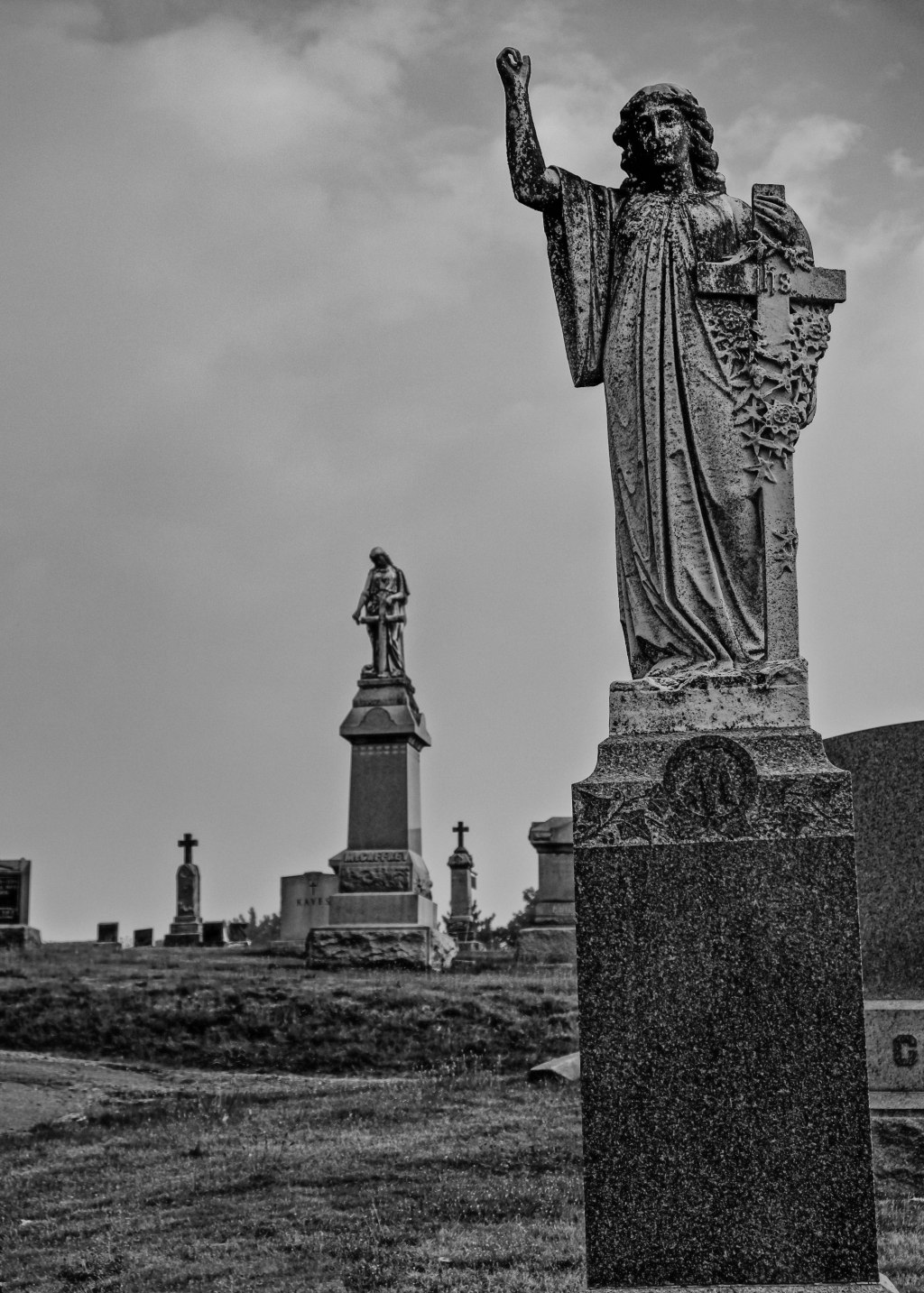

 The cemetery is named for a local university that students claim to be haunted. Who knows whether the stories are actually true. You can read them here and decide for yourself. In the meantime, here’s one as a great companion to those late night readings. You may want to keep the light on.






 Just found this blog post today. I love it because it gives insight to Polish traditions and life in Poland from the prospective of a transplant. One of my New Year’s resolutions is to post weekly. Having three active blogs, this may seem difficult, but having access to great re-posts such as this one will make things a bit easier.



 StoriesFromthePast.com
