Author: Mari K Flowers

  • She looks just like me. But who is she?

    She looks just like me. But who is she?

    I missed posting on Wednesday. Writing about my Tante Rosa was important, but it took a lot out of me.  By the time I had completed the post, I was emotionally worn down.  I didn’t feel like I was just blogging about my aunt; I was writing for all of  the families of the holocaust. As a parent and grandparent, I imagined being forcefully separated from my young children and grandchildren.  From a child’s standpoint, I imagined the horror of discovery that the people whom I put my deepest faith in could not keep me from being snatched away from my family and sent to an unimaginable doom. It was tough and I needed a break. So Wednesday’s blog comes today.
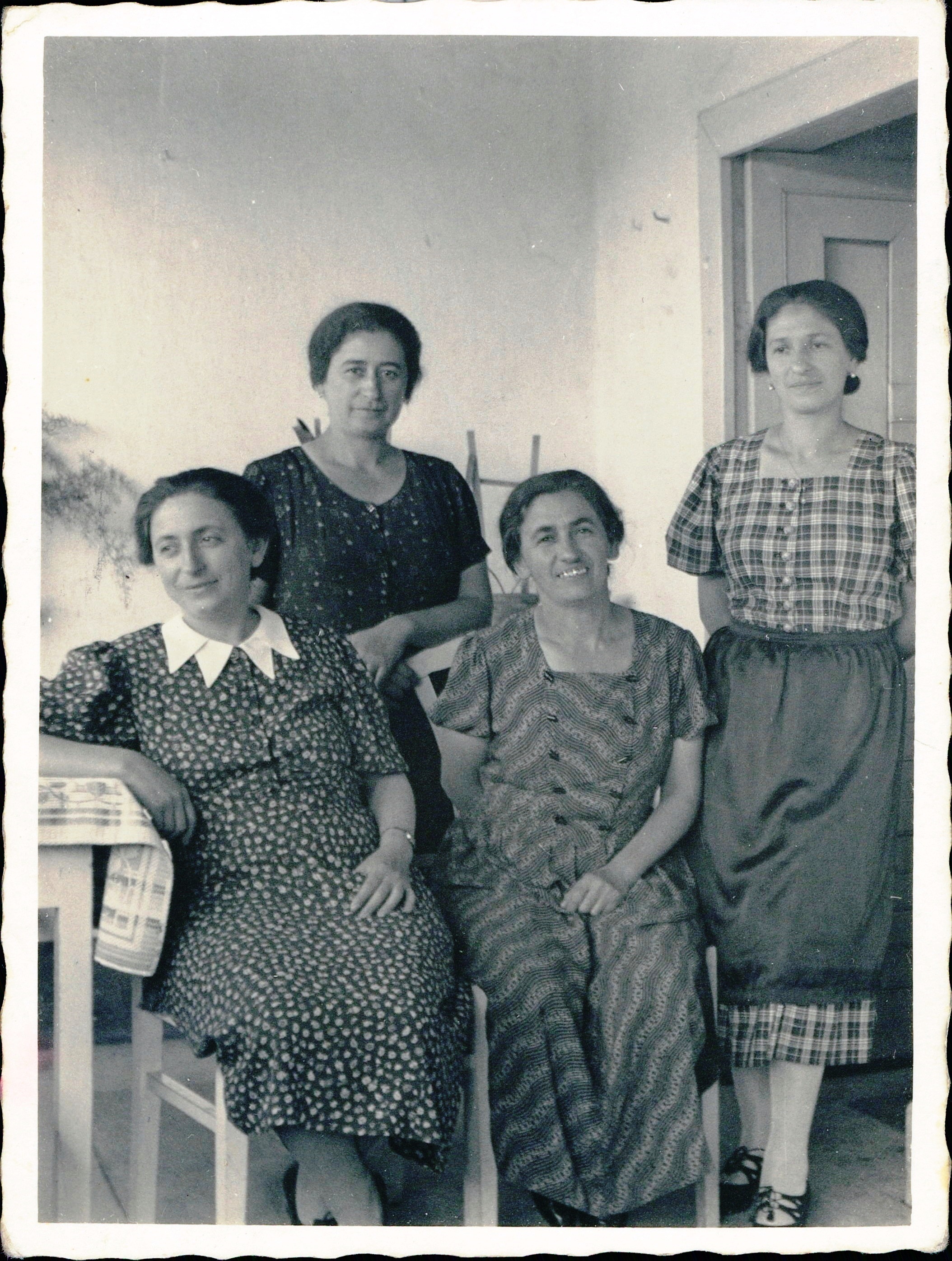
    We are pretty sure that the woman on the left is Gisela. Standing in the back is Helene (we knew her). But the woman sitting to the right and the one in the doorway–we are unsure of . They are most likely Rosa and Sommer (Hermine?), but which is which?

    I talked with my mother at length regarding September 3rd’s post (Why Grandma Cried). But memory is a fickle thing, coming and going without permission as we get older.  From my childhood I remember mom talking about Grandma’s four sisters; but as I started putting records together and gathering photos, I was only able to find evidence of three.  I told my mother this, and she began questioning her own memory.  Together, we decided that our memory had failed us. We labeled the photo of the four women according to this discussion, despite Mom’s insistence that her mother had four sisters.

    A few days after my post appeared I got a phone call. It was my dad. “Your Grandma Rothsprack had four sisters. The one that was missing was named Hermine.”  Okay, now the story is starting to make more sense.  I remember Mom saying that Grandma had four sisters. So I did a little more digging and sure enough, it came out of my own Grandmother’s mouth.  My father had tape-recorded my grandma’s life story when I was just a baby and had made type-written transcripts for each of his children.  This is what Grandma said:

    “I am one of five girls in the family–no boys. [She lists them] Gisela who lives in Austria. Rosa: killed in Auschwitz (sic). Not Married. Helen: Lives in Graten [California]. Sommer – lives in Austria.”

    Wait.

    Didn’t dad say the other sister’s name was Hermine?  This is confusing. Tante Leni didn’t have any children, I’ve never met my Austrian cousins, and Tante Leni and Grandma are not around to help us get it straightened out.

    Same eyes, same nose, same smile, same tilt of the head. Even the same eyebrows!
    Same eyes, same nose, same smile, same tilt of the head. Even the same eyebrows!

    As we were looking at the photograph I noticed something interesting.
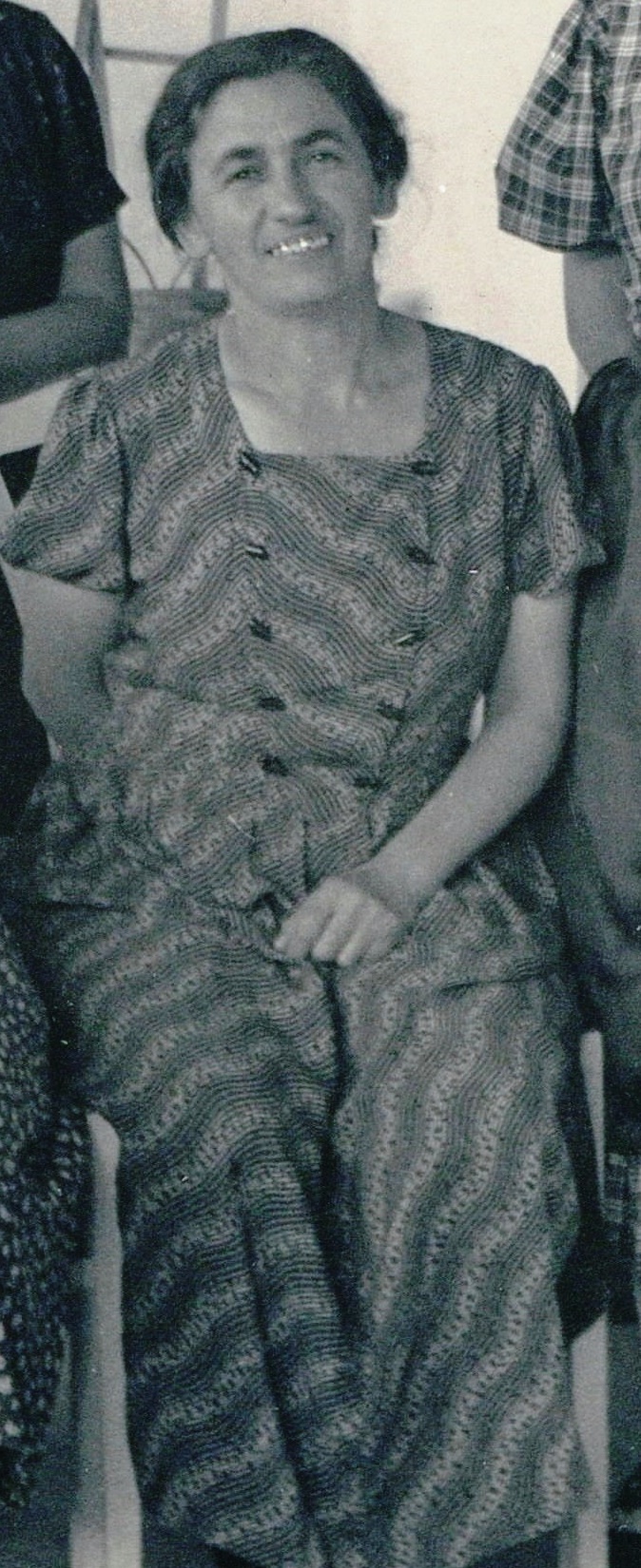
    She is either Rosa or Sommer (or Hermine?)
    She is either Rosa or Sommer (or Hermine?)

    When I pointed it out to my husband he disagreed. I kept thinking about it, and I was pretty sure that he was wrong. Until last night.  I was at our local family history library because I was trying to solve the mystery of the missing sister. I showed the genealogist my information and the photograph from my blog; as she looked at the photo, her jaw dropped open, her eyes got big, and she pointed at the photograph. “Do you see this woman?” She asked. I laughed with relief. She saw it too.  We know it is my grandmother’s sister. Because Rosa and Giselle were the oldest, I think it is my Tante Rosa. And she looks like me!

    For me, this is the most awesome thing about genealogy.  I am living proof that I am related to this woman, and she is an integral part of my past. My dad tells me that he just uncovered several more photographs of Rosa.  I can’t wait to get the copies and make the comparisons.
  • Why Grandma Cried

    Why Grandma Cried

    My mother was born in 1940, one month after Germany began it’s attack on Great Britain. A few months later, Pearl Harbor was attacked, and the United States entered the war. By that time, Hitler had been rampaging through Europe for more than four years. Two days after Mom’s fifth birthday, Emperor Hirohito agreed to unconditional surrender and Hitler had been dead five months. Mom was very young when she heard her mother crying late at night when she thought no one could hear.  Grandma was heart-broken, but it would be at least another twenty years before Mom would learn why.

    Josephine Daniel Rothsprack, my grandmother, grew up in Austria with her four sisters, Giselle, Hermine, Rosa, and Helene.  I usually hear them referred to as “Tante” (German for “aunt”). Although Grandma was close to her family, she was tired of being poor.  “All our clothes were rags,” she told my dad. “They were patched and patched until there were patches on top of patches,” she complained. Grandma told of a friend who had gone to New York and was living as a maid making $50.00 a month. “That was a fortune to us in Austria,” she said. So Grandma left her three sisters behind to seek her fortune in the United States.

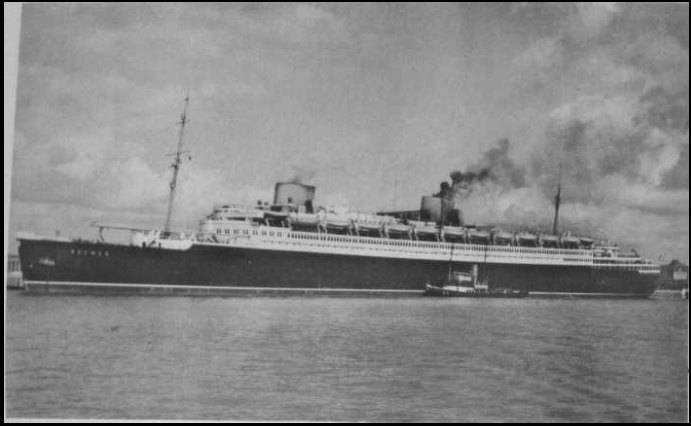
    Grandma was on the Manifest for the “Bremen” arriving in September 1923. The Bremerhaven was renamed Bremen in March of that year.

    Grandma arrived in Boston September 14, 1923 (National Archives and Records Administration (Ancestry.com), Passenger Ships and Images database). From Boston, she took a train to San Fransisco where she stayed with friends until she could make a living on her own.  That’s where Grandma met my grandfather, Wilhelm (“Willie” or “Bill”) Rothsprack.  They were married,  settled into a home of their own, and had three girls. My mother was the youngest.

    Grandma's sisters in Austria
    Grandma’s sisters in Austria. Tante Leni is standing in the back. I can’tbe certain, but I believe the woman seated to the right is Tante Rosa.

    Back in Austria, things were getting worse for the Jews.  Giselle and Hermine had married  influential Germans who kept them safe from harm; but news reports, letters and phone calls told Grandma that Rosa and Helene (Leni), her two other sisters, were still in danger. Grandma began saving money to bring them to the United States.

    Hitler invaded Austria in March of 1938, and with very little violence, annexed it, declaring Austria part of Germany.  Jews and Gypies were not allowed to vote in the annexation, making the vote nearly unanimous.  At that time, what was tough became even tougher. When Kristallnacht came in November, Rosa and Helene remained safe due to the fact that they were the only Jews in a very small town.  But things did get worse when my Tante Leni’s boyfriend turned the family in to the Nazis.  My mother tells me that Tante Leni’s boyfriend was himself a Nazi. (more…)

  • What’s in a Surname?

    What’s in a Surname?

    “What’s in a name?”  Juliet’s well-known question, in Shakespeare’s Romeo and Juliet, implies that a name has no meaning, therefore Romeo could give up his family’s name without affecting Romeo as a person. Despite Juliet’s assertion, names, especially surnames, tell us a whole lot about a person. If Romeo had changed his surname, as Juliet asked him to do, he would have disassociated himself from his family, making it extremely difficult to prove his paternal identity.  And Romeo’s descendants, had he changed his name and lived to have children, would have had a very difficult time growing their family tree past Romeo. As both the Montagues and the Capulets knew, a surname is very important.

    Roses or bacon?

    Along with a surname comes an association with a larger group of people.  Your last name says a lot about who you are and where you come from.  Names, like all other words in the English language, have meaning.  If I give you a word, such as rose, a picture forms in your head. You have already made some sort of judgment based on that one word, and all I said was rose. In fact, this particular word implies not only a flower, but a specific smell accompanying that flower, making Juliet’s reply (to her own question) that “a rose by any other name would smell as sweet” untrue. If I gave you the word bacon accompanying a picture of a rose, a completely different smell would come to mind.  It’s true. They’ve actually done studies on it!  This particular phenomena, connecting words to ideas and things, is called semiosis.

    But words change, making the meaning derived through semiosis change along with the words themselves.  This is called etymology (the evolution of words), and this is where we run into trouble when we do genealogy. We see this in many surnames today. For example, the patronyms Johnson and Johns both indicate that an individual has a forefather by the name of John.  One name, Johnson, typically indicates Nordic ancestry, while Johns indicates Welsh ancestry.  If you can get that particular patronym far enough back on your family tree, you will actually get to that specific ancestor by the name of John. I have noticed this phenomenon in my family tree. Once we’ve reached the ancestor with the name of John, we suddenly find that John was the son of  Harold, and in the next generation back, we learn that Harold was the son of George.  This patrilineal method of naming often causes trouble when trying to figure out the matrilineal line. Didn’t John, Harold, and George have mothers too? (more…)

  • How my Mormon Mom learned she was a Jew

    How my Mormon Mom learned she was a Jew

    Mom calls herself a “hidden child.” Although she doesn’t exactly fit into the hidden child mold, I think I agree with her. A “hidden child” is a child, often orphaned, whose identity as a Jew was kept a secret as they were sent away to be protected and raised by Christian families, or Christian orphanages,  during the Holocaust.  Many of these children did not learn of their Jewish identity until long after the Holocaust was over.  Some may have never learned of their true identity. And only a handful of these hidden children were reunited to their Jewish families due to the high mortality rate of the Holocaust.

    Mom was never sent away from her family. Her mother lived in the United States when Hitler began his purification pogrom. So how could my mother be classified as one of the hidden children? Well, it does have everything to do with the Holocaust. But I think I’m getting ahead of myself.

    Mom is the little one in the middle.
    Mom is the little one in the middle. This is a good example of how Tante Leni did Mom’s hair. I think it’s adorable.

    Mom’s side of story comes first.  Mom was born in 1940, and the war ended in 1945. She was the youngest of three girls–her closest sibling being ten years older than her. The year before mom was born, my grandmother’s sister, Leni, came to live with them from Austria.  Leni was a big help to my grandparents–she took care of my mother while my grandparents ran a ranch. Mom says that she remembers Tante Leni braiding her hair so tight that she thought her eyeballs would pop out.

    Mom says she must have been right around five when she heard her mother crying late at night.  She also struggled with Tante Leni’s strange behavior–Leni would run and hide whenever anyone came to the door; someone else would have to answer, because Leni was nowhere to be found. Mom thought it was just a weird quirk Leni had. (more…)

  • What Happened to the Skeen Family?

    What Happened to the Skeen Family?

    I wrote the original Untold Stories more than ten years ago.  At that time, there was little information to be found on the internet, and since I no longer lived in the area, I had to wait to get my questions about the Skeen family answered. I’ve been doing my research on my own free time, knowing that there was a story there. I haven’t been disappointed.  Thanks to a few phone calls, Family Search, Ancestry.comPlain City Utah.org, and one more trip to the Plain City Cemetery, I was able to find all the information that I needed to complete the Skeen’s story.  The story coincides with the history of  town itself, so it must be told as part of the town’s history.

    William Skeen
    William Skeen. Courtesy of Ancestry.com

    William Dolby Skeen was born in 1839 in Steelville Pennsylvania, son to Joseph Skeen, and brother to Lyman Skeen, all of whom were primary settlers in the Plain City , Utah area. The three men were among a larger group of Mormon pioneers who had originally settled in Lehi, but left to scout out an area in Weber County for a place with rich land for farming and a good water source.  The area now known as Plain City lies at the edge of a delta where the Weber River fans out upon entering the Great Salt Lake. These early pioneers found that they could use water from the river for irrigation, and culinary water could easily be found by sinking wells. It was a good spot with plenty of water for their small party of pioneers. This group of men staked claim to the land, and are therefore among the founders of Plain City. (more…)

  • What I found in Plain City

    What I found in Plain City

    If you’ve read my Untold Stories essay,  you know that I had many questions that I needed answers to so I could finish telling the Skeen’s story. Over the years, I looked things up on the internet, just out of curiosity, and this last spring I made another trip to Plain City.  I took pictures this time, and added them to my collection of information from Family Search, Ancestry.com, and the history archives of Plain City.  I have pieced together a complete story, and I’m so excited to tell it!

    Please be patient with me as I put the finishing touches on the story of the Skeen family. As I get the story ready, here are some teasers for you: (more…)