Burgenland is a state of Austria encompassing the entire eastern border adjacent to Hungary. The Bucklige Welt, or Hunchback World, is a region of foothills situated in the southeastern corner of Lower Austria particularly suited to hiking and biking. Also called “The Land of a Thousand Hills,” Bucklige Welt shares the northern corner of Burgenland. As an American “tourist,” I’d describe the area as Austria’s best-kept secret.
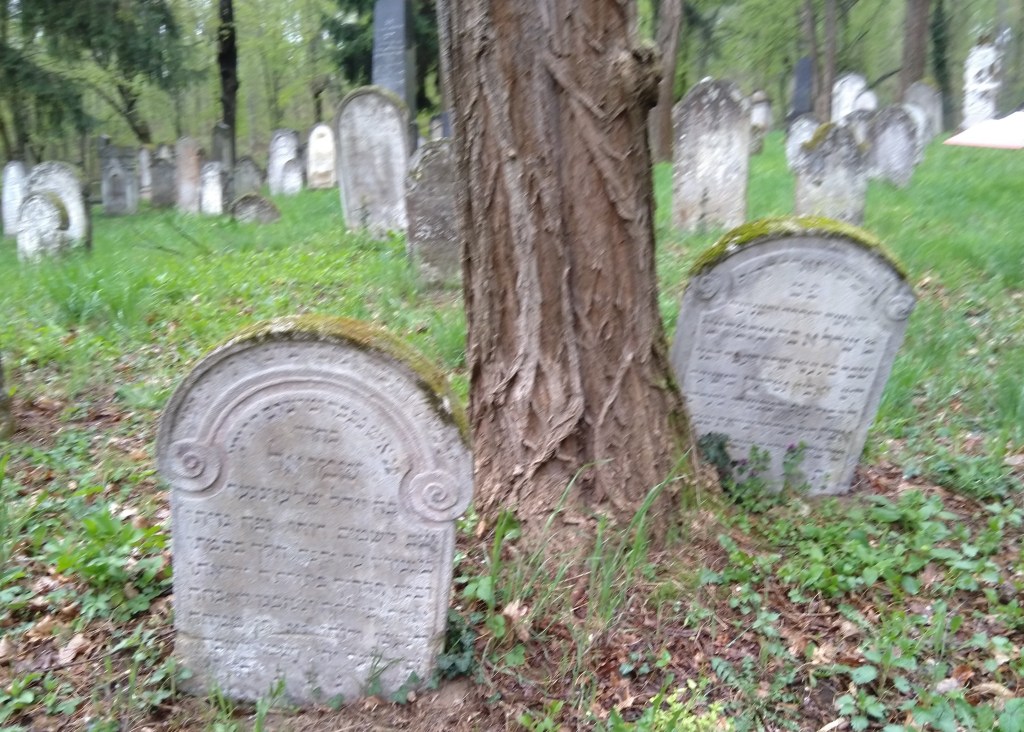
The secrets to my Semitic past have been left behind in the remaining homes, synagogues, and cemeteries of the Austrian Jews from the former Austro-Hungarian Empire. The unfortunate tides of history have forever altered access to those secrets. Homes and synagogues were torn down and aryanized while cemeteries were desecrated and/or destroyed. Larger cemeteries in key cities were often lost to the ravages of war. Many of those cities, such as Wiener Neustadt, have made quite successful attempts at restoring their historical town centers to their former glory, despite the loss of vibrant and thriving Jewish sectors. (more…)
My original plan to retell the story of Judah Loew ben Bezalel’s golem for Halloween has changed a bit given recent events in Pittsburgh. I have decided to focus more on the man himself than the story that often has the Rabbi dabbling in occult mysticism. Although Judah Loew is credited as the creator of the golem, his contributions to the Jewish community in Prague, and to Judaism as it is practiced today, far outweigh anything the Rabbi may have accomplished through any sort of magic.
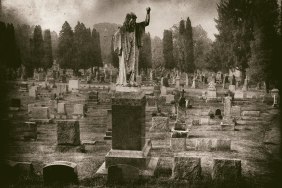
Rabbi Loew’s body was laid to rest among a great many others in the Old Jewish Cemetery in Prague. Also known as “The Maharal of Prague” (great teacher), Judah Loew ben Bezalel was born somewhere between 1510 and 1530. Less ambiguous is his place of birth; most accounts place his birth in Poland, although his family is said to have come from Germany. Others say he was born in Germany and moved to Poland later. What is not debated is the fact that Rabbi Loew was a great leader to the Jews of Prague.
The Maharal came from a family of well-known Rabbis and Jewish scholars. It should be no surprise, then, that Judah Loew immersed himself not only in the study of the Talmud, but also science, math, physics and astronomy. Loew was an avid reader and his studies included the Kaballah, a mystical interpretation of the Bible, the writings of Copernicus, and Martin Luther’s translation of the Bible in German. It is no wonder, then, that the medieval Jewish community of Prague revered him, and even considered him the wielder of great mystical power.
The story of the golem is the type of myth that urban legends are borne from, but it is also the kind of myth that has the power to evoke fear and grow the seeds of hatred. Like any urban myth, the story changes depending on who is telling it. In short, the Rabbi created a man made out of clay (golem). He used a Talisman to bring the golem to life during the day when it would be sent out to perform good deeds among the community. At night the golem would be returned to its inanimate form. When the golem had outlived its usefulness, he was placed in the attic of the synagogue in Prague and was never seen again.
Other more sinister versions of the story are told, turning the Rabbi into more of a Dr. Frankenstein than a great leader, and the golem into an out-of-control monster which was destroyed in order to save the people from its ravenous evil appetite. Perhaps it is just as well that the story of Rabbi Loew’s Golem never quite made it into the repertoire of well-known Halloween legends. Personally, I prefer to think of the Rabbi as a great leader and scholar who was revered by his people to the point that they believed him capable of magic.
For further study on Judah Loew ben Bezalel, I recommend the following:
To those who have been waiting for Thomas Davies‘ ancestor landing page, I would like to assure you that it is finished. However, due to the immense variation in genealogical details and a couple of migraine headaches, I did not finish it until last night, and I did not want to publish a page and a post on the same day. On Monday, November 5, I will publish a newsletter detailing what can be expected for the month, and Thomas Davies’ landing page will be posted the next day (November 6).
At least at the Lindon Grove Cemetery in Covington, Kentucky, that is. The cemetery is named after the grove of Lindon trees that once grew naturally in this part of town, so trees are important here. Lindon Grove is not just a Cemetery. It’s also a city park and certified arboretum. Many of the older and larger trees in the cemetery are marked with plaques designating both species and native origination.
Of course tombstones aren’t intentionally planted in the trees, but as the trees grow they encroach upon nearby tombstones, nearly swallowing them. The photograph below is probably the most picturesque I found, but there are a great many tombstones growing in the trees here. Some are still identifiable; others are more tree than stone.
Of all the cemeteries I’ve ever visited, this one ranks among my favorites. It’s not a typical, run-down, Halloween-type graveyard, although it is one of the many I have seen that once suffered from neglect and vandalism. Despite the absence of play equipment, children feel welcome here. I brought my granddaughter with me, and she was just as entranced by the trees, tombstones, and gently rolling landscape as she would have been in a playground.
Fascinated by tombstones.
This particular graveyard sits on the northern edge of the former Confederate States of America. Just two miles away, across the Ohio River, lays the land of freedom for African Americans still in the bonds of slavery. This is Underground Railroad country and a former hotbed of strife where brother fought against brother. Kentucky was the first southern state to fall back in to Union control.
This particular cemetery does not hide its dark past; it embraces and rises above it. Set up as a public cemetery by a local Baptist Theological Institute, it began as a fully integrated cemetery including a pauper section where those who could not afford a proper burial were buried for free. A veteran’s section includes memorials for all United States’ wars since the cemetery’s establishment in 1843. Black and white, bond and free are all buried here.
Civil War history is prominent in Lindon Grove. Because Kentucky did not last long as a Confederate State, both Union and Confederate memorials are laid row by row with Union stones facing off against Confederates. A wide pathway separates the two in semblance of the uneasy front line of a battlefield. Interestingly, and certainly not intentionally, if one looks north towards Ohio, they can see the tips of Cincinnati’s towering skyline above the the war memorials as a reminder that freedom from the bonds of slavery was not far away.
At Linden Grove, contemporary life is inspired to mingle with the past. Pebbled walkways meander through the park encouraging foot traffic. Historic walking tours through the cemetery are occasionally offered. The serenity of the area is perfect for yoga enthusiasts. There are also picnic tables for a relaxing repast with family and friends. In the warmer months, the cemetery turns into a theater where theatrical performances and movies are provided for family entertainment. And of course the tombstones make great conversation pieces.
There is so much history here. The cemetery is actually included on the U.S. National Register of Historic Places. Among the prominent members of the cemetery, are the city’s founders, politicians, soldiers, and every day heroes including slaves, freed slaves, and their free progeny. One memorial marks the grave of B. F. Howard, a black railroad porter, and founder of the first African-American Elks Chapter in Cincinnati, Ohio. Another belongs to Dr. Louise Southgate, a female physician and early women’s rights activist.
It does not take much digging to find information on the many stories that are buried here. After just one visit and a quick Google search I had everything I needed for several blog posts. I could spend days digging through the mounds of historical information available at the Historic Linden Grove Cemetery & Arboretum website, and I could fill the rest of my lifetime telling stories from just this one cemetery. As Dave Schroeder, former director of Kenton County Public Library put it, “. . . If . . . you start writing down the names of some of the folks and look at the dates of birth and death and do a little research, you can learn so much about the community and what it was like at the time period just by taking your stroll through the cemetery.” My sentiments exactly.
If you try it, let me know! I’d love to share the stories you find.
There is a sign hanging in my mother’s laundry room. It says, “On this site in 1897 nothing happened.” But who knows if that’s actually true? Who’s to say nothing happened on that site. Right there. You know, on that very spot right next to the washing machine? If there’s no evidence of schoolchildren following a path to an old schoolhouse just down the road, a young woman milking cows, an old farmer stooping to clear a clogged ditch, or a native woman searching for firewood to warm her hearth, who’s to say nothing actually happened right there, on that very spot? If something did not happen on that very site next to my mother’s washer in 1897, I’m betting that there were a whole lot of somethings going on not too far away, and every time I see that silly sign in Mom’s laundry room, I wonder exactly what those somethings were.
Of course, I might be exaggerating a little, but the first log cabin was built in the area in 1877, so something could have happened there. Mom’s bathroom memorial makes me think. We post memorials for all sorts of historical events–things like battles, negotiations, inventions, catastrophes, births of historical figures, and of course, deaths (to name a few). Those memorials can tell us a lot. And although I could probably visit the local museum to find out if anything happened in the general vicinity of my mother’s bathroom sink in 1897, I could also look for memorials in the cemetery.
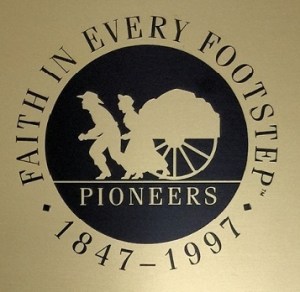
I love cemeteries. In fact, I still need to get myself that bumper sticker with the warning, “Caution, I brake for Cemeteries.” In 1997, when Utah was celebrating it’s sesquicentennial of the arrival of the Brigham Young and his followers, someone at the headquarters of The Church of Jesus Christ of Latter Day Saints came up with a reason to make me love cemeteries even more: A plaque to adorn every tombstone belonging to Utah pioneers who came before the arrival of the transcontinental railroad in 1869. I was raised in Utah as a member of that church. I wasn’t born there, and I had absolutely no pioneer ancestors, but I still remember the stories of courage, struggle, heartache and triumph that accompanied the many families who crossed the American plains mostly by foot. It was an unfathomable journey taking about three months. I tried it last summer by car with my daughter and granddaughter from Kentucky to Utah. It took us four days. Of course, it was a round-trip ride, which meant a total of eight days in an air conditioned car. By the time we arrived back home, we discovered that we’d picked up stowaways in the form of bed bugs along the way. I am in no hurry to try that trip again any time soon.
But I digress.
Utah pioneer grave marker image courtesy of Sons of Utah Pioneers
The metal plaque, emblazoned with the phrase, “Faith in every footstep,” soon began appearing on tombstones throughout the state. By 2001, the pioneer plaques had been placed on nearly every known pioneer tombstone. By that time, my interest in graveyards had fully matured, and the histories known, and the mysteries unknown, called to me like ghosts in a romantic novel. So when I stepped into the Cemetery in Plain City Utah, I was hoping those ghosts would lead me to a story.
And they did.
Inscriptions on tombstones are not usually put there to make you laugh (even though some do); they are there to make you think. The family memorial I found that day left me thinking for years. Names and dates are inscribed on all four sides of the tombstone. I could tell just by looking at birth dates, that this was the grave site of pioneer settlers, but that’s not what got me thinking. It was the birth and death dates accompanying nine other names. All children. In the Fall of 1870, and into January of the next year, eight of those children died. Now I knew there had been an epidemic of some sort. I could see that there was a mystery begging to be solved.
I was in college on that initial visit, and a single mom at that. I didn’t have time to look for clues and answers, but that story stuck with me enough that I knew I had to write about it. I used an essay assignment from one of my English classes as an excuse to put my conjectures into writing. The essay won second place in a department contest at Weber State University, and I kept it over the years.
When I finished school and became an empty-nester, I finally started digging for the tombstone’s story. My first foray came up with some answers–enough to help me see that I could easily build a history around that grave marker. I went back to Plain City and took pictures of all four sides of the tombstone. What I found, shocked me. On the backside of the tombstone are the names of three of the children who died during the epidemic, and one more who was born and died in the following years. It wasn’t those children that surprised me, though. It was the inscription I had missed in my first visit at the bottom of the back side of the tombstone, “Children of William and Mary Skeen.” I stepped back around to the front and looked at the bottom. It said, “Children of William and Caroline Skeen.” There were two different mothers and one father. This was a polygamous family.
If you zoom in, you can see Mary’s name at the bottom of the memorial. The names of her progeny who died as children are above hers.
I grew up in Utah, and I am very familiar with polygamy, even though I have no Utah Pioneer roots. Many Utah pioneers practiced polygamy, and I had friends who were descendants of polygamous marriages. There was even a handful of families in my neighborhood who still practiced it, even though it was disavowed by The Church of Jesus Christ of Latter-Day Saints in the late 18th century and church members who currently enter into such unions are excommunicated. Today, they call themselves Fundamentalist Mormons. Knowing what I know about Utah and polygamy, I can’t pass judgment on the pioneer families who still practice it despite laws and church condemnation. I’ve seen happy children and wives who claim to share equally in marital bliss. Neither am I blind to the fact that some sects have taken the practice much too far by forcing children into unwanted marriages. It’s because of that second marriage that I decided to focus on Mary Davis, the second wife of William Dolby Skeen.
I’ve lived outside of Utah for most of the time since I started my research, but that hasn’t stopped me. Thanks to the internet, I have access to nearly everything I need to complete my research. Sometimes I think I have too much, and that I will need to pare down the story before it gets too unwieldy. It has become interesting to me that I could build a compelling biography of an utter stranger without ever having met her or having any access to written memoirs.
I nearly missed Mary, tucked away as she was at the bottom of the backside of the monument. When I found her, I realized that her story is far more important than the location on the tombstone suggests. At a first glance, it’s easy to think nothing happened here. But from surrounding names, places, and dates, I could see that something had happened, and that little name tucked away in the corner had been there and played an integral role in the town’s history. It’s not her death that’s important, it’s her life. I don’t want Mary Davis Skeen to be forgotten, and I feel compelled to commit her to the memory of others who would never have known her otherwise. We are surrounded on a daily basis by people living what they feel are ordinary and unremarkable lives, but if we make an effort to get to know them, we can learn valuable lessons and come to see them as crucial members of our community. Mary’s tale unfolds in bits and pieces. Like a patchwork quilt, it is colorful, warm and inviting. Her story includes heartache, tragedy and tribulation along with faith, perseverance and promise. While Mary’s story reminds us that happily ever after never happens, it also tells us that happy endings do.
Please join me in my journey to tell Mary’s story. Your comments and helpful criticism are welcome and encouraged. Treat each post as rough drafts to Mary’s biography, as that is what they are intended to be. Mary’s story will be told one chapter at a time, and one month at a time, over the next year. My ultimate goal is to publish them together in a book. If you feel that you have information that may be helpful, or that will clarify ambiguities in Mary’s story, please leave a comment or contact me. And thank you in advance for your help!
Along with his other cemetery photographs, Bernie sent me three tombstones of literary figures. How did he know I majored in English? Perhaps Bernie is more of a kindred spirit than I thought.
The first is a photo of Emily Dickinson’s grave. I have few favorites when it comes to poetry, and Dickinson is easily my American favorite. It is believed that she suffered from Seasonal Affective Disorder (SAD), and many of her poems reflect her struggle. I really relate to her poem, There’s a certain Slant of light, as I also suffer from SAD. When I read it for the first time, I felt that she put into words exactly what SAD feels like. In fact, as the days begin to grow shorter again, and the sun begins to approach that winter “slant,” I am starting to feel “the Heft of Cathedral Tunes” once again.
Emily Dickinson tombstone, West Cemetery, Amherst MA, Photographed by Bernie Kubiak
There’s a certain Slant of light
BY EMILY DICKINSON
There’s a certain Slant of light,
Winter Afternoons –
That oppresses, like the Heft
Of Cathedral Tunes –
Heavenly Hurt, it gives us –
We can find no scar,
But internal difference –
Where the Meanings, are –
None may teach it – Any –
‘Tis the seal Despair –
An imperial affliction
Sent us of the Air –
When it comes, the Landscape listens –
Shadows – hold their breath –
When it goes, ’tis like the Distance
On the look of Death –
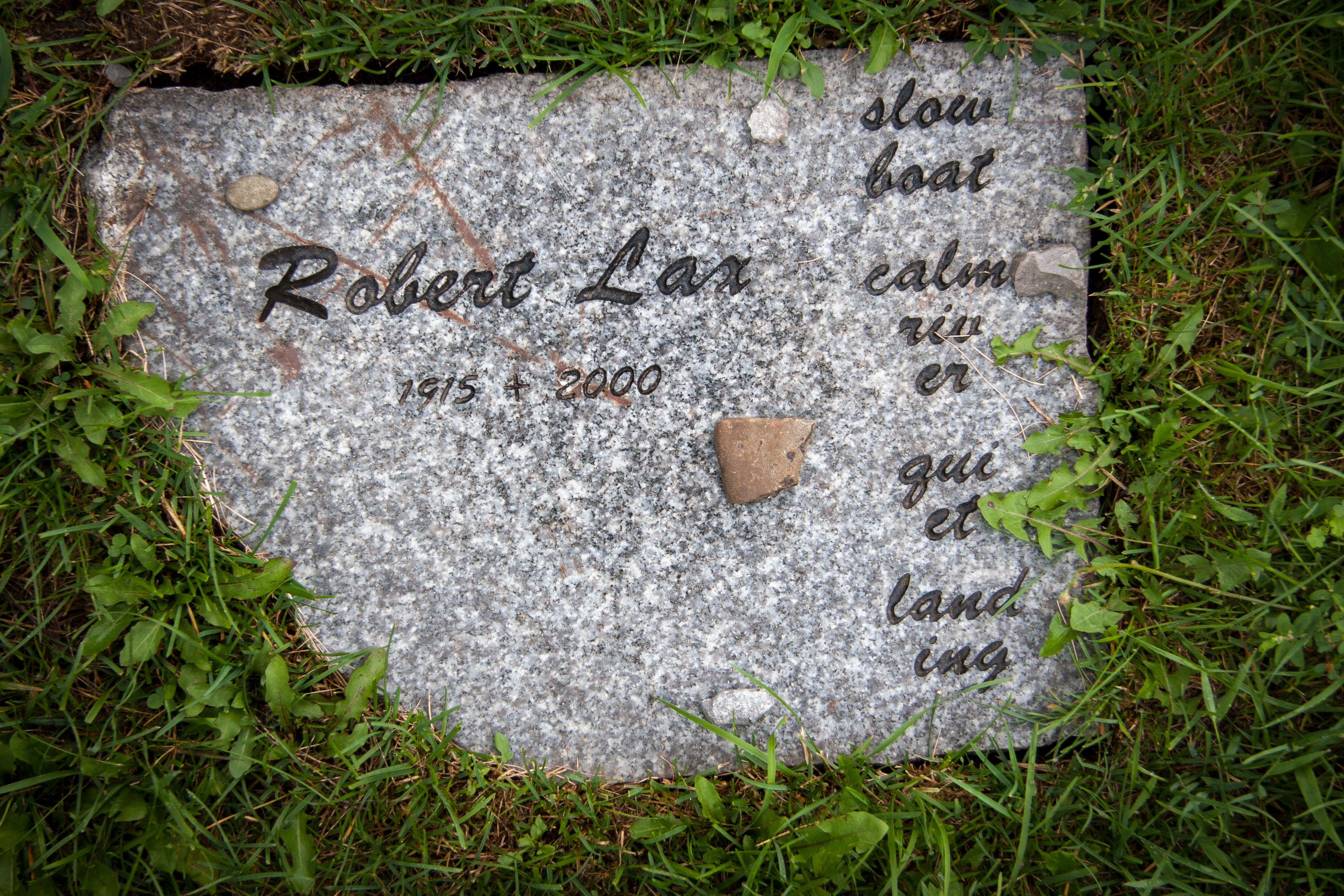
The second tombstone is from St. Bonaventure Cemetery, the same cemetery where many of my relatives are buried. I had never heard of Robert Lax until I received this photo of his tombstone. He was born into Judaism in the same town my father came from, but converted to Catholicism in his adult years. He lived in the islands of Greece for more than thirty years of his adult life; first on the island of Kalymnos, then Patmos. Lax returned to his birthplace of Olean, New York during the last few weeks of his life. Most of his original work is now housed at St. Bonaventure University, where his funeral services were held. (https://www.poetryfoundation.org/poets/robert-lax)
Robert Lax tombstone, St. Bonaventure University Cemetery, Allegany NY, Photographed by Bernie Kubiak
Lax was a minimalist poet. His ability to put together small words with few syllables in a single line down the page, and still pack both imagery and depth of meaning into those simple lines is amazing. I found his poem about life in Kalymnos, titled simply, “Kalymnos,” a very simple read; it only took a few minutes to get through it. Somehow though, the poem felt more like a novella as I absorbed its meaning. Divided into “chapters,” I feel 3 adequately captures the mood of the season with its description of the death of a fishing vessel. The vessel itself was the only casualty:
Kalymnos
BY ROBERT LAX
at 5
in the
morning
at the
cafeneion
the captain
described
the wreck:
the boat
had turned
over &
over
in the
water
churning it
like a
propell-
er
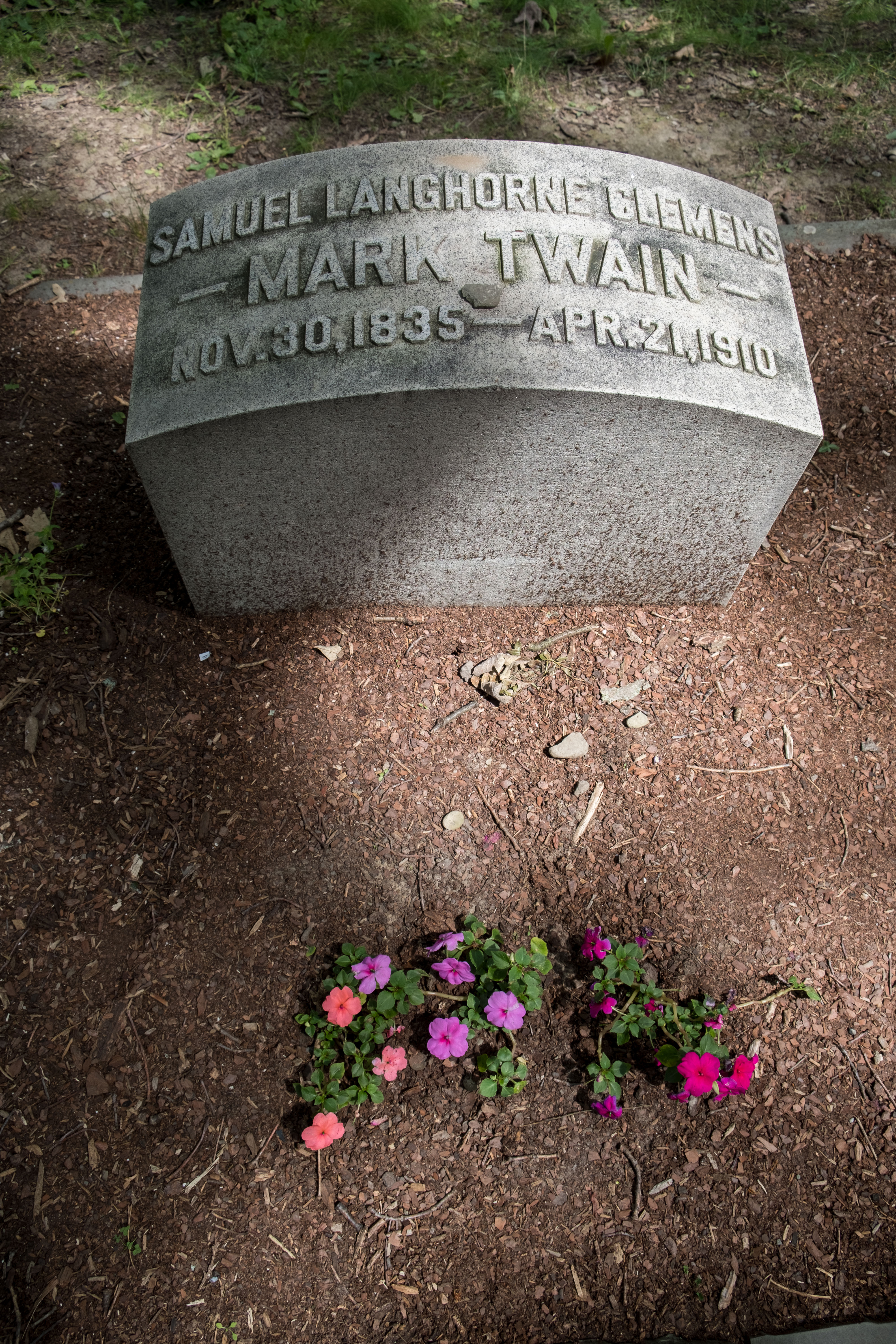
The final tombstone in this collection comes from America’s best known literary artist. Born Samuel Langhorne Clemens, he later adopted the pen-name Mark Twain. Despite many highly acclaimed literary successes, Twain suffered great loss as a husband and father, and was not as successful financially as he was artistically. Three of his children and his wife preceded him in death, and his declining literary success may have contributed to increasing pessimism in his later years. In his final days, Twain was said to have become a recluse prone to “volcanic rages and nasty bouts of paranoia .” (https://www.biography.com/people/mark-twain-9512564) He died in 1910 at his Connecticut home, and was laid to rest in Elmira, New York.
When I think of Twain, I don’t think of his final days. I think of Tom Sawyer’s Aunt Polly standing on her front porch, fists planted firmly on each hip, and shouting, “You, Tom!” while Tom runs blithely in the opposite direction. I loved both Tom Sawyer and Huckleberry Finn.
My favorite work of Twain’s is his short story, The Celebrated Jumping Frog of Calaveras County, but I wanted to include something of Twain’s more fitting for the season, so I went in search of a ghost story. I was not disappointed. In fact, what I found is actually titled A Ghost Story. Like most of Twain’s literary works, this one is quite suitable for children. Before you read it to your kids, though, I recommend that you read up on the background story of The Cardiff Giantat History.com. Share the giant’s history with your children before reading A Ghost Story. Just follow the links to each.
My birthday is this week. I consider this post my birthday gift. I thoroughly enjoyed “opening” it. Thanks, Bernie!
I’d like to give a shout out to Bernie Kubiak for freely sharing his photographs with us for Cemetery Month at StoriesFromThePast.com. His talent as a photographer comes from years of practice. A large portion of the photographs submitted by Bernie for cemetery month come from St. Bonaventure Cemetery in Allegany New York. Bernie shares his reason in a short autobiographical passage:
“My mother took it upon herself to maintain the family graves at St. Bonaventure Cemetery and frequently took me with her to help. That, plus the fun of rolling down the big hill where the Stations of the Cross were, kind of started an interest in cemeteries and how people memorialize the deceased. As the opportunity presents itself, I make images of cemeteries, not as documents but my impression of the place. The older cemeteries are visually more interesting, before graveyards took on an industrial quality with similar stones at precise intervals which makes for easier maintenance. Some cemeteries started in the 19th century were designed to be places to visit, with gardens, picnic spots, and walking trails.
I’m largely self-taught as a photographer, taken some workshops, and have benefited greatly from acquaintances sharing skills. I abandoned film over a decade ago, freed myself from the darkroom, and find myself wondering when I’ll have the time or resources to scan all the slides I’ve left behind. I’ve been fortunate enough to exhibit in galleries in Massachusetts and Vermont and do sell prints. But photography remains an avocation. Having retired from too many years working in human services and municipal management, I can spend more time at the craft and maybe even finish up a website. In the interim, one can find a very random sample of my work at: www.flickr.com/photos/berniekubiak/.”
Bernie is attracted to cemeteries for the stories he can tell through images. It turns out that Bernie and I have a lot in common when it comes to cemeteries. Whodathunk?
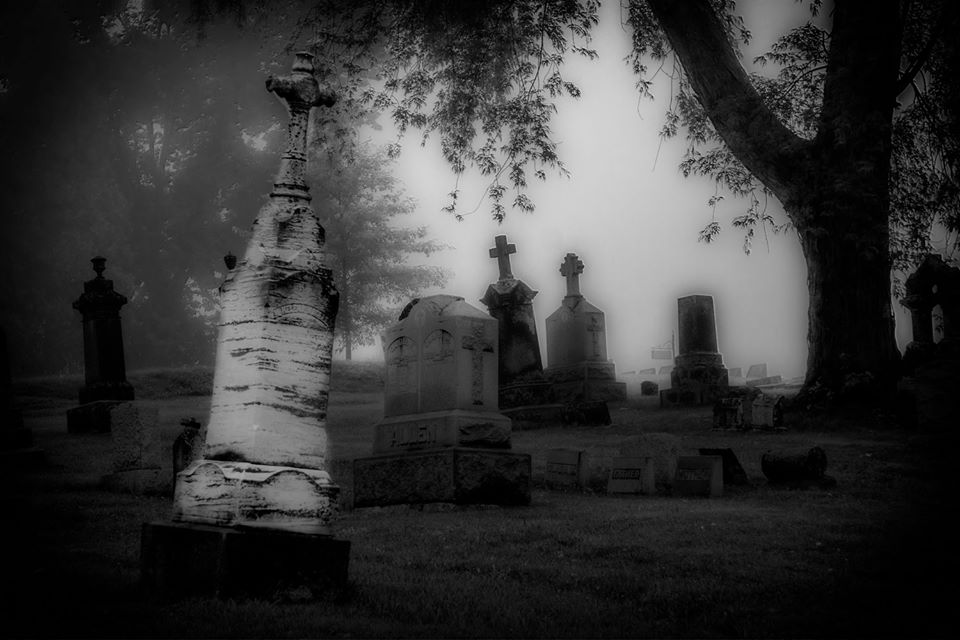
Happy October! I’m featuring cemetery photos from my cousin Bernie Kubiak this month. This one is from Chestnut Hill Cemetery in the village of Portville, New York (near Olean).
Photo by Bernie Kubiak
I don’t think we have any relatives buried here. You can find a complete listing of interments here.

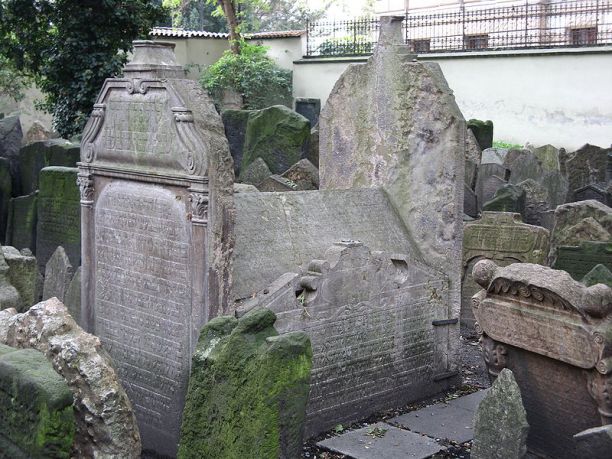
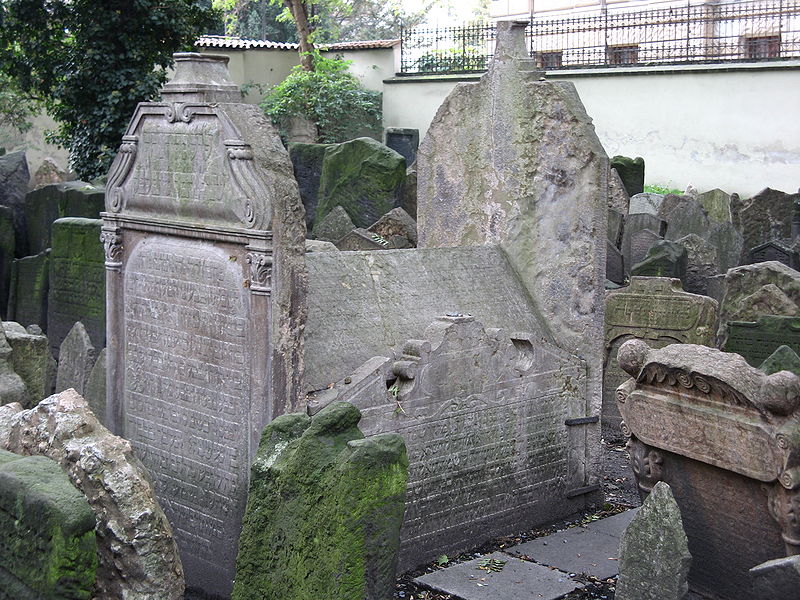 Rabbi Loew’s body was laid to rest among a great many others in the
 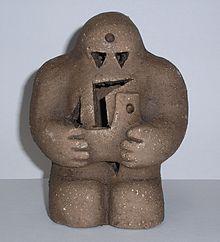 The story of the golem is the type of myth that urban legends are borne from, but it is also the kind of myth that has the power to evoke fear and grow the seeds of hatred. Like any urban myth, the story changes depending on who is telling it. In short, the Rabbi created a man made out of clay (golem). He used a Talisman to bring the golem to life during the day when it would be sent out to perform good deeds among the community. At night the golem would be returned to its inanimate form. When the golem had outlived its usefulness, he was placed in the attic of the synagogue in Prague and was never seen again.


 It does not take much digging to find information on the many stories that are buried here. After just one visit and a quick Google search I had everything I needed for several blog posts. I could spend days digging through the mounds of historical information available at the





 StoriesFromthePast.com
