Category: Plain City, Utah Cemetery

  • In 1870, Something Happened Here

    In 1870, Something Happened Here

    Preface to The Second Wife’s Story (a biography)

    There is a sign hanging in my mother’s laundry room. It says, “On this site in 1897 nothing happened.” But who knows if that’s actually true? Who’s to say nothing happened on that site. Right there. You know, on that very spot right next to the washing machine? If there’s no evidence of schoolchildren following a path to an old schoolhouse just down the road, a young woman milking cows, an old farmer stooping to clear a clogged ditch, or a native woman searching for firewood to warm her hearth, who’s to say nothing actually happened right there, on that very spot?  If something did not happen on that very site next to my mother’s washer in 1897, I’m betting that there were a whole lot of somethings going on not too far away, and every time I see that silly sign in Mom’s laundry room, I wonder exactly what those somethings were.

    Of course, I might be exaggerating a little, but the first log cabin was built in the area in 1877, so something could have happened there. Mom’s bathroom memorial makes me think. We post memorials for all sorts of historical events–things like battles, negotiations, inventions, catastrophes, births of historical figures, and of course, deaths (to name a few). Those memorials can tell us a lot. And although I could probably visit the local museum to find out if anything happened in the general vicinity of my mother’s bathroom sink in 1897, I could also look for memorials in the cemetery.

    I love cemeteries. In fact, I still need to get myself that bumper sticker with the warning, “Caution, I brake for Cemeteries.” In 1997, when Utah was celebrating it’s sesquicentennial of the arrival of the Brigham Young and his followers, someone at the headquarters of The Church of Jesus Christ of Latter Day Saints came up with a reason to make me love cemeteries even more: A plaque to adorn every tombstone belonging to Utah pioneers who came before the arrival of the transcontinental railroad in 1869. I was raised in Utah as a member of that church. I wasn’t born there, and I had absolutely no pioneer ancestors, but I still remember the stories of courage, struggle, heartache and triumph that accompanied the many families who crossed the American plains mostly by foot. It was an unfathomable journey taking about three months. I tried it last summer by car with my daughter and granddaughter from Kentucky to Utah. It took us four days. Of course, it was a round-trip ride, which meant a total of eight days in an air conditioned car. By the time we arrived back home, we discovered that we’d picked up stowaways in the form of bed bugs along the way. I am in no hurry to try that trip again any time soon.

    But I digress.

    faith in every footstep. Sons of Utah Pioneers
    Utah pioneer grave marker image courtesy of Sons of Utah Pioneers

    The metal plaque, emblazoned with the phrase, “Faith in every footstep,” soon began appearing on tombstones throughout the state. By 2001, the pioneer plaques had been placed on nearly every known pioneer tombstone. By that time, my interest in graveyards had fully matured, and the histories known, and the mysteries unknown, called to me like ghosts in a romantic novel.  So when I stepped into the Cemetery in Plain City Utah, I was hoping those ghosts would lead me to a story.

    And they did.

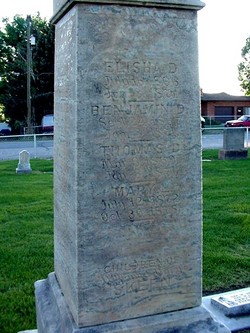
    Inscriptions on tombstones are not usually put there to make you laugh (even though some do); they are there to make you think. The family memorial I found that day left me thinking for years. Names and dates are inscribed on all four sides of the tombstone. I could tell just by looking at birth dates, that this was the grave site of pioneer settlers, but that’s not what got me thinking. It was the birth and death dates accompanying nine other names. All children. In the Fall of 1870, and into January of the next year, eight of those children died. Now I knew there had been an epidemic of some sort. I  could see that there was a mystery begging to be solved.

    I was in college on that initial visit, and a single mom at that. I didn’t have time to look for clues and answers, but that story stuck with me enough that I knew I had to write about it. I used an essay assignment from one of my English classes as an excuse to put my conjectures into writing. The essay won second place in a department contest at Weber State University, and I kept it over the years.

    When I finished school and became an empty-nester, I finally started digging for the tombstone’s story. My first foray came up with some answers–enough to help me see that I could easily build a history around that grave marker. I went back to Plain City and took pictures of all four sides of the tombstone. What I found, shocked me. On the backside of the tombstone are the names of three of the children who died during the epidemic, and one more who was born and died in the following years. It wasn’t those children that surprised me, though. It was the inscription I had missed in my first visit at the bottom of the back side of the tombstone, “Children of William and Mary Skeen.” I stepped back around to the front and looked at the bottom. It said, “Children of William and Caroline Skeen.” There were two different mothers and one father. This was a polygamous family.
     

    I grew up in Utah, and I am very familiar with polygamy, even though I have no Utah Pioneer roots. Many Utah pioneers practiced polygamy, and I had friends who were descendants of polygamous marriages. There was even a handful of families in my neighborhood who still practiced it, even though it was disavowed by The Church of Jesus Christ of Latter-Day Saints in the late 18th century and church members who currently enter into such unions are excommunicated. Today, they call themselves Fundamentalist Mormons. Knowing what I know about Utah and polygamy, I can’t pass judgment on the pioneer families who still practice it despite laws and church condemnation. I’ve seen happy children and wives who claim to share equally in marital bliss. Neither am I blind to the fact that some sects have taken the practice much too far by forcing children into unwanted marriages. It’s because of that second marriage that I decided to focus on Mary Davis, the second wife of William Dolby Skeen.

    I’ve lived outside of Utah for most of the time since I started my research, but that hasn’t stopped me.  Thanks to the internet, I have access to nearly everything I need to complete my research. Sometimes I think I have too much, and that I will need to pare down the story before it gets too unwieldy. It has become interesting to me that I could build a compelling biography of an utter stranger without ever having met her or having any access to written memoirs.

    I nearly missed Mary, tucked away as she was at the bottom of the backside of the monument. When I found her, I realized that her story is far more important than the location on the tombstone suggests. At a first glance, it’s easy to think nothing happened here. But from surrounding names, places, and dates, I could see that something had happened, and that little name tucked away in the corner had been there and played an integral role in the town’s history. It’s not her death that’s important, it’s her life. I don’t want Mary Davis Skeen to be forgotten, and I feel compelled to commit her to the memory of others who would never have known her otherwise.  We are surrounded on a daily basis by people living what they feel are ordinary and unremarkable lives, but if we make an effort to get to know them, we can learn valuable lessons and come to see them as crucial members of our community. Mary’s tale unfolds in bits and pieces. Like a patchwork quilt, it is colorful, warm and inviting. Her story includes heartache, tragedy and tribulation along with faith, perseverance and promise. While Mary’s story reminds us that happily ever after never happens, it also tells us that happy endings do.


    Please join me in my journey to tell Mary’s story. Your comments and helpful criticism are welcome and encouraged. Treat each post as rough drafts to Mary’s biography, as that is what they are intended to be. Mary’s story will be told one chapter at a time, and one month at a time, over the next year. My ultimate goal is to publish them together in a book. If you feel that you have information that may be helpful, or that will clarify ambiguities in Mary’s story, please leave a comment or contact me. And thank you in advance for your help!
  • A Tale of Two Cemeteries

    A Tale of Two Cemeteries

    Too many years ago I wrote an essay. I wasn’t really doing it just for fun, but I can honestly say it was the most rewarding essay I’ve ever written (for school, that is). That essay, titled Untold Stories, won second place in a department contest and put me on a journey of discovery that led me to create this blog. Written for one of my many English classes (Do you think I majored in English?), it was a comparison of Cemeteries; one in Prague, the capitol city of the Czech Republic, and the other in Plain City, Utah. I was required to write eight to twelve pages. I can’t remember how many pages it actually ended up being, but I felt it was just too long for a blog post, so in the spirit of Cemetery Month and reviving this blog, I’ve decided to share a new abridged version:

    UNTOLD STORIES

    (revised, and abridged 2018)

    by Marianne Kwiatkowski

    I  begin with lines borrowed from Walt Whitman’s poem, Song of Myself. Although the title leads the reader to believe that Whitman is about to embark on a narcissistic journey of self-love (he begins with, “I celebrate myself, and sing myself”), one quickly discovers that we share qualities as members of the human race, making us more like him than not. It was the following lines, though, that got me thinking of the many stories that we bury with our dead:

    –I guess the grass is itself a child . . . the produced babe of the
    Vegetation–
    –now it seems to me the beautiful uncut hair of graves.
    Tenderly will I use you curling grass,
    It may be you transpire from the breasts of young men,
    It may be if I had known them I would have loved them;
    It may be you are from old people and from women and from
    offspring taken soon out of their mother’s laps,
    And here you are the mother’s laps.–
    –O I perceive after all so many uttering tongues!
    And I perceive they do not come from the roofs of mouths for
    nothing.
    I wish I could translate the hints about the dead young men and
    women,
    And the hints about old men and mothers, and the offspring
    taken soon out of their laps.
    What do you think has become of the young and old men?
    And what do you think has become of the women and children?

     As I stoop to read weather-beaten, time-worn headstones, I wonder as Whitman must have;  If I had known them, would I have loved them? I wonder about the loved ones that were left behind.  What kind of anguish was suffered at the untimely death of children?  What kind of heartbreak occurred at the death of a beloved spouse?  Was it a relief to know that long-term suffering had ended?  What about the families of strong young men who left brave-hearted and never returned from war?  What kind of reunion took place between the spirits of those who quietly slipped away to join their loved ones beyond the veil? These stories hang in the air at every grave site I visit.

    Seventeen years ago, I visited Europe.  While I was there, I explored the Jewish cemetery in Prague.  Located in the Jewish sector of the old town, the Prague cemetery is the second oldest Jewish cemetery to survive the Holocaust.  Back home in Utah, I explored another cemetery in the small town of Plain City.  It holds the remains of some of the original Mormon pioneers.

    I wanted to visit the old Jewish cemetery in Prague because my Americanized grandmother was raised Jewish in that part of the world.  Many of her family members disappeared during World War II.  Visiting the cemetery in Prague was a way to connect with my ancestral past. The stories of the Jews are just as intriguing, and far more lamentable than the Mormon pioneer stories.  It was so difficult for my grandmother to tell her own history that she refused to talk about it.  My mother tells me that she often heard my grandmother sobbing late in the night when she thought her family was sleeping. The Holocaust was so hard on her, but we’ll never know the details of her despair.  Like so many of the inhabitants of these cemeteries , Grandma’s story died with her.

    I went to Prague just once, but I took many pictures.  I used to live in Plain City, have visited the cemetery there many times and taken just a few pictures relevant to my story.  I liked to visit at dusk in the summertime, as the activities of the day were quieting down, and the people of the town began to prepare for a night’s rest.  One visit in particular occurred on a frosty November morning.  This time I went with the purpose of finding a story.  I was not disappointed.

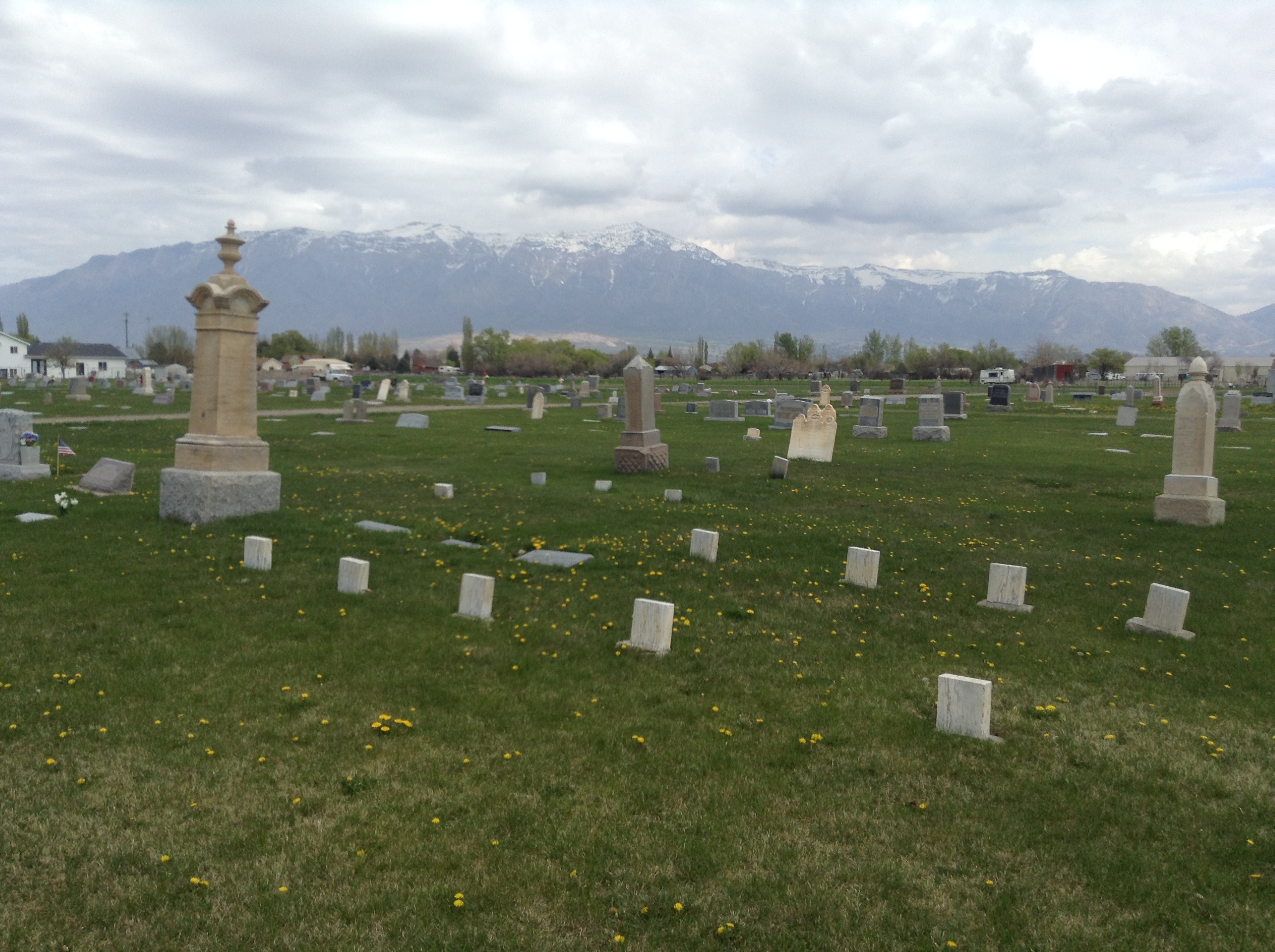
    The graveyard in Plain City has many graves of Mormon pioneers who crossed the plains by wagon or handcart.  These are the stories that interest me.  Stories of faith and courage.  Stories that ended in triumph as families settled into their new homes after surviving the long arduous pilgrimage across the plains. Many of these stories have been told somewhere in the annals of the family histories in Utah.  I have no such pioneer heritage, so the stories and faith of those pioneer people are unknown and yet intriguing to me, just as the untold stories of family members who were separated by the Holocaust intrigue me.


    Memorials to so many children are located in the older end of the Plain City cemetery.  I spent nearly an hour hovering around one large needle shaped memorial.  At first I was intrigued about the family who had buried each of their children together.  As I walked around the four sides of the stone though, an intensely tragic story began to unfold, and I discovered the preface to an unwritten book, one that I desperately wanted to read.  Nine small stones lie neatly in two rows next to the memorial.  Each stone says simply, “Skeen.”  These little graves tell the beginning of a sorrowful journey for their saddened parents.

    Skeen Family

    Apparently the story began in the fall of 1870 when one by one, seven of the Skeen’s  children began to fall ill.  Whatever the epidemic was, the household must have been quarantined, because I was only able to find the grave of one other Plain City child who died during those three months.  It must have been six year-old Jane who brought the illness into the household.  On November twenty-third, the little girl succumbed to the illness and left this earthly life, leaving behind at least six siblings, a pregnant mother, and a worried father.

    Less than three weeks later, Caroline Skeen gave birth to a baby who died the same day it was born.  One more spirit to keep little Jane company.  Two days later, the ten year old namesake of Caroline died.  Maybe for a while it looked like the worst might be over, but after what must have been a very sad Christmas, two more children joined their siblings in death.  Four year-old Benjamin and five-year old Elisha died on January third of the new year.  By this time, the epidemic was raging throughout the Skeen household and nothing would stop it.  Five days later, two year-old Thomas died, followed by seven year-old Amanda on January tenth.

    I wondered about the oldest child, William, who was thirteen when he died on January fifteenth.  Was he hanging on in an attempt to care for his brothers and sisters?  How the parents must have mourned as each of their children went to the grave, one after another, in such a short time.

    The Skeen’s tragic story doesn’t end here, though. Several years after my discovery of the tragedy, I returned to take another look at the tombstone. On the opposite side of the tombstone where the names of Caroline and William were inscribed, are the names of a second wife, Mary Davis Skeen and some of her children.  Polygamy was not uncommon in Utah Territory in those days, specifically among devout Mormon families.  Two decades later, polygamy was officially denounced and the church abstained from further plural unions. I decided that I could not pronounce any condemnation upon the heads of William, Caroline, or Mary, though. For all I know, both marriages were solid, amicable, and willingly entered into by all parties.  In fact, I am well aware that many polygamous families have laid claim to happy unions and cordial friendships among wives and children.

    One more child was born to the Skeen family nineteen months after the tragedy.  Unfortunately, this little girl also joined her brothers and sisters in death just six years later.  This is just the beginning of the untold story of the Skeen family.  I wonder what their lives must have been like before and after the deaths of their children?  Which children belonged to which wife? Did they live together in the same house or even on the same street? Did they have any other children who survived?

    Less than a century after the Skeen tragedy occurred, a new devastation began to unfold in the Old World.  As the Holocaust swept over Europe, it wreaked larger destruction upon the inhabitants of the European continent than even the Skeen family could imagine.  After those black days, one Jewish cemetery in Prague stood as a testament against Nazi snipers.  The small plot in Prague escaped destruction, but as Longfellow penned in his poem, The Jewish Cemetery at NewportThe dead nations never rise again.”  Like the graves in Plain City, each cemetery has its own tale of sorrow.  Prague is no different.

    I couldn’t read the headstones at the cemetery in Prague.  Most of the markers were inscribed in “the mystic volume” of Hebrew, and other markers were in Slavic languages.  Even so, the majority of the headstones were weathered to the point that they would have been nearly impossible to read in any language.  I didn’t need to read them. The town’s history and the condition of the graveyard told its own intriguing story of heartache and struggle.  Longfellow thought the Jewish cemetery in Maine to be strange.  To me, it wasn’t strange or gratifying; it was sad and unjustified.  Then again, the very existence of the cemetery tells a tale of triumph over  bigotry and hatred.

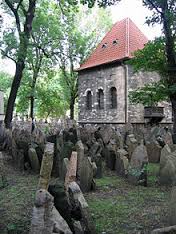
    The casual observer in the old Jewish sector would find “narrow streets and lanes obscure” just as Longfellow described, but the cemetery is hidden from casual view. It is located on a small hill completely enclosed by a stone fence. I don’t think that the hill occurs naturally. After 700 years of burials on such a paltry lot of land, it became necessary for the Hebrew community to bring in more soil to bury their dead.

    Jewish cemetery PragueLess than an acre of land. Seven hundred years of death. Men, women, children. Old and young. All of their dead went there. As the years went on, bodies were uncovered, lifted up and reburied with new companions. People who were total strangers, never met, and lived hundreds of years apart became roommates in death. Strange bedfellows.

    Entering the cemetery from a busy street, one is met with an eerie silence. Brownish tombstones, large and small, rest grotesquely upon one another. Most of the stones are so old that the writing has been erased through years of wind and rain. The newer stones are written in Hebrew and couldn’t be read anyway (by me, at least). A pencil-thin pathway winds forlornly through the piles of hand-hewn rock. Above in the trees that serve to hide the sepulchral plot from mortal view, big black birds caw solitarily to one another, adding to the unearthly atmosphere. The calls reminded me of Edgar Allen Poe’s plea; “Is there–is there balm in Gilead? –tell me–tell me, I implore!” I almost expected to hear the raven’s plaintive cry of “Nevermore!”nhsd_raven

    Death is always sad for the living. Billions of tears were shed worldwide for the loss of over six million lives of the Holocaust. I am sure that the Plain City community mourned in a similar fashion for the loss of the Skeen children at what should have been a joyous time of the year. They were the tears of loss. Those who died may have been lucky, as Whitman put it, but those who were left behind lost a piece of their own lives as they put their loved ones into the ground. Often the only solace for the living is knowing that one day they will join their cherished families in death. If there is indeed life beyond the grave, then death cannot part loved ones, it only separates them for a while.

    As for the rest of this world, people come and go from this life daily. Some leave histories.  Most don’t.  Their voices are silent.  Their stories die with them.  My interest is to find tales worth telling and uncover their secrets.  There are some things that will never be known to the living, but the mysteries make great stories.


  • What Happened to the Skeen Family?

    What Happened to the Skeen Family?

    I wrote the original Untold Stories more than ten years ago.  At that time, there was little information to be found on the internet, and since I no longer lived in the area, I had to wait to get my questions about the Skeen family answered. I’ve been doing my research on my own free time, knowing that there was a story there. I haven’t been disappointed.  Thanks to a few phone calls, Family Search, Ancestry.comPlain City Utah.org, and one more trip to the Plain City Cemetery, I was able to find all the information that I needed to complete the Skeen’s story.  The story coincides with the history of  town itself, so it must be told as part of the town’s history.

    William Skeen
    William Skeen. Courtesy of Ancestry.com

    William Dolby Skeen was born in 1839 in Steelville Pennsylvania, son to Joseph Skeen, and brother to Lyman Skeen, all of whom were primary settlers in the Plain City , Utah area. The three men were among a larger group of Mormon pioneers who had originally settled in Lehi, but left to scout out an area in Weber County for a place with rich land for farming and a good water source.  The area now known as Plain City lies at the edge of a delta where the Weber River fans out upon entering the Great Salt Lake. These early pioneers found that they could use water from the river for irrigation, and culinary water could easily be found by sinking wells. It was a good spot with plenty of water for their small party of pioneers. This group of men staked claim to the land, and are therefore among the founders of Plain City. (more…)

  • What I found in Plain City

    What I found in Plain City

    If you’ve read my Untold Stories essay,  you know that I had many questions that I needed answers to so I could finish telling the Skeen’s story. Over the years, I looked things up on the internet, just out of curiosity, and this last spring I made another trip to Plain City.  I took pictures this time, and added them to my collection of information from Family Search, Ancestry.com, and the history archives of Plain City.  I have pieced together a complete story, and I’m so excited to tell it!

    Please be patient with me as I put the finishing touches on the story of the Skeen family. As I get the story ready, here are some teasers for you: (more…)