Category: Recipe

  • Grandma Stancik’s Slovak Christmas Eve

    Grandma Stancik’s Slovak Christmas Eve


    Merry AlmostChristmas!

    Today’s Christmas Eve tradition and recipe contributor and friend of mine, just happens to have been one of my professors at DePaul University in Chicago. At first I was surprised to learn that Gloria Simo and I  have so much in common. After learning her family’s story, I am even more surprised to learn the reason for our commonalities.

    First, our grandmothers. Although they were born in different countries, they grew up less than 80 miles from each other.  Both of them left their childhood homes at young ages and immigrated by boat to the United States alone. Josephine Daniel, my Grandma, was 21 and Anna Vitek, Gloria’s grandmother was just 16. Anna was just three years older than  Josephine, they immigrated within eight years of each other, and both married fellow immigrants they met here in the United States. Josephine was raised Jewish in Austria, but she became a practicing Lutheran when she married my grandfather. Anna was also Lutheran, married to a man named John Stancik.
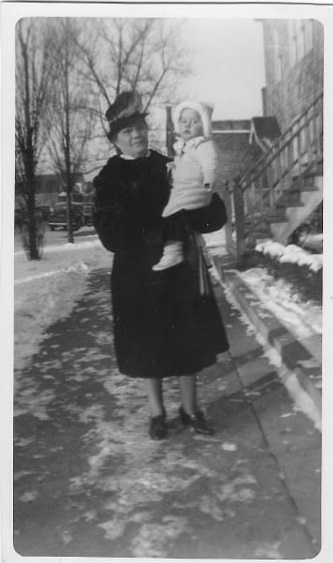
    Anna Vitek holding her granddaughter, Gloria Simo
    Anna Vitek Stancik with her granddaughter, Gloria Simo

    Next, our genealogical origins. Anna was born and raised in Bratislava, Czechoslovakia. Today, Bratislava is the capital city of Slovakia. Josephine’s great-grandfather was a well-known rabbi from Pressburg, Austria-Hungary, the very same city known as Bratislava, Slovakia today. It is very likely that Josephine’s grandfather, my second great-grandfather, was born in Pressburg. I have Slavic roots as well on my Polish grandfather’s side.

    Coincidence? Yeah, probably. But when Gloria described her family’s Christmas Eve meal, I said, “That sounds like something my mom used to make!” Well, we at least shared similar dietary preferences. I grew up on Polish and Austrian food. Slovakia is bordered by Poland to the North and Austria to the West. Naturally, they shared similar dinner menus.

    It was the meal that featured so prominently in Gloria’s recollection of childhood:

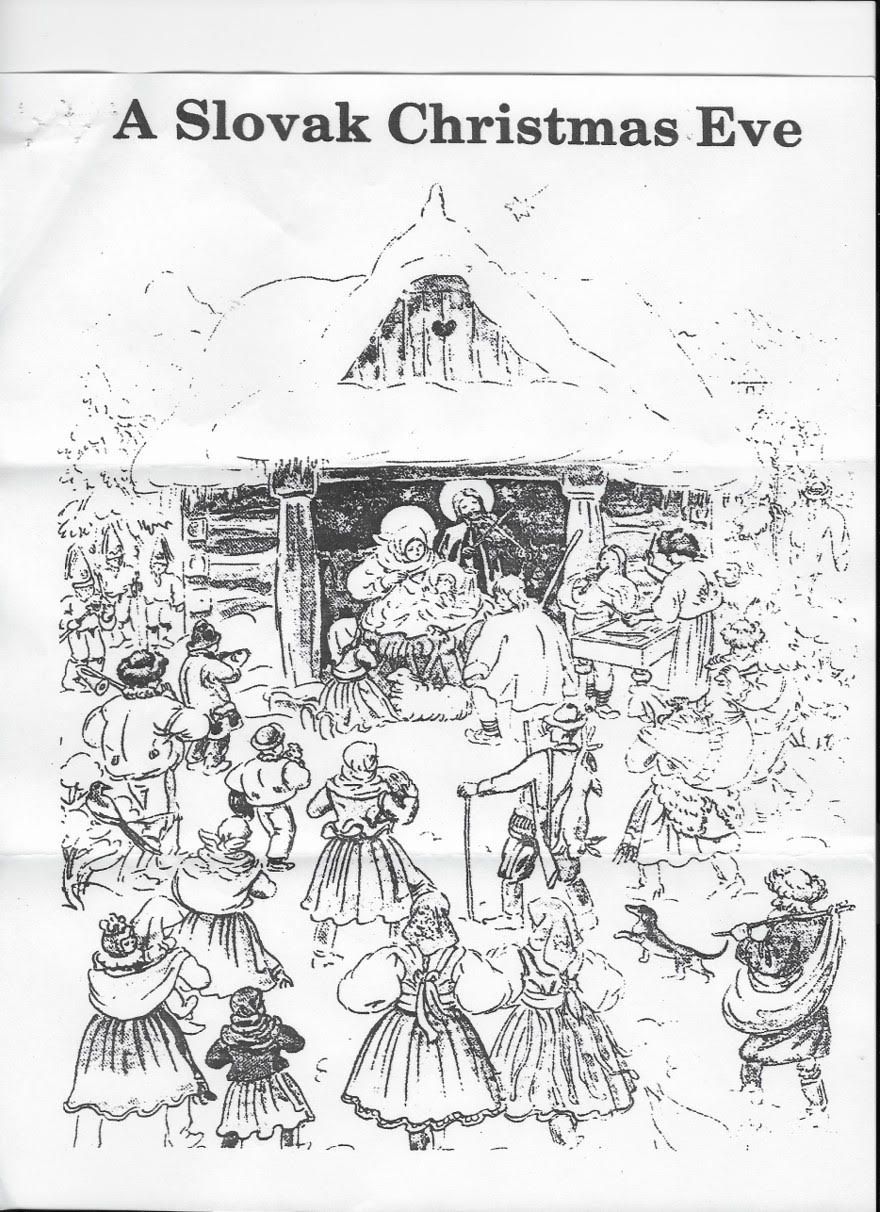
    One Christmas Eve meal tradition sticks in my head and was followed by almost every family in our small Lutheran Slovak congregation. And we wouldn’t dream of missing it. The matriarch of each family made a kind of stew of sauerkraut, pork ribs, Polish :sausage, potatoes, prunes, etc (I think whatever Grandma decided on) and paired it with honey/poppyseed biscuits. Before the meal we broke a communion like wafer called Oplatky smeared with honey and shared it around the table while saying grace. After the meal we went to candlelight services – where we knew everyone had just had the same meal – and then out Christmas caroling.

    The “stew” Gloria describes is called Kapustnica, and is almost identical to a Polish dish called Bigos, or Hunter’s Stew. Trust me, it’s delicious. I have been thinking that I might want to get ambitious and start making it as part of our Christmas Eve tradition before we go to midnight mass (a Catholic tradition). Oplatky is also a Polish-Catholic tradition.

    Click here for the Slavic recipe (Kapustnica), or here for the Polish version (Bigos). I think you’ll see they are quite similar!

    Gloria also sent recipes along with detailed instructions for celebrating in the Slovak tradition. I will post them on their own page in the coming weeks. If you’d like to have a copy sooner, please contact me here.
     

  • Cousin Connection #3: John Woodgie

    Cousin Connection #3: John Woodgie

    The Duck, The Whole Duck, and Nothing but the Duck

    Quack.

    But seriously, my New York cousins from my dad’s generation are very Polish. I mean, many of them speak the language, and even if they don’t, they know a few words here and there and even understand much of the Polish dialogue. Even my father, who was separated from the family when he was just thirteen, can speak a few words. Not only that, but many of them are still staunchly Catholic as their grandparents from the old world would have wanted it, and even more still enjoy the good old Polish cuisine.

    I myself grew up enjoying many culinary delights from the Old World. I ate things many of my American counterparts would never dream of touching. It’s too bad for them, though. They don’t know what they are missing out on. Beef tongue served the Bohemian way will always be my favorite.  One of these days I’ll have to post that recipe as well.

    The first thing John Woodgie, another of my New York cousins, suggested for this month’s Cousin Connection was another Polish recipe. I can’t blame him. Polish food is delicious. (By the way, you can get the best Polish food in the U.S. if you visit Chicago.) This particular recipe uses the whole dang duck! It’s one of John’s favorites. I’ve never had it, and like many of my counterparts, I’m a bit reticent to try it; but then I’ve had lots of strange foods in my life, and most of them are amazingly delicious.

    First, a little about John and how we are related. John Woodgie is my family’s genealogical expert.  He has been working on the Kwiatkowski family line for some time and has identified over 2100 family members. He links names while I am looking for stories. I am eager to connect faces and places with those names, linking each of us in a way that brings the past to life. But I’m just a dabbler compared to him.

    Like Chuck Kwiatkowski, John also lives in Olean, NY. In fact, he tells me he’s only a mile away from Chuck. Olean is where my dad was born. I’ve only visited once, staying for just a couple of hours. I think this means I need to plan a trip up north to meet these guys in person sometime soon.

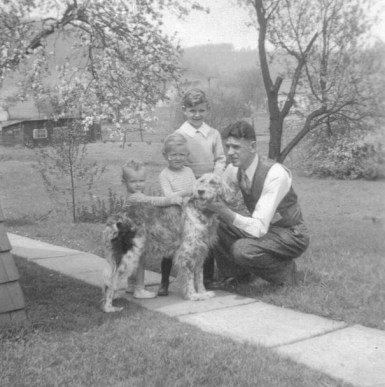
    John, Louis, Sonny and Dad (Joe)
    Joseph Woodgie with sons John, Louis and Steve with their dog Rags circa 1943. John is the little one.

    I am related to John through his mother, who was daughter to my great-uncle Joseph Kwiatkowski. Like my dad, John’s father was also born in New York  but he was a first generation American. Two of John’s uncles were born in Poland before the family immigrated.


    John tells me that his grandfather on his mother’s side, Chuck‘s grandfather, Bernie‘s grandfather, and my dad’s grandfather were all brothers. There are plenty more where they came from, too. Their father, Joannes (“John”) Kwiatkowski, and his wife Catharina  had a total of thirteen children. John’s Kwiatkowski grandparents had twelve children, and John is one of 41 grandchildren. Bernie’s grandparents had at least five children. I don’t know how many children Chuck’s grandparents had, but I know that my own great-grandparents also had a dozen children, and I am sure that my father probably has just as many first cousins as John Woodgie does. This means I have only touched the tip of the iceberg as far as my New York cousins go, although I have no intention of focusing all of my Cousin Connection efforts there. I still have three other grandparents to search through.

    Of course, creating a new cousin chart for John was pretty easy. I just had to substitute a few names:John Woodgie Second cousin once removed

    So about that duck.

    Skala Sophie and
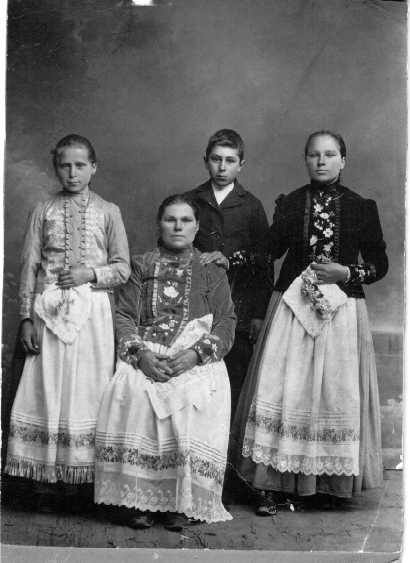
    Salomea, Frankie and Sophie Skała with their mother Maria Dynia-Skała circa 1910, Rzeszów Poland.

    Joseph Kwiatkowski married Sophia Skała ,who was born in Zaczernie, Poland, in Olean, NY May 13, 1913. Sophie was John’s grandmother. She would make her duck soup almost every autumn. John says, “Grampa K would kill the ducks that he raised in their backyard along with chickens and pigeons.” Because the family relied on home-grown resources, they never went hungry. But there is more to it than that. The recipe frugally incorporates every edible component of the duck , including the blood.  A goose can be used interchangeably with the duck in this recipe.


    Sophie Kwiatkowski’s Duck soup is a regional recipe known as Czarnina (char-NEE-nah). The name is derived from the Polish word, czarny, for black. It refers to the dark color of the soup which comes from the blood in the recipe. The soup often has a sweet-sour flavor, a flavor I remember well from many of the European recipes I grew up on. I’ve never tried it, and I doubt I’ll ever have the opportunity to acquire a whole freshly slaughtered duck, but if I come across the concoction, I’ll be sure to give it a try.

    Or maybe not. Legend has it that Polish suitors would receive Czarnina from their prospective in-laws. It was a way for the family to let a young man know that his advances would not be welcome. But John likes it, so it can’t be that bad.

    Sophie Skała’s Czarnina

    • 1 whole duck (gutted and feathers removed, reserve heart, neck and gizzard)
    • 2 containers blood
    • 1 medium onion
    • 1 medium potato
    • 1 carrot
    • 1 medium apple
    • 1 cup sour cream
    •  sugar to taste
    • 3 tbsp flour

    In an 8 quart pot place duck, neck, heart, gizzard. Cut up onion, potato, carrot, apple into quarters and place them in a piece of cheese cloth. Tie cloth and place in pot.Cover with water to two inches of top of pot. Cook for two hours until duck is done.

    Take duck and veggies of out the soup. Let soup cool to touch. In a bowl, mix  blood and flour. Blend until smooth. Stir in sour cream and pour this into the soup. Stir until soup comes to a boil. Reduce heat and let simmer for about 1/2 hour.

    While cooking you can make Kluski to add when soup is finished. Some people prefer to use Polish potato dumplings instead. I have also heard that Polish-Americans often use pre-made gnocchi found in the freezer section of their local grocery store.

    You can find different versions online or in Polish cookbooks, but this is how John Woodgie’s Grandma Kwiatkowski made it, and it is his favorite. The others, he says, have too many ingredients.

    I’ve been learning a lot about the workings of my Polish forbears from my New York cousins. Especially John. From both John and Chuck, I have gained new insights into the workings of my Polish-American cousins including changes in surnames and immigration patterns. I’m looking forward to learning more from them and sharing even more with my readers.


  • Babci Mary’s Polish Soup

    Babci Mary’s Polish Soup

    Happy Mother’s day!

    Okay; Mary is not my grandmother. In fact, we’re only related by marriage. Since I came across the existence of Babci Mary from a cousin I’ve never met in person, I decided that this would be a great opportunity to get to know my cousin. By proxy, I’ve gotten to know my own family better.

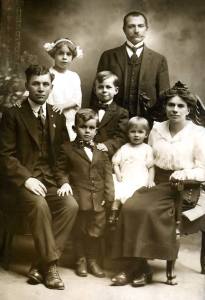
    1917 Kwiatkowski Joannes Mary children and possibly Michael
    “Babci” Mary is the beautiful woman seated to the far right. Bernie’s mother is the little blonde seated next to her; his grandfather Joannes “John” is seated on the left. We have speculated that the man standing on the right is my great-grandfather Michael. Michael and Joannes were brothers.

    Babci is a Polish word meaning grandmother. It is pronounced bob-chee with the emphasis on the last syllable, making the last consonant in the first syllable sound more like p. 

    I met my cousin Bernie on Facebook when I started this blog. Hoping to connect with other family researchers, I created a companion Stories From the Past Facebook group. Many researchers have joined the group, along with friends and childhood classmates. Thanks to my father’s familial connections on Facebook, I was further connected to many cousins from Southwestern New York and Northwestern Pennsylvania. Bernie is one of those cousins. (more…)