
In honor of Martin Luther King Junior Day and my current home state of Kentucky, I have chosen to share a Kentucky story from Documenting the American South‘s collection of North American Slave Narratives.
Living in Northern Kentucky, the lap of the Underground Railroad, has been an eye-opener for me. Since moving here I have learned that Kentucky has the unique distinction as the land where the civil struggle between the Union and Confederate states reaches much deeper than North vs. South.

https://commons.wikimedia.org/wiki/File:USA_Map_1864_including_Civil_War_Divisions.png
Kentucky was a slave state before the Civil War, but it never fell to Confederate control. In fact, it was the first of the four “border states” between North and South to succumb to Union control. Because the commonwealth of Kentucky had both a Union and a Confederate constitution, the struggle between the opposing forces reached not only into neighborhoods, but into the very hearts of families where brother fought against brother, and cousin against cousin. In fact, Kentucky’s most infamous family feud, Hatfields vs. McCoys, is said to have begun over family members fighting on opposite sides of the Civil War.
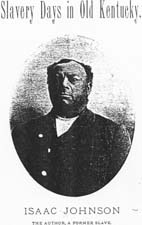
Isaac Johnson, 1844-1905
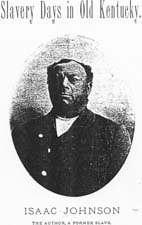
Some families were even further divided by race. Isaac Johnson’s autobiography, Slavery Days in Old Kentucky. A True Story of a Father Who Sold His Wife and Four Children. By One of the Children, is the story of a child born into a family with a white father and a black mother. Isaac’s family began in the traditional sense with a mother and father living as a happy family in nearly every sense but one: Isaac’s parents were never married, and even though they lived as husband and wife, Isaac’s mother, Jane Johnson, was actually Richard Yeager’s slave.
Yeager had originally desired nothing more than a simple family life with his common-law wife and their four boys, but he eventually gave in to the social constraints bearing down on him and made the fateful decision abandon pretense and sell off Jane and her children. Isaac’s oldest brother, Louis was nine and Isaac was seven years-old at the time.
Johnson, Isaac. Slavery Days in Old Kentucky. A True Story of a Father Who Sold His Wife and Four Children. By One of the Children.
The auctioneer continued his cry for bids and Louis was at last sold for eight hundred dollars. By this time we had taken in the situation, and it seemed as though my mother’s heart would break. Such despair I hope I may never again witness. We children knew something terrible was being done, but were not old enough to fully understand.
Isaac’s youngest brother was just two when he was separated from his father, mother, and older brothers for two hundred dollars.
Following his separation from his family, Isaac went through several owners and even made a couple of unsuccessful attempts to escape. His second escape attempt was met with the torture and murder of his fellow slave and good friend who was blamed for inciting the attempted escape.
It was the Civil War that offered Isaac his third escape attempt leading to his freedom. He found refuge with a Union regiment marching through Kentucky, and eventually enlisted in the First Michigan Colored Infantry which became part of 102nd United States Colored Regiment. Isaac stayed with his regiment until the war ended.
Upon war’s end, Isaac’s desire to see his final master amidst the destruction of his livelihood as as a slave owner led him to return to Kentucky one last time. He found his former master paralyzed and bedridden, but despite his debilitation, the master was happy to see his former slave. He welcomed Isaac as an old friend, telling him that he was the first of his slaves to leave and the first to return. He even offered Isaac a job with wages if he were to stay. Isaac. of course, could not forget the murder of his friend, and turned down the offer.
Despite his service to the Union, Isaac believed he would never be free until he left the States behind, so he moved to Ontario, Canada where he married Theodocia Allen. Isaac did finally return to the States, albeit just across the St. Lawrence river from Canada. Isaac stayed as a free man with his wife and seven children in Waddington, New York, where he worked as a stone cutter and mason on Waddington’s Town Hall.
Isaac eventually moved a little further west along the river to Ogdensburg where he could stay in full view of Canada. His memoirs, Slavery Days in Old Kentucky, were completed and printed in Odgensburg in the hopes that he would one day be reunited with his mother and brothers. Isaac’s heartbreaking closing words are thus:
“In order that my relatives may know where to find me, in case this little pamphlet should fall into their hands, I give my Post Office address: . . . (pg. 40).”


 It does not take much digging to find information on the many stories that are buried here. After just one visit and a quick Google search I had everything I needed for several blog posts. I could spend days digging through the mounds of historical information available at the
  StoriesFromthePast.com
