
Today marks the 32nd anniversary of the first official observance of Martin Luther King, Jr., Day as a national holiday in the United States, and on this day I felt it important to tell the stories of “othering” in our own personal family trees.
Before I get started, let me make a disclaimer. In no way do I intend to downplay the significance of discrimination experienced by Americans of African descent. There can be no excuse made for the maltreatment of Black Americans today and in the history of the United States. It’s just that today seems like the best time to focus on xenophobia in my own family history. Not that it matters to me, but there is no evidence of African blood in my DNA, and I have simply not found any such stories to tell. Not yet anyway.
I was raised in a community where the “others” were often those of different religions. I grew up in Utah as a member of the Church of Jesus Christ of Latter-day Saints (LDS or “Mormons”). I wasn’t necessarily taught this othering at home, but I saw it and learned it from the discourse around me: at school, in social gatherings, in the workplace, and at church. Many Utah LDS families inherited a deep distrust of outsiders from their ancestors who experienced persecution and intense harassment leading to an official extermination order from the state of Missouri and their eventual exodus from Illinois to what was then Mexican Territory. Terms like prejudice and racism never entered the conversation, and I was well into adulthood before I learned to put a name to the fear that governed that public discourse. The name is xenophobia, an intense and irrational fear of aliens. I’m not talking about little green guys with antennae growing out of their heads coming from distant planets; I am talking about human beings coming into our communities from different places, cultures, and religions. Here in the United States, that can be anyone.
Dad’s Story
So I begin with a simple story from my father’s childhood. Dad was born in Olean, New York and lived there until he was thirteen. During the 1940s, he attended Olean Public School no. 7. As Dad tells it, there were two doors serving students in the school, the main door on the East, and a side door on the South. The side door had been claimed by a large group of Italian students at “the Italian door,” and when teachers weren’t looking, they patrolled the door for encroachments upon their self-proclaimed territory. The “Italian” door was closer to Dad’s route home, so one day he decided to leave through it. As he heard the door latch behind him, he knew he was in trouble; there was a group of kids waiting at the bottom of the steps. Dad took off at a run and managed to escape, but looking back at that day, Dad said, “I learned to run real fast.”


Even though many Italian Americans share similar physical features, their mostly fair skin and European facial features keep them firmly entrenched in white-American society. The only way those schoolchildren truly knew whether one came from one European background or another, was to be well aware of families in the neighborhood and the other students attending their school. So when the Hawaiian Kwiatkowskis came to stay with family following their mother’s death in 1952, their unfamiliar faces and tanned complexions immediately identified them as alien.
Tod and Ski’s Story
Being the youngest of the Hawaiian clan, Ski doesn’t remember much about his trip to New York in 1952, and he does acknowledge that there are many reasons why resettling in New York didn’t work for Leo Kwiatkowski and his five children. However, the one obstacle to the widowed father and his family that Ski remembers well is the othering of himself and his siblings by New Yorkers who could not accept mixed marriages. As Ski put it,
It was almost scandalous that a white man from New York was marrying a dark skinned Hawaiian woman. But it was not at all as scandalous as some might have thought as a lot of us newer generation Hawaiians are mostly of mixed blood, so inter racial marriages started way back in Hawaii, where there really is no racial bias or prejudice. [sic.] The only bias, if one could call it that, was a form of reverse discrimination where the Hawaiians were very wary of any white man and how he would fit into “our” society. Our society is very, very different from that of the mainland U.S. The most glaring difference is the mixture of races and the harmony in which we all live. Japanese, Caucasian, Negro, Hawaiian, Filipino, Chinese, Korean, Puerto Rican, Portuguese, and the list goes on with as many ethnic groupings as the earth holds.
Tod remembers that time as “a tragic and confusing time for five children, ages 14 to 5, and a single Father with no job, and no income.” Although both brothers admit that racism was just a part of the issues facing the young Hawaiians in New York, xenophobia often has the effect of further alienating families from the very places where they go to seek refuge, just as it did for this family.
Mom’s Story
The Jews of Europe know that story well. Those who survived the Holocaust and chose to return to their European homes faced an uphill battle to reclaim their ravaged property and maintain an uneasy peace among many of their neighbors. Their numbers are significantly reduced from pre-Holocaust days. Those who chose to seek asylum in the reformed nation of Israel have yet to find peace. Still others who scattered to the Americas denied their identity as a form of protection to their progeny. Such was my mother’s case, as she was in her early twenties when her mother finally revealed her Jewish identity.
I grew up believing that racism and cultural bias did not exist in my Utah home. It wasn’t until I returned to Utah after living in California for two years that I could truly see the extent of xenophobia in my beloved mountain home. Although that’s another story for another time (and maybe a different blog), the most profound example came when my empty-nester parents moved into a typical Utah suburban home. One neighbor who came to welcome them into the neighborhood, exclaimed to my mother, “Thank goodness you are not blacks or Jews!” I’m sure she explained her reasoning that neither group could be trusted to my mother, but by that time, Mom was no longer listening and had firmly decided to look elsewhere for new friends.
Tony’s story

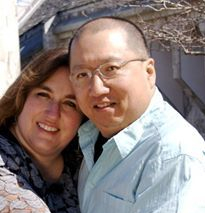
Now I have a confession to make. I am in a bi-racial marriage. Mine is not the first. It won’t be the last, but when we find such a thing among our ancestors it is not only a talking point, but often a source of contention. My husband was born in Hong Kong, China and came to the United States when he was just three months old. He grew up in the near suburbs of Chicago, and when people ask him what country he comes from, his answer is always the same, “The United States.” He grew up here. He knows nothing else, but unlike European Americans, his skin color and distinct facial features belie the fact that he was not born here. He goes by the distinctly Western name of Anthony, so when I tell people who have never met him that my husband is an immigrant and his name is Anthony (“Tony”), they nearly always say, “Oh, he’s Italian, right?” No.
It seems pretty common for Chinese immigrants to take on an “American” identity when they come here. Most I have met go by names like David, Catherine, Alexander, and Marie. On his birth certificate, his name is Sai Fung, but on his naturalization papers, social security card, and other official documents, he has always been Anthony. We didn’t think anything of it until he brought his Illinois driver’s license into a Utah DMV to exchange for a new one. I was able to exchange mine within a matter of minutes. For Tony, it was a matter of months. Six years and a move to Kentucky later, all of his legal documents identify him by a name no one but his siblings recognize. I blame xenophobia cloaked in our Patriot Act signed into law on my 36th birthday.
As Tony was nearing the end of his legal paperwork nightmare, a casual encounter with a drunk man at a bus station revealed a side to Tony’s life that I had not yet seen or understood. The drunk man approached my husband, and said, “Fried rice on the side?” Giggling to himself, the man staggered off. It was not the first time my husband had encountered such ignorance, but it sure helped me understand Tony’s lament, “Sometimes I wish I was white.”
We can’t deny that xenophobia exists all around us, and it would take willful blindness to claim that there is no racism in the midst of our families and ancestors. But we have to face it as it happens, and learn to acknowledge it. It is so easy to claim superiority based on the color of our skin and country of origin, but we must be wary as it happens to us. To be clear, my surname is Kwiatkowski, an obviously Polish name. As happened with the Italians in my father’s grade school, it would be just as easy to group together and claim racial superiority based on pure Polish blood. That is, until one encounters another who has had different experiences and sees life from a different narrowly appointed point of view.
Yesterday, my dear cousin Bernie illustrated this point in a Facebook post quoting Thomas E. Watson, an American politician from Georgia. As Bernie pointed out, Watson is “Talking about [our mutual] ancestors from some hole* in Eastern Europe.
*That would be Poland.”
So here it is:
“The scum of creation has been dumped on us. Some of our principal cities are more foreign than American. The most dangerous and corrupting horde of the Old World have invaded us. The vice and crime they planted in our midst are sickening and terrifying.” Thomas E. Watson, 1912
It has not been my intent to preach or to politicize my family history. I simply want to create awareness. After events such as those in Charlottesville, West Virginia, last summer, I have become hyper-aware that xenophobia in the United States seethes barely beneath our surface. We need a new way of looking at things, and I believe the best way to start is by acknowledging our mistakes of the past. We could also look to places, like Hawaii, that have managed to become true melting pots. As my cousin Ski explains, “Hang loose is an expression we use to say “Just chill, take it easy, there’s no need to rush” and it befits the island lifestyle.” We could learn a few things from the Hawaiians.


 StoriesFromthePast.com