
Part Three of Four–Robert Moulton’s Story
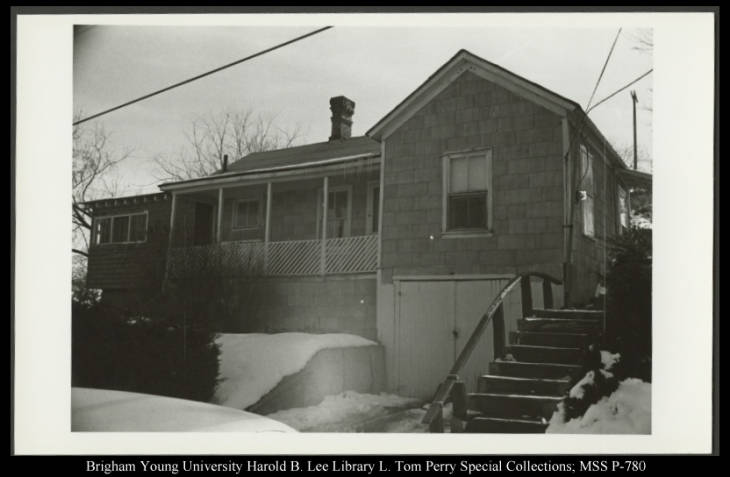
I don’t think I ever met Robert Moulton, but I remember his father, Bob Moulton. We lived just down the street from Bob and his wife for two years while my dad was preparing the foundation for a new home in the hills nearby. I always thought the Moultons lived in the most beautiful house in Lark, Utah.
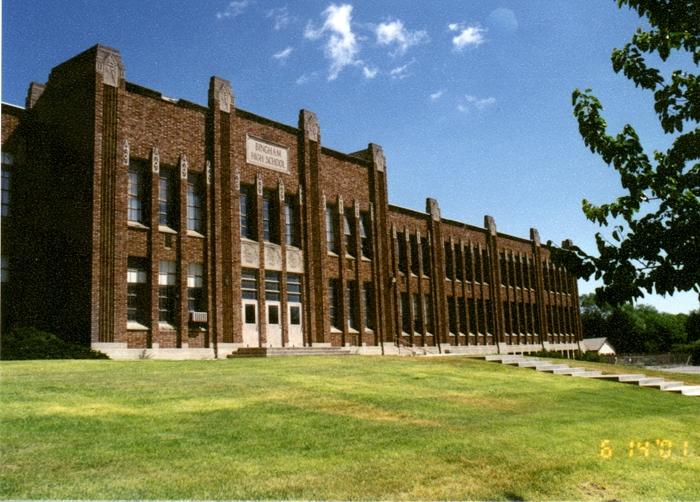
After Dad was laid off at Christmastime in 1974, Bob Moulton hired him as a custodial assistant at Bingham High School in Copperton, Utah. It wasn’t a full-time job, but Dad was so grateful for it in the months before he found another job in his field of civil engineering the next fall.
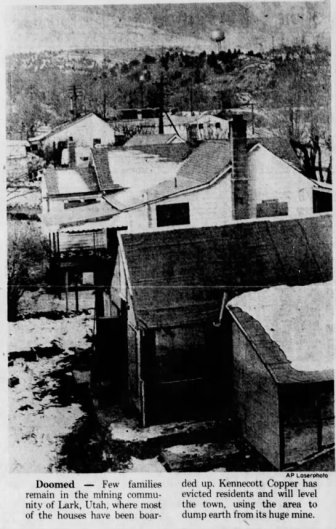
The town of Lark no longer exists, but its memories are kept alive thanks to a Facebook group dedicated to former residents. I’ll have to share Lark’s Story in the coming months. I came across Robert Moulton’s Memoirs shared with the group a couple of months ago. I was surprised at how so many of his stories paralleled stories from my father’s childhood in Olean, New York, especially young Robert’s quest for a Christmas tree.
Just like my father’s stories, Robert’s stories made me laugh. Prepare to be amused.
REAL CHRISTMAS TREES
From LARK TAILS, a selection of memoirs by Robert D. Moulton, PhD:
Lark was surrounded by what we called “junipers” and they were our Christmas trees, and Dick and I hated them. We hated them because they reminded us that other Lark families had more money than the Moultons and could afford to buy “real” Christmas trees. We thought that only pine trees made good Christmas trees. Pine trees have pointed tops that you can attach stars and angels to, and pine trees have needles that you can hang tinsel and ornaments on. But junipers are more bush than tree, have rounded tops, and they lack needles. No matter that the juniper trees came already decorated with blue-green berries and filled our house with their lovely, distinct perfume; and no matter that cutting a juniper Christmas tree meant an outing with our dad and Jill. We were ashamed of juniper Christmas trees and always insisted that Mom and Dad place them away from our windows so they couldn’t be seen from the street.
I don’t know how Dick and I knew that “real” Christmas trees grew high on the mountain above Lark. Perhaps Dad had mentioned pine trees in his stories of hunting mountain lions and mule deer up there. In any event, we knew that pine trees grew on top of the mountain, and Dick and I decided to go on a Christmas tree expedition. There was considerable secrecy about the trip. The mountain was private property, full of dangerous, abandoned mines and other scary stuff, and Mom and Dad had forbidden us to go up there. But we were convinced that our parents, too, were ashamed of junipers and would understand once we presented them with a real Christmas tree.
Dick and I probably thought it fitting that we planned the hike to the mountain top on a Saturday when Mom and Dad were in the Salt Lake valley shopping for Christmas presents. I should add that Mom and Dad had earned the family’s Christmas money by thinning and then picking apples in Alpine at a big commercial orchard on Saturdays throughout the summer and fall. They did this along with Mom’s brother, Virgil, and his wife, Rita, who also lived in Lark. Uncle Virg was tall and could work even the tallest apple trees without a ladder, so they said.
When the day of our big adventure finally came we waited impatiently for our parents to leave so we could set off. We had hoped that they would leave early so that we would have enough time to climb the mountain, find a tree, and return before they got home that night. However, Mom never could leave the house without first making all the beds, washing the dishes and cleaning everything that could be cleaned. It was noon by the time they left and we feared that there wouldn’t be enough daylight left for our trek. Nevertheless, we took Dad’s axe, and with Jill, our lop-eared boxer, headed west, toward the top of the mountain.
We were hiking through snow that got deeper and deeper as we climbed. We thought we had dressed warmly, but as it got later in the day the sun went behind the peaks above us and it got colder and colder. I don’t know how poor Jill managed with her short-haired coat, and Dick and I were about as cold as cold can be. I kept thinking about one of Dad’s favorite stories. He told us that when he was a boy, his generation of Moultons spent a few winters in Montana. He claimed that winters were so cold there that words froze and conversations were not heard until spring thaw.
At last Dick and I found a stand of pine trees near the top of the mountain. They were beautiful and came complete with needles and pointed tops. In our minds, we could see them decorated smartly and sitting proudly in front of our living room window. We were so excited that we forgot for a moment how cold we were. We ran from tree to tree looking for the perfect one. When we finally found it, I claimed the honor of cutting it down. With what I imagined was a mighty swing of the axe, I hit the base of the would-be Christmas tree. It shook a little, and all its needles fell to the snow.
Dick blamed my clumsy axemanship and claimed his turn. Same result: one swing of the axe and we were looking at a naked pine tree. We kept trying, but after we had denuded a dozen or so trees we figured out that they were so frozen that it was impossible to cut them down without shaking their needles off.
And so we gave up and started our hike back down the mountain toward Lark, cold and hungry. All too soon we were plowing through deep snow in the dark, tripping, falling, rolling, and shivering. We had no lights with us. Dad had a flashlight or two, but we hadn’t been brave enough to “borrow” one. And besides, we hadn’t planned on hiking back in the dark.
As we got closer to Lark, we saw what must have been thirty or forty lights moving below us and heard people calling our names.
As the first group of would-be rescuers reached us, they called out, “Seen the Moulton boys? Their parents think they have fallen into a mine shaft or been buried in an avalanche.”
“No, we’re lookin’ for ‘em, too.” we answered.
Eventually we got home, cold, hungry, without a Christmas tree, and in big trouble. Later, after we were forgiven a little, Dick and I went with Dad and Jill to cut a juniper Christmas tree.
My four children will tell you that when they were growing up in Texas I was never very enthusiastic about buying Christmas trees. You just can’t buy a good juniper in Texas.
I think the only “live” Christmas Tree I’d allow in my home these days would have to be a juniper. Just for old time’s sake.




 StoriesFromthePast.com