
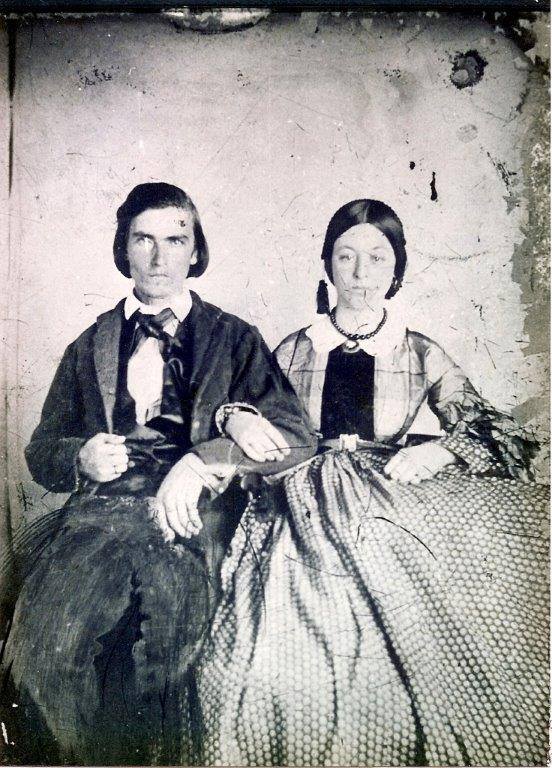
Facebook follower David Damron’s paternal great-great grandparents are George Wesley DAMRON and Mary ROGERS. In 1863 Mary’s father John ROGERS was lynched by Confederate Bushwhackers in Mulberry, Arkansas. She married George Wesley DAMRON a Union soldier from Company F, Kansas 13th Infantry Regiment. He was a part of the occupation of Van Buren, Arkansas. He died in 1876 the same month his brother murdered her brother.
Category: Uncategorized
-

(n)O Christmas Tree
Part Two of Four–Mom’s story
Continued from 12/17/18 Part One
That lean Christmas in a 19-foot travel trailer was a tough one for me, but it was great preparation for the next Christmas. The trailer was a temporary fix for my family, and even though we called it “home” for less than a year, it seemed like an eternity at the time. In the first few weeks, Mom and Dad slept on the sofa which folded out to a full-sized bed, while two of my brothers slept in a drop-down bunk that acted as a storage cupboard in its “up” position. Both of those beds were not quite full-sized, but they weren’t exactly cramped.
My sister and I, however, shared the bed over the drop-down dining table. It was not quite as wide as a twin bed, and yes, it was cramped; there was literally no room to roll over. But my four year-old brother had just a thin strip of foam laid down on the floor. He had it the worst. If anyone wanted to get to the bathroom near the entrance of the trailer at night, they would have to step over him (assuming they hadn’t already stepped on him).
As it was, Mom and Dad only stayed in the trailer long enough for Dad to put a lid of sorts over the cement foundation. It was to be quite a large home in its finished state, so the basement level functioned as a storage unit/work shed, with a corner sectioned off as a master bedroom of sorts. If I remember correctly, Mom kept the bed covered with plastic sheeting in an attempt to keep the sawdust out of the sheets. During that summer, Dad worked hard to get the upper floors framed in. He ran a power line from a transformer to the trailer and another to the house in order to keep an upright freezer and an old refrigerator running. Extension cords fed a work light and power tools, and we made a weekly drive to the nearest laundromat fifteen miles away . A laundry room and a bathroom with a full-sized tub were the first rooms finished.
By fall, the roof trusses were up and covered over with plywood and tar paper, and insulation in the form of shredded, recycled, fire retarded newspaper particles filled the walls. It was the best insulation to be found at the time, the wall studs were covered and it was blown into the walls through a layer of plastic. It was one of the very few projects on the house that Dad contracted out, and my brothers helped with most projects calling for more than two hands. This tough task was compounded by the fact that Dad was working a full-time job and functioning as a bishop in our local ward of the Church of Jesus Christ of Latter-day Saints. If Dad wasn’t at his paid job, he could be found attending meetings with church leaders or counseling church members. In his spare time, Friday evenings and Saturdays, he worked on the house. I’m amazed he got so much done during that first year.
As it was, there were still no windows installed and the roof shingles had not yet been laid on the roof as October neared its close. That fall, Dad spent nearly every waking moment either harnessed to the steeply pitched A-frame roof or installing windows. There would be no sitting down for a family meal during those weeks. Mom would often bring Dad’s dinner to him while he worked. He even tried working on the house one Sunday, but ran a two-by-four through a newly installed window as he was cleaning up the next Sunday. Dad never, ever, worked on a Sunday again after that, but he still managed to get the house fully closed in before the winter snow began to collect. Thankfully, Christmas of 1974 would be white.
America’s Problems get Personal
1974 was a tough year world-wide, but it was even tougher in the United States than in most nations. In response to its support of Israel during the 1973 Yom Kippur War, the United States was banned from oil trades with the world’s oil producing nations (OPEC). By the year’s end, As the country using the largest percentage of the world’s fossil fuel resources, the oil embargo hit hard, causing fuel prices to quadruple, followed by increased prices on imported products, including anything that could not be produced locally. Adding insult to injury, President of the U.S. Richard Nixon, resigned his position amidst allegations of White House involvement in a break-in of Democratic headquarters during an election year. To this day, Nixon is the only U.S. president to voluntarily resign, adding political upheaval to the nation’s deepening economic woes.
To avoid fuel shortages, people were asked to drive only when necessary. We lived a mile uphill from the nearest neighbor, five miles from church, ten miles to school and the nearest grocery store, and more than fifteen miles to work. Walking was out of the question.

Photo by fotografierende on Pexels.com Families across the United States were tightening their belts, including ours. Because of the increased strain on the family’s resources, Mom got a job working at a workshop/school for disabled adults. That really helped, and thanks to her, the building project was moving along as quickly as could be expected under the existing conditions. What wasn’t expected was the loss of Dad’s job in December. If last year’s Christmas was lean, this year’s would be worse.
Well, at least we had snow.
I’m Dreaming of Any Kind of Christmas
I had finally reconciled with Santa’s fall from Christmas grace, and I figured that nothing could be worse than the binder paper Christmas. The trailer had been moved closer to the basement entrance, and Dad’s tools and building materials went to to the second floor. With windows and insulation added, Mom and Dad’s “bedroom” was moved to it’s permanent home on the third floor despite the lack of carpeting, painted walls, or electrical amenities. Now there was plenty of room on the basement level for a dining/living area. We no longer had to use the trailer for bathroom purposes, and we could actually sit on a full-sized sofa and watch whatever channel might be getting reception on our thirteen-inch black and white television set.
It also meant room for a real Christmas tree. I didn’t care about presents, but I couldn’t face another year without a real tree. Apparently Mom felt the same way.
Mom’s Side of the Story
The only good news coming from Dad’s Christmastime lay-off was that he now had much more time to work on the house. Despite her meager salary, or perhaps to spite it, Mom felt the burden of Christmas falling directly upon her shoulders. Dad took a practical approach–stuff like this happens, and the world would not end without a tree or presents. His focus was on keeping a roof, unfinished as it was, over our heads, and getting a new job as quickly as possible so he could get everything under that roof finished.
Mom wasn’t quite so pragmatic about it.
Mom is the most creative person I know. If it’s too expensive or cheaply made, she figures out a way to create a better home-made version. The first thing Mom did was cut down a four-foot juniper tree from our six-acre property. It wasn’t the traditional fir tree we were used to, it had a fuzzy trunk, and it didn’t have that familiar Christmas tree smell. In addition, it was short. But it was still an evergreen, very nicely shaped, not school bus yellow, and it fit perfectly beneath the open staircase. I was thrilled. We had a Christmas tree.
Mom must have garnered a lot of trust at her job, because her boss gave her unlimited use of the scrap bins and let her use the shop’s power tools after hours. Mom made wooden ornaments in various shapes and drilled holes for red yarn. They looked so cute on the tree. She also gathered up some nice round branches from other trees on our property, and cut them into evenly shaped pieces. Using scraps of lumber from the building project and her workshop scraps, she built three sturdy lumber trucks–just as good or better than can be found in vintage toy shops today. I am not at all sure what my brothers thought of them, but I thought they were amazing. I’m pretty sure Dad helped some with that project, but I was impressed to learn that my mom actually had woodworking skills.
Woodwork wasn’t the only thing mom was good at. In her adolescence, She learned to sew; and from a very young age, she sewed her own clothes. She made her own wedding dress, and when I got married the first time, she remade it for me. I was aware of a stigma that came with having homemade clothes versus store-bought clothes, but I never worried about it. If mom could find nice affordable fabric, she could make any clothing look better than its commercial counterpart. That year, Mom made fabric dolls for my older sister and I, and although I no longer played with dolls, I thought mine would make a nice decoration when I finally moved in to my new bedroom.
There wasn’t much in the way of Christmas baking that year but there was one tradition Mom was determined that we would not go without–Stollen and hot cocoa. Stollen is a German sweet bread made with nuts, spices, and dried or candied fruit, coated with confectioner’s sugar icing. As the daughter of an authentic German baker, it just wouldn’t be Christmas without it. I don’t know how she managed to get all of the ingredients, and she does say that she knows the bread went without the usual, albeit expensive, pine-nuts, but I know I didn’t notice.

Love–The Best Gift of All
Along with wooden trucks and rag dolls, mom made a new pair of pajamas for each of us. I think, though, that most dazzling was the wide array of treats and trinkets to be found in our stockings. Mom said she scrounged around everywhere to find cool things to fill them up. My favorite gift that year came from a local automotive shop–a transistor radio that bore an uncanny resemblance to a car battery. It worked great, and even though I was no car enthusiast, I truly loved it.

My favorite gift in 1974. Not as tacky as a leg lamp. When I asked Mom about that Christmas, she told me that year was such a hard one for her that she had forgotten much of it. She suffered so much angst that year, and I know we felt it, but I’m still so amazed at what she was able to pull off. It simply hadn’t occurred to me that it was the worst Christmas in her memory. Looking back at my own motherhood though, especially as a single mother, I now realize that tough times are difficult for kids, but they are always toughest on the parents because we worry that we cannot give our children so many of the things they need, and that at the very least, their innocence will be lost in the process.
Until I started writing this story it hadn’t even occurred to me that my two younger brothers would have had to come to terms with the man in the red suit that year. The youngest would have been just five or six years old at the time. If either of them believed in Santa before that year, they certainly would not have afterwards. I didn’t bother to ask for anything, and if my younger brothers asked, they definitely didn’t ask for wooden logging trucks. For me, the magic I had lost in the abrupt revelation that there is no Santa two years earlier had returned. For my brothers, the magic was definitely changing.
Lessons Learned
Christmas can be magical for children, but it’s not about Santa Claus or about the gifts we get. It’s about love and giving. There is no greater love than that of a parent to a child, and there is no better gift than one that comes from the heart. Homemade gifts are thoughtful gifts, and everyone knows it’s the thought that counts. Mom never stopped thinking in December of 1974. That Christmas was filled with so much love that I didn’t care weather or not we had eggnog for the New Year. I wasn’t thinking of what we had to do without, but of our fortune in being able to have the things that we had.
Dad found a new job by the next fall, and the next Christmas was celebrated in a nearly completed home. Dad received a huge Christmas bonus in thanks for helping his new boss maintain the trust of a very important client. It was big enough that we were able to help out two other families for Christmas. Gifts were more than plentiful, and we even had our very first full-sized color television set. But the most appreciated presents, once again, were the handmade ones from Mom.
I still have two wooden ornaments from that year– a star and an A-frame house. The star remains in its unpainted form just as it was that Christmas, but the little wooden house, along with many of those ornaments from the Christmas of 1974, is tole-painted to resemble an Austrian style chalet (painting–another one of my mother’s many talents). Mom had managed to capture the image of our mountain home in that ornament, and in the other, the true spirit of Christmas. I normally include them in my annual decorations, but after our cross-country move, and last summer’s bout of bed bugs, the ornaments have accidentally been relocated to a storage unit, and I haven’t yet gone to retrieve them. I’ll add a photo of them as soon as I am able.
It’s been more than a decade since I celebrated with a real Christmas tree, and these days I don’t even bother with a full-sized tree. Now I have a Christmas tree collection. I display miniature trees everywhere, and every year I add to it, knowing that no matter how lean the celebration, there will always be trees.
-

Yá’át’ééh, Brody, It is Good
Well, I just repeated myself.
Before I moved to Page Arizona, I always thought the traditional Diné (Navajo) greeting was pronounced Yah-ta-hey.
Someone just smack me.
I came by it honestly, I guess. I learned my lousy pronunciation from the Brady Bunch. Sorry, folks, it was the only point of reference I had at the time.
I quickly learned, though, that pronunciation wasn’t the only thing I was struggling with. I had confusedly assumed, as I bet you do too, that Hello and Yá’át’ééh meant the same thing.
Well, they don’t.
First of all, hello is little more than a holler. You may have even guessed correctly that hello is actually a derivation of holler. But yá’át’ééh is a lot warmer and fuzzier than that. The greeting is an equalizer–a recognition that you approach your fellow human being with good intentions, and that you expect the same from them. The actual meaning of the term is it is good. As it was explained to me: it is good between us. So now that we have set the expectation, we can converse without animosity.
I love it.
Now back to pronunciation
It’s a good thing I listened a few times and actually asked someone to help me pronounce the word before I tried it on my students from the rez. As it was, I absolutely butchered it, but I am getting better at it, even though I now live in Kentucky and have absolutely no one to try it on.
As I was struggling to figure out how to help my grandchildren learn Dinè terms correctly, I ran across this awesome website called Navajo WOTD (word of the day). I’ll be using it a lot as I explain what I have learned about the Dinè language and culture.
It turns out that yá’át’ééh is two short syllables and one long one. Emphasis on the first and last. Take a listen:
Now say it again. Keep trying ’til you get it right. I think it’s gonna take me forever, but I’ll bet those smart grandkids of mine will get it right.
For the sake of those awesome grandkids, I’m gonna keep at it, so that as I learn, they can learn about their Diné grandmother and their family from the rez. Maybe one day they will be able to go back and actually put their native language to the test.
What does Brody have to do with this?
I knew you were gonna ask that.
I have decided that in honor of my grandchildren’s Native American heritage, I would post a story or fact to help them learn about, and to appreciate, their native ancestors on or near their birthdays, and it just so happens that today is Brody’s fourth birthday.

One thing that everyone said when they saw that big boy with piles of dark hair is that he looks like a little Navajo boy. I said it too. Because he is. So Happy Birthday, Brody! I love you lots, and I can’t wait to practice this with you!
-

3 Graves, 2 Poems, 1 Ghost Story
Along with his other cemetery photographs, Bernie sent me three tombstones of literary figures. How did he know I majored in English? Perhaps Bernie is more of a kindred spirit than I thought.
The first is a photo of Emily Dickinson’s grave. I have few favorites when it comes to poetry, and Dickinson is easily my American favorite. It is believed that she suffered from Seasonal Affective Disorder (SAD), and many of her poems reflect her struggle. I really relate to her poem, There’s a certain Slant of light, as I also suffer from SAD. When I read it for the first time, I felt that she put into words exactly what SAD feels like. In fact, as the days begin to grow shorter again, and the sun begins to approach that winter “slant,” I am starting to feel “the Heft of Cathedral Tunes” once again.
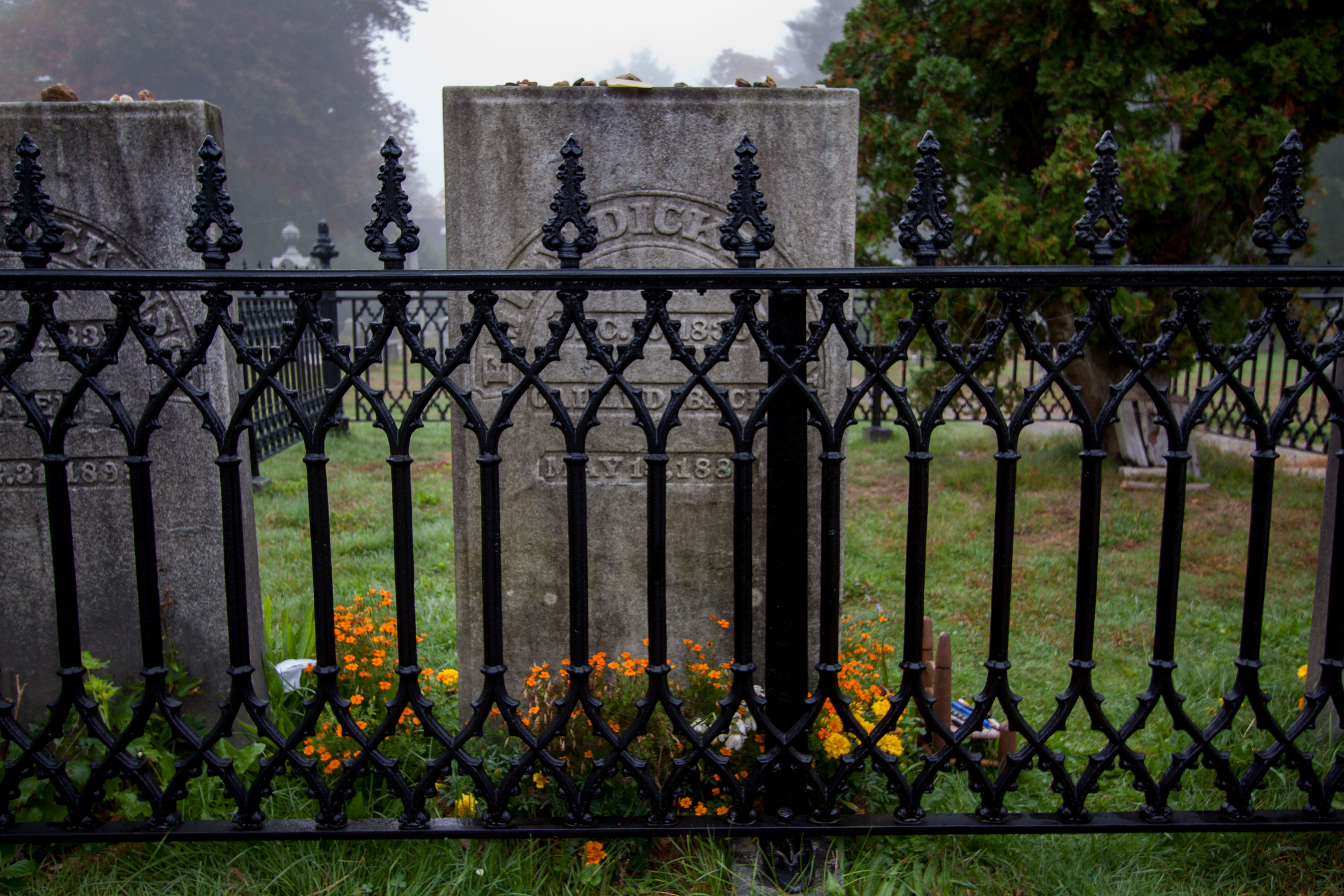
Emily Dickinson tombstone, West Cemetery, Amherst MA, Photographed by Bernie Kubiak There’s a certain Slant of light
BY EMILY DICKINSON
There’s a certain Slant of light,
Winter Afternoons –
That oppresses, like the Heft
Of Cathedral Tunes –
Heavenly Hurt, it gives us –
We can find no scar,
But internal difference –
Where the Meanings, are –
None may teach it – Any –
‘Tis the seal Despair –
An imperial affliction
Sent us of the Air –
When it comes, the Landscape listens –
Shadows – hold their breath –
When it goes, ’tis like the Distance
On the look of Death –
The second tombstone is from St. Bonaventure Cemetery, the same cemetery where many of my relatives are buried. I had never heard of Robert Lax until I received this photo of his tombstone. He was born into Judaism in the same town my father came from, but converted to Catholicism in his adult years. He lived in the islands of Greece for more than thirty years of his adult life; first on the island of Kalymnos, then Patmos. Lax returned to his birthplace of Olean, New York during the last few weeks of his life. Most of his original work is now housed at St. Bonaventure University, where his funeral services were held. (https://www.poetryfoundation.org/poets/robert-lax)

Robert Lax tombstone, St. Bonaventure University Cemetery, Allegany NY, Photographed by Bernie Kubiak Lax was a minimalist poet. His ability to put together small words with few syllables in a single line down the page, and still pack both imagery and depth of meaning into those simple lines is amazing. I found his poem about life in Kalymnos, titled simply, “Kalymnos,” a very simple read; it only took a few minutes to get through it. Somehow though, the poem felt more like a novella as I absorbed its meaning. Divided into “chapters,” I feel 3 adequately captures the mood of the season with its description of the death of a fishing vessel. The vessel itself was the only casualty:
Kalymnos
BY ROBERT LAX
at 5
in the
morning
at the
cafeneion
the captain
described
the wreck:
the boat
had turned
over &
over
in the
water
churning it
like a
propell-
er
The final tombstone in this collection comes from America’s best known literary artist. Born Samuel Langhorne Clemens, he later adopted the pen-name Mark Twain. Despite many highly acclaimed literary successes, Twain suffered great loss as a husband and father, and was not as successful financially as he was artistically. Three of his children and his wife preceded him in death, and his declining literary success may have contributed to increasing pessimism in his later years. In his final days, Twain was said to have become a recluse prone to “volcanic rages and nasty bouts of paranoia .” (https://www.biography.com/people/mark-twain-9512564) He died in 1910 at his Connecticut home, and was laid to rest in Elmira, New York.

Samuel Langhorne Clemens, a.k.a. Mark Twain, tombstone, Woodlawn Cemetery, Elmira, New York. Photographed by Bernie Kubiak 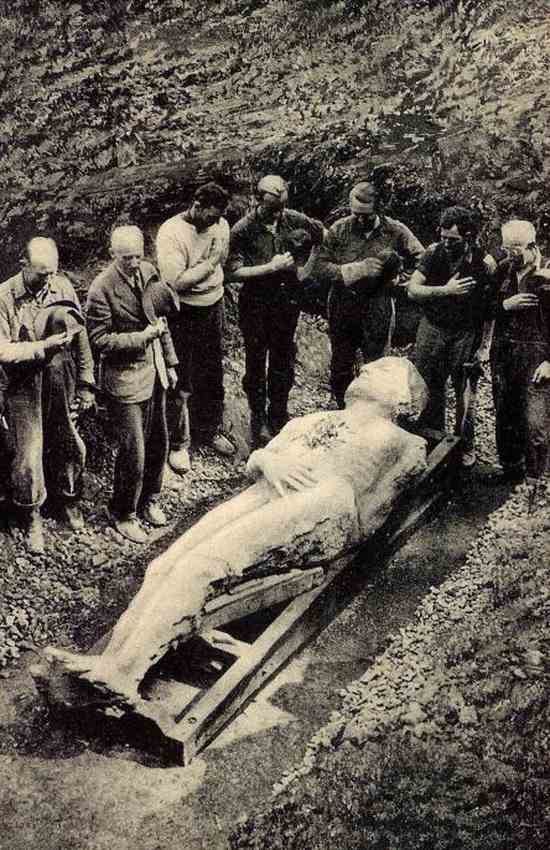
The Cardiff Giant image from https://commons.wikimedia.org/wiki/File:Cardiff_Giant_2.jpg When I think of Twain, I don’t think of his final days. I think of Tom Sawyer’s Aunt Polly standing on her front porch, fists planted firmly on each hip, and shouting, “You, Tom!” while Tom runs blithely in the opposite direction. I loved both Tom Sawyer and Huckleberry Finn.
My favorite work of Twain’s is his short story, The Celebrated Jumping Frog of Calaveras County, but I wanted to include something of Twain’s more fitting for the season, so I went in search of a ghost story. I was not disappointed. In fact, what I found is actually titled A Ghost Story. Like most of Twain’s literary works, this one is quite suitable for children. Before you read it to your kids, though, I recommend that you read up on the background story of The Cardiff Giant at History.com. Share the giant’s history with your children before reading A Ghost Story. Just follow the links to each.
My birthday is this week. I consider this post my birthday gift. I thoroughly enjoyed “opening” it. Thanks, Bernie!
 StoriesFromthePast.com
