Author: Too Many Hats

  • Cousin Connection #5: Family Lost and Found

    Cousin Connection #5: Family Lost and Found

    In honor of Mexico’s Dia de los Muertos (Day of the Dead), which officially begins at midnight, November’s Cousin Connection comes one day early. Coinciding with the the Catholic All Saints Day, and incorporating garish costumes resembling skeletons, Dia de los Muertos is not Mexican Halloween, but a much more elaborate version of Memorial Day in the U.S.

    In Mexico, this year’s commemoration began a few days ago with a large parade including a salute to rescue workers who worked tirelessly to save family, friends, and fellow countrymen from the rubble of recent earthquakes.

    When Pete, a Mexican friend from college, entered a Facebook post celebrating his recent connection to cousins he never knew he had, I decided that this week’s holiday is the perfect time to include it.


    Pete tells his own story:

    I have become obsessed with making a family tree. It did not just happen out of nowhere. It started when I submitted my son’s DNA to Ancestry.com. I wanted to show him his multi-ethnic background. We were not disappointed. He is from all over the world–every continent except Antarctica and Australia.

    Ancestry told us that he is mostly Native American from the area of Zacatecas and Aguacalientes. His ethnicity estimate is also 24% Great Britain with Western Europe, the Iberian Peninsula, Scandinavia, Ireland, Finland, European Jewish, Polynesia, the Middle East, Senegal, and Africa North all vying for a slice of the genetic pie.

    But this smorgasbord of the world is not what compelled me to create a family tree. It was a feature of Ancestry that I did not expect. Our DNA was matched with other people who submitted their DNA with Ancestry.

    There was a small group of people who were listed as close relatives. Some of these were easy to figure out. They were: a sister of my wife, a first cousin of my wife and his daughter, and a first cousin of my son. Then, there was a man and a woman who had a majority of Native American ethnicity in their report. They had to be related to my side.

    But how?

    My father was the only member of his family who came to this country. That was in 1948. How could he have close relatives in this country? My mother was raised as an only child. I was the only Mexican in the world who did not have a cousin, an uncle, or an aunt. We held our family reunions inside a closet. But, on the bright side, there were more tamales for us during the holidays. We did not have to share them with relatives.

    But who are these people that Ancestry claims are closely related to my family?

    Did my father stray, and now the evidence is coming back Maury Povich style to say that “The DNA evidence is in, you are the father?” Did my mother’s parents have a secret child? Did I have a close relative from Mexico who came unannounced to Chicago in the 1930s?

    I did some research and found that these two people listed on Ancestry are from Chicago. One was 73 years old. The other was in her 20s.

    The older man eliminated my father. My father was not here 73 years ago. He was still in Mexico.

    Was my mother’s lingering doubt that her parents are not her biological parents more than a doubt? Could she be related to this 73 year-old man?

    I found records for the younger woman. She had been arrested a couple of times in her early 20s. We have to be related and share the arrested development gene. My line has proven that this gene exists. It lingered in me into my twenties.

    She lives in a northern suburb of Chicago. The older man lived in an adjacent suburb. They lived near each other.

    I went to Facebook. I found a connection between the two people. I began to develop a hypothesis. These were the biological relatives of my mother, who was adopted in 1934. Now, I need to apply science to prove my hypothesis. I need evidence.

    I sent messages via Ancestry to both people. I did not receive a response. I tried again. I received the same result-no reply.

    I began to create my tree. I spent about 200 hours in September researching for my tree. September is our month off for home school. I needed to make progress and uncover these connections in one month before I started in October with Geometry, U.S. Government, Spanish, and Language Arts for my 13-year-old son. He takes three other classes in the regular school system.

    I was obsessed. I searched every clue. I looked under every rock. Researching my family is not an easy thing. My name is not Gonzalez. Anyone researching my family will come to an instant dead end.

    Our real family name may go back only a few generations. It may not be our real family name. Family legend has it that someone in the family line helped a gang rob a Zacatecas silver mine payroll. He then disappeared into another Mexican state with a new name and a richer, new life. I found nothing to prove or disprove that legend.

    I did hit a dead end with the family lineage in the mid 19th century.

    If my mother was adopted then there is another instant dead end. Could these two people be the key to answering the question about my mother’s biological parents?

    Maybe my mother was not adopted although I have always believed in that theory. My grandparents resemble no one in my family. None of them look like any of the ensuing offspring. I look like my dad. My son, Pete, looks like me.

    Did I really want to go down this road?

    In my mind, my grandparents will always be my grandparents no matter what I find out. My grandmother, in her late-60s, would take her rug muffin [sic] grandchildren to the movies and to the 12th Street beach. She had a folding chair, and she would sit and wait with us at the Roosevelt Street bus stop. She did a lot for us.

    I loved swimming in the 12th Street Beach. I never would have had that experience if not for my grandmother. She cared about us.

    I loved the movies except for a horror movie that was in Spanish. I was afraid for about a week after watching it. I was about six years old.

    She fed us when we visited her apartment down the street on Peoria. She fed me my first jalapeno when I was about five. She and her husband laughed about it. It was a rite of passage, and one of my dearest memories of them. She was performing an important ritual. I cannot live without jalapenos and spicy foods.

    I searched census forms from the 1930s, line by line, of every residence in the Taylor Street area. I looked at immigration records, marriage records, death records, and I sent out a few smoke signals and gave offerings of fried bread and jalapenos to the family tree gods.

    I made flowcharts comparing the DNA evidence and the relationship between these two people and me. I developed a hypothesis that the older man had to be either the first cousin of my mother or her brother.

    I hit dead ends in my search for more information. I felt hesitant to call to contact the man. What does one say?

    “I think that your mother or your aunt gave up your older sister/cousin for adoption. I have no evidence, it is just a hunch.”

    I do not think so.

    There was one other person who was listed as a close relative. She had a family tree with about 3,000 people listed on it, but it was private. I contacted her and asked for permission to look at her extensive family tree. I explained that we probably shared a common ancestor from one hundred years ago. I was hoping that her family tree would provide some vital clues to help me determine how we are related. She granted me permission, but she added that she doubted if we were related. She said that she had no Gonzalez in her tree.

    Neither did I.

    Looking at her tree was an eye opener. I immediately found a link between her and the two people who are closely related to me. I asked her about the two. One was the granddaughter of her aunt. The other, the 73 year-old man, was her first cousin.

    Let’s call her aunt Aunt Zuzu.

    If he was my mother’s first cousin, then this woman with the family tree was also my mother’s first cousin. I was on the right track.

    She said that all her family lived in the Taylor Street area. She was not sure if we were related.

    Her grandparents had one daughter who possibly could have been the mother of my mother. All the DNA evidence would fit if she was. There were two daughters who possibly could be the biological mother of my mother. One was pregnant with another child when my mother was born. It could not be her. The other would have been 14 when she was pregnant with my mother. I think it was this teen who gave birth to my mother.

    I asked my mother if she knew this Aunt Zuzu. My mother’s voice picked up with excitement when she heard Zuzu’s name. She said that Zuzu was her cousin.

    Cousin? But she had no relatives in Chicago. How could she be related? She said that my grandmother wanted her to address Zuzu as her cousin Zuzu and to call Zuzu’s mother dia Maria.

    I asked her the name of Zuzu’s mother. She answered. It was the exact name of the mother of the person who I hypothesized was the biological mother of my mother. Dia Maria most likely was my mother’s grandmother.

    It was a tangled web.

    Zuzu’s mother was a close friend of my grandmother. Who else would you trust with your grandchild but your good, trusted friend?

    It made sense. Was Aunt Zuzu my mother’s biological aunt? Was her sister the teen who gave up her daughter, my mother, for adoption? It was during the Great Depression. She came from a large family. She was only 14 when she became pregnant.

    Was I solving this puzzle that I thought was unsolvable? I had thought that anyone who would know the truth about my mother was long deceased. But here I am, on the cusp of putting in the last few pieces of this puzzle.

    Her mother was right there all the time. It was the older sister of her friend, Zuzu.

    The owner of the huge family tree confirmed that her aunt had given up her child for adoption. She had heard that family story.

    My mother is 83.

    Her parents will always be her parents.

    She finally found out the truth and received the answer to her doubt. It all fell into place like it was preordained. We were meant to know the truth while she was still alive.

    In her last response. the woman with the huge family tree addressed the message to cousin Pete. I smiled when I read it.

    I finally have a cousin. I am no longer the only Mexican in the world sin primos.

  • 3 Graves, 2 Poems, 1 Ghost Story

    3 Graves, 2 Poems, 1 Ghost Story

    Along with his other cemetery photographs, Bernie sent me three tombstones of literary figures. How did he know I majored in English? Perhaps Bernie is more of a kindred spirit than I thought.

    The first is a photo of Emily Dickinson’s grave. I have few favorites when it comes to poetry, and Dickinson is easily my American favorite. It is believed that she suffered from Seasonal Affective Disorder (SAD), and many of her poems reflect her struggle. I really relate to her poem, There’s a certain Slant of light, as I also suffer from SAD. When I read it for the first time, I felt that she put into words exactly what SAD feels like. In fact, as the days begin to grow shorter again, and the sun begins to approach that winter “slant,” I am starting to feel “the Heft of Cathedral Tunes” once again.

    dickinson_MG_9782
    Emily Dickinson tombstone, West Cemetery, Amherst MA, Photographed by Bernie Kubiak

    There’s a certain Slant of light

    BY EMILY DICKINSON

    There’s a certain Slant of light,
    Winter Afternoons –
    That oppresses, like the Heft
    Of Cathedral Tunes –
    Heavenly Hurt, it gives us –
    We can find no scar,
    But internal difference –
    Where the Meanings, are –
    None may teach it – Any –
    ‘Tis the seal Despair –
    An imperial affliction
    Sent us of the Air –
    When it comes, the Landscape listens –
    Shadows – hold their breath –
    When it goes, ’tis like the Distance
    On the look of Death –

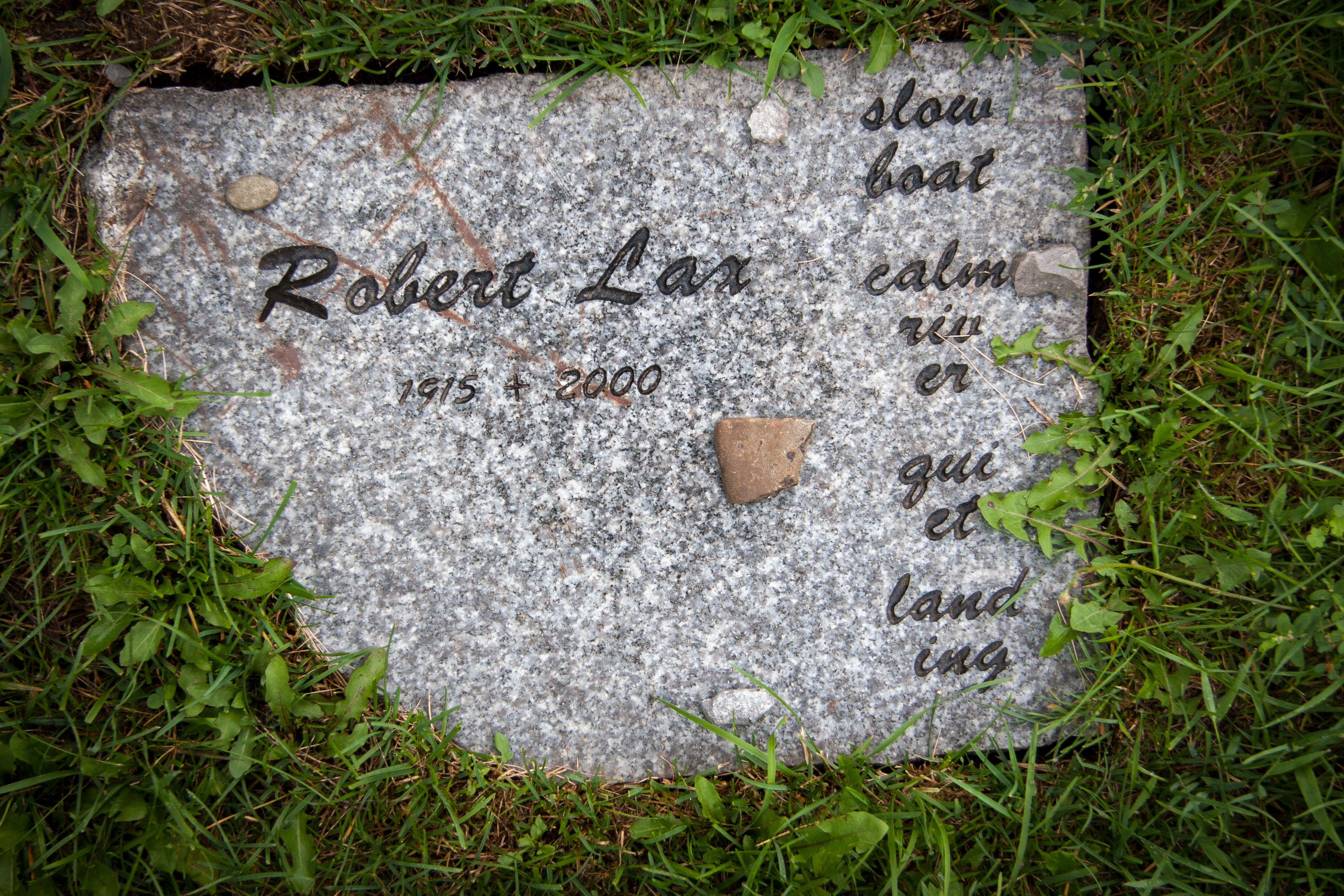
    The second tombstone is from St. Bonaventure Cemetery, the same cemetery where many of my relatives are buried. I had never heard of Robert Lax until I received this photo of his tombstone.  He was born into Judaism in the same town my father came from, but converted to Catholicism in his adult years. He lived in the islands of Greece for more than thirty years of his adult life; first on the island of Kalymnos, then Patmos. Lax returned to his birthplace of Olean, New York during the last few weeks of his life. Most of his original work is now housed at St. Bonaventure University, where his funeral services were held.  (https://www.poetryfoundation.org/poets/robert-lax)

    lax_MG_3700.jpg
    Robert Lax tombstone, St. Bonaventure University Cemetery, Allegany NY, Photographed by Bernie Kubiak

    Lax was a minimalist poet. His ability to put together small words with few syllables in a single line down the page, and still pack both imagery and depth of meaning into those simple lines is amazing. I found his poem about life in Kalymnos, titled simply, “Kalymnos,” a very simple read; it only took a few minutes to get through it. Somehow though, the poem felt more like a novella as I absorbed its meaning. Divided into “chapters,” I feel 3 adequately captures the  mood of the season with its description of the death of a fishing vessel. The vessel itself was the only casualty:

    Kalymnos

    BY ROBERT LAX

    at 5
    in the
    morning
    at the
    cafeneion
    the captain
    described
    the wreck:
    the boat
    had turned
    over &
    over
    in the
    water
    churning it
    like a
    propell-
    er

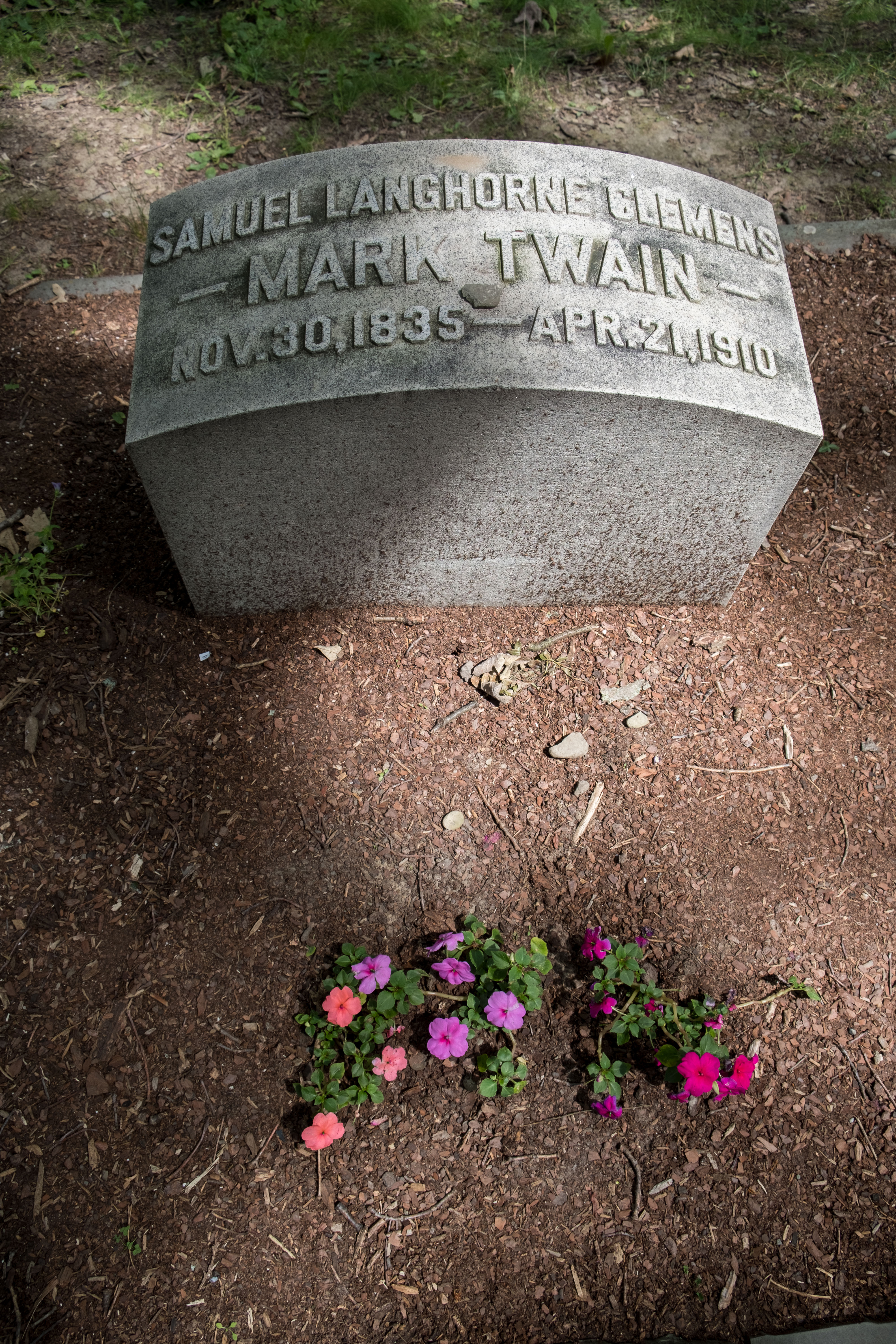
    The final tombstone in this collection comes from America’s best known literary artist. Born Samuel Langhorne Clemens, he later adopted the pen-name Mark Twain. Despite many highly acclaimed literary successes, Twain suffered great loss as a husband  and father, and was not as successful financially as he was artistically. Three of his children and his wife preceded him in death, and his declining literary success may have contributed to increasing pessimism in his later years. In his final days, Twain was said to have become a recluse prone to “volcanic rages and nasty bouts of paranoia .” (https://www.biography.com/people/mark-twain-9512564) He died in 1910 at his Connecticut home, and was laid to rest in Elmira, New York.

    twain_DSF9506.jpg
    Samuel Langhorne Clemens, a.k.a. Mark Twain, tombstone, Woodlawn Cemetery, Elmira, New York. Photographed by Bernie Kubiak
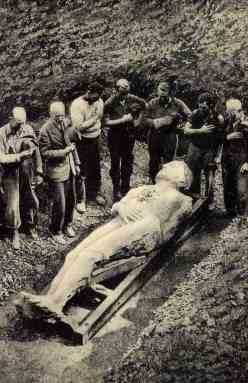
    Cardiff_Giant_from Google image search
    The Cardiff Giant image from https://commons.wikimedia.org/wiki/File:Cardiff_Giant_2.jpg

    When I think of Twain, I don’t think of his final days. I think of Tom Sawyer’s Aunt Polly standing on her front porch, fists planted firmly on each hip, and shouting, “You, Tom!” while Tom runs blithely in the opposite direction. I loved both Tom Sawyer and Huckleberry Finn. 

    My favorite work of Twain’s is his short story, The Celebrated Jumping Frog of Calaveras County, but I wanted to include something of Twain’s more fitting for the season, so I went in search of a ghost story. I was not disappointed. In fact, what I found is actually titled A Ghost Story. Like most of Twain’s literary works, this one is quite suitable for children. Before you read it to your kids, though, I recommend that you read up on the background story of The Cardiff Giant at History.com. Share the giant’s history with your children before reading A Ghost Story. Just follow the links to each.

    My birthday is this week. I consider this post my birthday gift. I thoroughly enjoyed “opening” it. Thanks, Bernie!


  • Cousin Connection #4: Evidence from the Grave

    Cousin Connection #4: Evidence from the Grave

    I had already published my first Cousin Connection when I met Diedre MacLean, I just didn’t know it yet. Diedre contacted me using Stories From the Past’s Tell Your Story form after she discovered several name matches from the same cemetery where  Kathy, wife of my cousin Chuck, had discovered a connection to me. It was Diedre’s WordPress message that inspired me to create my Cousin Connection. If I could connect with Diedre through an online cemetery photo, I figured the possibilities were endless. There may be an end somewhere, but as long as there are ancestors yet to be found, I can keep telling stories for many years to come.

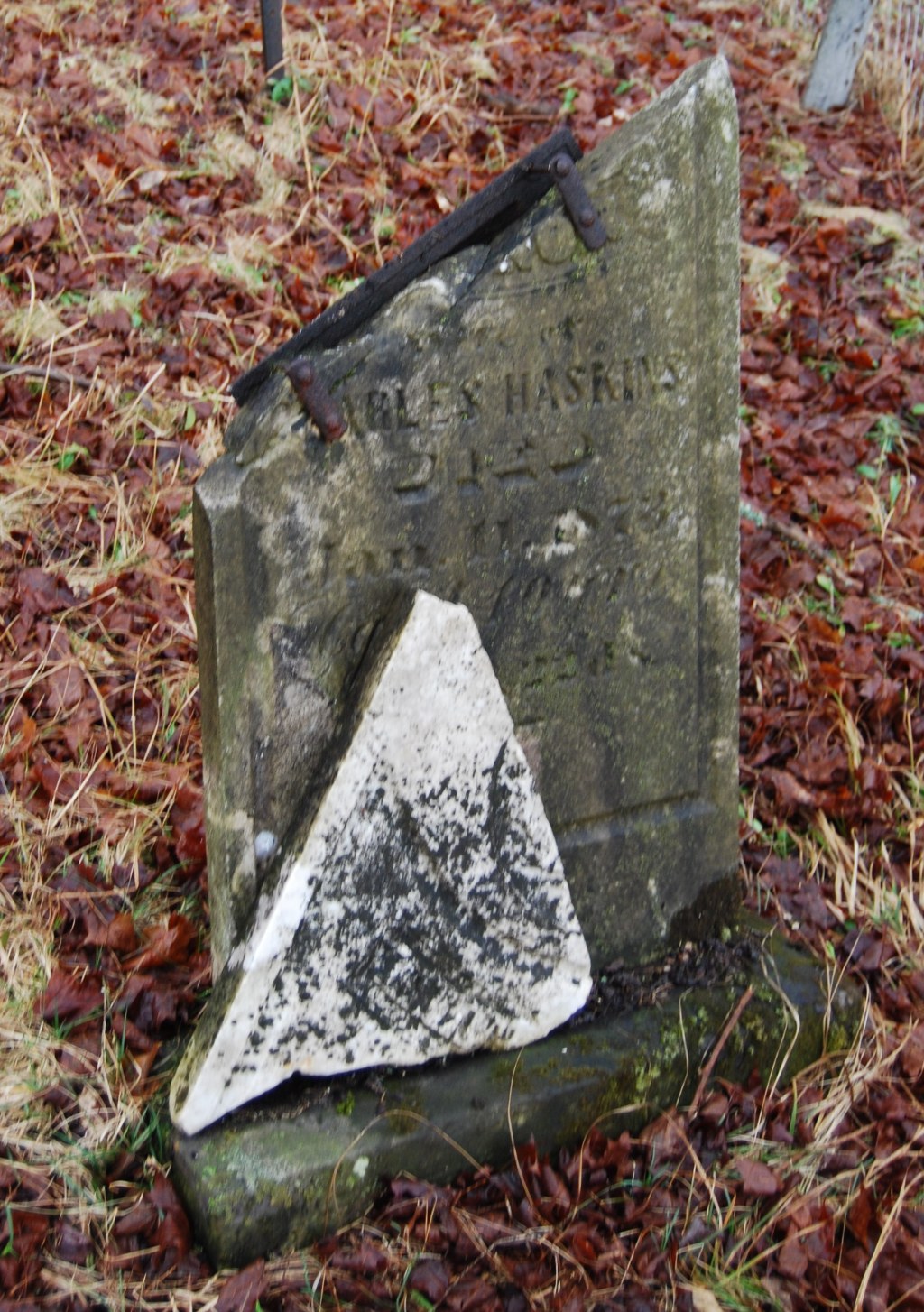
    Diedre’s information came from word of mouth. Her grandmother shared her family’s history with her, as I am sure it was passed along from generation to generation. When Diedre shared the information with me, I could see that we did indeed have a solid match. I just needed to verify the information that matched our shared ancestor, so I started with Elenor Haskins, Diedre’s g-g-g-grandmother whom Diedre believed to be the daughter of our shared ancestors William Auckey Wyckoff and his wife Eleanor Van Mater. The first thing I found was her tombstone.

    As I probed into FamilySearch data, and did a records search, I found discrepancies from the tombstone of Elenor [Wykoff] Haskins, and the Eleanor Wykoff listed as daughter to our shared ancestor. The first and last names matched, but the dates did not match the tombstone. I assumed the dates on the tombstone were correct. (They are written in stone.) I knew we had the right ancestor. After all, it would have had to have been an elaborate hoax on Diedre’s part, and really, what’s in it for either of us? We are, after all, complete strangers. So what was missing?

    After further communication with Diedre, I was convinced that I did indeed have the right tombstone, but I was not convinced that I had found the right ancestor on FamilySearch. I began to rattle some bones. I surmised that Diedre was missing a generation in her family tree, so I began digging with the oldest male among William and Eleanor Wykoff’s thirteen children. He had a daughter named Elenor. Her husband’s name did not match. The next child was the daughter named Eleanor, so I skipped her. The third child and second son also had a daughter named Eleanor. but her husband, children, and death date did not match either. I was beginning to worry that I would have to search all thirteen of the Wykoff children before I found the right Eleanor. The third son was my g-g-g-grandfather Cyrenius. He didn’t have any Eleanors. Thank goodness. I found Diedre’s Eleanor with the fourth son Charles. I was right. Charles was the missing link and his wife’s name was

    -wait for it-

    -wait for it-

    Eleanor! Obviously his wife was not the Eleanor Haskins I was looking for, but their daughter was.

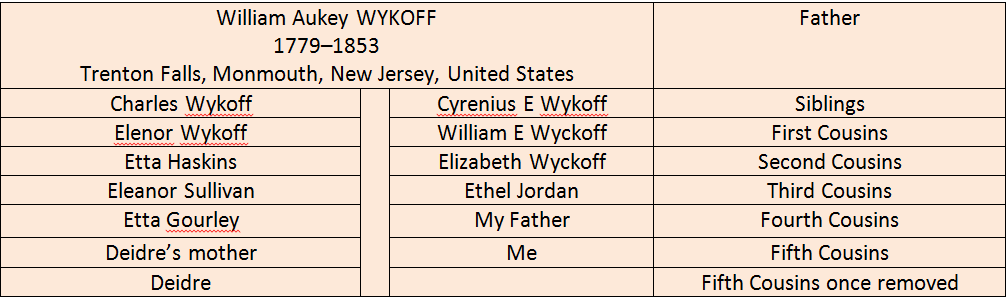
    So. William married Eleanor. They had a daughter named Eleanor. Their sons could not be named Eleanor so they named their daughters Eleanor. Charles, one of those sons, had a wife named Eleanor and they also named their daughter Eleanor. She married a Charles too, but they named their daughter Etta, who named her daughter Eleanor, and that Eleanor named her daughter Etta. That Etta was Diedre’s Grandmother. Confused? That’s why I make charts.

    The exciting part in all of this for me, is not the first name of Charles Wykoff’s wife, but her maiden name which is the same as my grandmother’s. Diedre and I may have more in common than we thought.

    Diedre 5th cousin once removedIn the end, Diedre and I are fifth cousins once removed. I am still a bit confused about the fact that Elenor Wykoff Haskins married a man named Charles and that her mother and father just happened to be named Eleanor and Charles as well. It’s not impossible that four individuals just happened to share given names with previously unrelated people, but I could not find corroborating evidence in the form of primary sources. The only thing proving FamilySearch’s information to be correct is that tombstone.
    I solved one mystery, but that leads to other mysteries. Welcome to genealogy.

    And welcome to my family, Diedre!

  • About the Photographer

    About the Photographer

    I’d like to give a shout out to Bernie Kubiak for freely sharing his photographs with us for Cemetery Month at StoriesFromThePast.com. His talent as a photographer comes from years of practice. A large portion of the photographs submitted by Bernie for cemetery month come from St. Bonaventure Cemetery in Allegany New York. Bernie shares his reason in a short autobiographical passage:

    st bonas 2 b.jpg
    St. Bonaventure Cemetery. Photo by Bernie Kubiak

    “My mother took it upon herself to maintain the family graves at St. Bonaventure Cemetery and frequently took me with her to help.  That, plus the fun of rolling down the big hill where the Stations of the Cross were, kind of started an interest in cemeteries and how people memorialize the deceased.  As the opportunity presents itself, I make images of cemeteries, not as documents but my impression of the place.  The older cemeteries are visually more interesting, before graveyards took on an industrial quality with similar stones at precise intervals which makes for easier maintenance.  Some cemeteries started in the 19th century were designed to be places to visit, with gardens, picnic spots, and walking trails.

    st bonas 1.jpg
    St. Bonaventure Cemetery. Photo by Bernie Kubiak.

    I’m largely self-taught as a photographer, taken some workshops, and have benefited greatly from acquaintances sharing skills.  I abandoned film over a decade ago, freed myself from the darkroom, and find myself wondering when I’ll have the time or resources to scan all the slides I’ve left behind.  I’ve been fortunate enough to exhibit in galleries in Massachusetts and Vermont and do sell prints. But photography remains an avocation.  Having retired from too many years working in human services and municipal management, I can spend more time at the craft and maybe even finish up a website.  In the interim, one can find a very random sample of my work at: www.flickr.com/photos/berniekubiak/.”

    Bernie is attracted to cemeteries for the stories he can tell through images. It turns out that Bernie and I have a lot in common when it comes to cemeteries. Whodathunk?

  • St. Bonaventure Cemetery, Allegany, NY

    St. Bonaventure Cemetery, Allegany, NY

    More Photos from Cousin Bernie.

    Since Bernie is the photographer, he naturally chose a cemetery with family in it. St. Bonaventure Cemetery in Allegany, New York is quite a large cemetery, and I found many family names among the Kwiatkowskis buried there, including my great grandfather and great-great grandmother (Bernie’s great-uncle and great grandmother), . The family relationships can get a bit confusing when I try to position myself and Bernie with the dead relative, but I did use the cousin finder, and I think I got it right. If you see any mistakes in family progression, please feel free to let me know so I can straighten it out. 

    st bonas kwiatkowski.jpg
    Bernie’s grandparents’ tombstone (my great-granduncle and “Babci Mary”).
    st bonas Bernie.jpg
    Bernie’s namesake who died in WWII when his plane crashed, probably in Papua New Guinea (my first cousin twice removed).

    st bonas 3.jpgThe cemetery is named for a local university that students claim to be haunted. Who knows whether the stories are actually true. You can read them here and decide for yourself. In the meantime, here’s one as a great companion to those late night readings. You may want to keep the light on.

  • Cousin Connection #3: John Woodgie

    Cousin Connection #3: John Woodgie

    The Duck, The Whole Duck, and Nothing but the Duck

    Quack.

    But seriously, my New York cousins from my dad’s generation are very Polish. I mean, many of them speak the language, and even if they don’t, they know a few words here and there and even understand much of the Polish dialogue. Even my father, who was separated from the family when he was just thirteen, can speak a few words. Not only that, but many of them are still staunchly Catholic as their grandparents from the old world would have wanted it, and even more still enjoy the good old Polish cuisine.

    I myself grew up enjoying many culinary delights from the Old World. I ate things many of my American counterparts would never dream of touching. It’s too bad for them, though. They don’t know what they are missing out on. Beef tongue served the Bohemian way will always be my favorite.  One of these days I’ll have to post that recipe as well.

    The first thing John Woodgie, another of my New York cousins, suggested for this month’s Cousin Connection was another Polish recipe. I can’t blame him. Polish food is delicious. (By the way, you can get the best Polish food in the U.S. if you visit Chicago.) This particular recipe uses the whole dang duck! It’s one of John’s favorites. I’ve never had it, and like many of my counterparts, I’m a bit reticent to try it; but then I’ve had lots of strange foods in my life, and most of them are amazingly delicious.

    First, a little about John and how we are related. John Woodgie is my family’s genealogical expert.  He has been working on the Kwiatkowski family line for some time and has identified over 2100 family members. He links names while I am looking for stories. I am eager to connect faces and places with those names, linking each of us in a way that brings the past to life. But I’m just a dabbler compared to him.

    Like Chuck Kwiatkowski, John also lives in Olean, NY. In fact, he tells me he’s only a mile away from Chuck. Olean is where my dad was born. I’ve only visited once, staying for just a couple of hours. I think this means I need to plan a trip up north to meet these guys in person sometime soon.

    John, Louis, Sonny and Dad (Joe)
    Joseph Woodgie with sons John, Louis and Steve with their dog Rags circa 1943. John is the little one.

    I am related to John through his mother, who was daughter to my great-uncle Joseph Kwiatkowski. Like my dad, John’s father was also born in New York  but he was a first generation American. Two of John’s uncles were born in Poland before the family immigrated.


    John tells me that his grandfather on his mother’s side, Chuck‘s grandfather, Bernie‘s grandfather, and my dad’s grandfather were all brothers. There are plenty more where they came from, too. Their father, Joannes (“John”) Kwiatkowski, and his wife Catharina  had a total of thirteen children. John’s Kwiatkowski grandparents had twelve children, and John is one of 41 grandchildren. Bernie’s grandparents had at least five children. I don’t know how many children Chuck’s grandparents had, but I know that my own great-grandparents also had a dozen children, and I am sure that my father probably has just as many first cousins as John Woodgie does. This means I have only touched the tip of the iceberg as far as my New York cousins go, although I have no intention of focusing all of my Cousin Connection efforts there. I still have three other grandparents to search through.

    Of course, creating a new cousin chart for John was pretty easy. I just had to substitute a few names:John Woodgie Second cousin once removed

    So about that duck.

    Skala Sophie and
    Salomea, Frankie and Sophie Skała with their mother Maria Dynia-Skała circa 1910, Rzeszów Poland.

    Joseph Kwiatkowski married Sophia Skała ,who was born in Zaczernie, Poland, in Olean, NY May 13, 1913. Sophie was John’s grandmother. She would make her duck soup almost every autumn. John says, “Grampa K would kill the ducks that he raised in their backyard along with chickens and pigeons.” Because the family relied on home-grown resources, they never went hungry. But there is more to it than that. The recipe frugally incorporates every edible component of the duck , including the blood.  A goose can be used interchangeably with the duck in this recipe.


    Sophie Kwiatkowski’s Duck soup is a regional recipe known as Czarnina (char-NEE-nah). The name is derived from the Polish word, czarny, for black. It refers to the dark color of the soup which comes from the blood in the recipe. The soup often has a sweet-sour flavor, a flavor I remember well from many of the European recipes I grew up on. I’ve never tried it, and I doubt I’ll ever have the opportunity to acquire a whole freshly slaughtered duck, but if I come across the concoction, I’ll be sure to give it a try.

    Or maybe not. Legend has it that Polish suitors would receive Czarnina from their prospective in-laws. It was a way for the family to let a young man know that his advances would not be welcome. But John likes it, so it can’t be that bad.

    Sophie Skała’s Czarnina

    • 1 whole duck (gutted and feathers removed, reserve heart, neck and gizzard)
    • 2 containers blood
    • 1 medium onion
    • 1 medium potato
    • 1 carrot
    • 1 medium apple
    • 1 cup sour cream
    •  sugar to taste
    • 3 tbsp flour

    In an 8 quart pot place duck, neck, heart, gizzard. Cut up onion, potato, carrot, apple into quarters and place them in a piece of cheese cloth. Tie cloth and place in pot.Cover with water to two inches of top of pot. Cook for two hours until duck is done.

    Take duck and veggies of out the soup. Let soup cool to touch. In a bowl, mix  blood and flour. Blend until smooth. Stir in sour cream and pour this into the soup. Stir until soup comes to a boil. Reduce heat and let simmer for about 1/2 hour.

    While cooking you can make Kluski to add when soup is finished. Some people prefer to use Polish potato dumplings instead. I have also heard that Polish-Americans often use pre-made gnocchi found in the freezer section of their local grocery store.

    You can find different versions online or in Polish cookbooks, but this is how John Woodgie’s Grandma Kwiatkowski made it, and it is his favorite. The others, he says, have too many ingredients.

    I’ve been learning a lot about the workings of my Polish forbears from my New York cousins. Especially John. From both John and Chuck, I have gained new insights into the workings of my Polish-American cousins including changes in surnames and immigration patterns. I’m looking forward to learning more from them and sharing even more with my readers.


  • Are You My Cousin?

    Are You My Cousin?

    Stories From the Past is proud to present The Cousin Connection Project.

    I grew up without cousins. Well, I did have cousins. I knew I had cousins. I had even met three of them. But I didn’t know them well, and I didn’t even live in the same state as any of them. I was well into my 40s by the time I started getting to know the rest of my cousins, and I still haven’t met most of them in person.

    I met my midwestern cousins on my mother’s side when I moved to Chicago for graduate school. As I sat at Thanksgiving dinner with all those first cousins trying to figure out how my children were related to them and how our children were related to each other, my cousin Allen patiently explained the differences between first, second, third cousins, etc., and the numbers of removal. It was a bit confusing, but I retained enough of the information that I felt comfortable in exploring cousin relationships to others.

    in search of myself

    Thanks to Facebook, I have been able to connect with even more cousins I have never met in person. With their cooperation, I am getting to know them better one blog post at a time. When my newly discovered cousin Bernie posted a family recipe on Facebook, I decided the recipe would make a great blog post. I felt that I should also identify just how we were related, so with Bernie’s cooperation, and using Allen’s “formula” I created a chart showing my newly discovered relationship. Bernie was great, and the post was so personally rewarding that I offered to do it for all of my cousins on Facebook.

    Between Bernie’s post and my next cousin post, I was contacted by a complete stranger named Diedre in Michigan. Diedre gave me some information indicating that we have common ancestors from early colonial America and the Netherlands (AKA Holland at the time). Much of Diedre’s information pointed to a probable family connection by removals with an old family friend in Utah. I could see that I could easily make cousin connections throughout the United States on a regular basis by connecting through common ancestors. I’ll go more into detail about those common ancestors in another cousin connection post, but suffice it to say I can see that I have plenty to keep busy.

    Thanks to my U.S. immigrant ancestors, and the cousins I’ve already connected with, I can connect with my past in a completely new and exciting way. Next week I’m connecting with another New York cousin, our family genealogy expert, John Woodgie. After that, Diedre, and I still have plenty of ideas to keep me going well into the new year. This is very rewarding for me, so I am creating a database for these cousin connections, and I am calling it The Cousin Connection Project.

    The Cousin Connection Project uses a surname and location database of most ancestors I have been able to identify.  The database is organized alphabetically by surname, and should be pretty easy to identify links to common ancestors. If you come across a name, location, and date range that matches names, locations, and date ranges in your own family tree, you can contact me for a free consultation and a possible cousin connection post showing your relationship to me.

    I am also including separate databases for Mary Davis Skeen and any other family lines for other historical biographies I decide to tackle in the future. The separate databases will make it easier to identify your own personal relation to other bygone figures. I have already checked Mary Davis and her husband William Skeen (who was from Pennsylvania), against my own family tree, and I have no reason at all to believe that there is a connection to myself (so far).

    As the connections grow, I plan to include links to stories, recipes, and family traditions. This is exciting for me, a person who grew up without knowing most of my extended family, including three of my grandparents and most of my first cousins. Where before I felt that I had almost no extended family, suddenly the world is becoming my family. I know that we have often been told that the family of humankind is all related. Some of those estimates claim that we are related by as little as sixth cousins. Other, more scientific endeavors claim that everyone on the earth is related by at least fiftieth cousins. I don’t know how much truth there is to that claim, but I am pretty sure that I am related to enough amateur genealogists to keep my Cousin Connection Project alive for as long as I want to pursue it. Here’s to getting to know you!

  • Cousin Connection #2 My Cousin Married My Cousin

    Cousin Connection #2 My Cousin Married My Cousin

    This isn’t a William Faulkner novel, it’s reality. It’s also not like it sounds. When your family has deep roots in the same area where you were born and raised, it’s bound to happen, and it doesn’t take much digging to find family members marrying family members.  They probably don’t even know they were doing it.

    This case is different because my cousin on my grandfather’s side, married a cousin from my grandmother’s side. They are not related at all to each other, but it’s not totally coincidental that it happened. All of my New York cousins come from my great-great grandfather who was born in Poland. Their roots are not nearly as deep in American soil, and they know who most of them are, so the chances of marrying one of the Kwiatkowski cousins are pretty remote. My grandmother’s genealogy can be traced well into pre-revolutionary America though. They settled in Pennsylvania, a wild and untamed frontier, approximately two generations before my Chuck’s grandfather and my great-grandfather arrived with their parents from Poland.  (more…)