Category: cousins

  • Family Xenophobia

    Family Xenophobia

    Today marks the 32nd anniversary of the first official observance of Martin Luther King, Jr., Day as a national holiday in the United States, and on this day I felt it important to tell the stories of “othering” in our own personal family trees.

    Before I get started, let me make a disclaimer. In no way do I intend to downplay the significance of discrimination experienced by Americans of  African descent. There can be no excuse made for the maltreatment of Black Americans today and in the history of the United States. It’s just that today seems like the best time to focus on xenophobia in my own family history. Not that it matters to me, but there is no evidence of African blood in my DNA, and I have simply not found any such stories to tell.  Not yet anyway.

    I was raised in a community where the “others” were often those of different religions. I grew up in Utah as a member of the Church of Jesus Christ of Latter-day Saints (LDS or “Mormons”). I wasn’t necessarily taught this othering at home, but I saw it and learned it from the discourse around me: at school, in social gatherings, in the workplace, and at church. Many Utah LDS families inherited a deep distrust of outsiders from their ancestors who experienced persecution and intense harassment leading to an official extermination order from the state of Missouri and their eventual exodus from Illinois to what was then Mexican Territory.  Terms like prejudice and racism never entered the conversation, and I was well into adulthood before I learned to put a name to the fear that governed that public discourse. The name is xenophobia, an intense and irrational fear of aliens. I’m not talking about little green guys with antennae growing out of their heads coming from distant planets; I am talking about human beings coming into our communities from different places, cultures, and religions.  Here in the United States, that can be anyone.

    Dad’s Story

    So I begin with a simple story from my father’s childhood. Dad was born in Olean, New York and lived there until he was thirteen. During the 1940s, he attended Olean Public School no. 7. As Dad tells it, there were two doors serving students in the school, the main door on the East, and a side door on the South. The side door had been claimed by a large group of Italian students at “the Italian door,” and when teachers weren’t looking, they patrolled the door for encroachments upon their self-proclaimed territory. The “Italian” door was closer to Dad’s route home, so one day he decided to leave through it. As he heard the door latch behind him, he knew he was in trouble; there was a group of kids waiting at the bottom of the steps. Dad took off at a run and managed to escape, but looking back at that day, Dad said, “I learned to run real fast.”

    Even though many Italian Americans share similar physical features, their mostly fair skin and European facial features keep them firmly entrenched in white-American society. The only way those schoolchildren truly knew whether one came from one European background or another, was to be well aware of families in the neighborhood and the other students attending their school. So when the Hawaiian Kwiatkowskis came to stay with family following their mother’s death in 1952, their unfamiliar faces and tanned complexions immediately identified them as alien.

    Tod and Ski’s Story

    Being the youngest of the Hawaiian clan, Ski doesn’t remember much about his trip to New York in 1952, and he does acknowledge that there are many reasons why resettling in New York didn’t work for Leo Kwiatkowski and his five children. However, the one obstacle to the widowed father and his family that Ski remembers well is the othering of himself and his siblings by New Yorkers who could not accept mixed marriages. As Ski put it,

    It was almost scandalous that a white man from New York was marrying a dark skinned Hawaiian woman.  But it was not at all as scandalous as some might have thought as a lot of us newer generation Hawaiians are mostly of mixed blood, so inter racial marriages started way back in Hawaii, where there really is no racial bias or prejudice. [sic.]  The only bias, if one could call it that, was a form of reverse discrimination where the Hawaiians were very wary of any white man and how he would fit into “our” society.  Our society is very, very different from that of the mainland U.S.  The most glaring difference is the mixture of races and the harmony in which we all live.  Japanese, Caucasian, Negro, Hawaiian, Filipino, Chinese, Korean, Puerto Rican, Portuguese, and the list goes on with as many ethnic groupings as the earth holds.

    Tod remembers that time as “a tragic and confusing time for five children, ages 14 to 5, and a single Father with no job, and no income.” Although both brothers admit that racism was just a part of the issues facing the young Hawaiians in New York, xenophobia often has the effect of further alienating families from the very places where they go to seek refuge, just as it did for this family.

    Mom’s Story

    The Jews of Europe know that story well. Those who survived the Holocaust and chose to return to their European homes faced an uphill battle to reclaim their ravaged property and maintain an uneasy peace among many of their neighbors. Their numbers are significantly reduced from pre-Holocaust days. Those who chose to seek asylum in the reformed nation of Israel have yet to find peace. Still others who scattered to the Americas denied their identity as a form of protection to their progeny. Such was my mother’s case, as she was in her early twenties when her mother finally revealed her Jewish identity.

    I grew up believing that racism and cultural bias did not exist in my Utah home. It wasn’t until I returned to Utah after living in California for two years that I could truly see the extent of xenophobia in my beloved mountain home. Although that’s another story for another time (and maybe a different blog), the most profound example came when my empty-nester parents moved into a typical Utah suburban home. One neighbor who came to welcome them into the neighborhood, exclaimed to my mother, “Thank goodness you are not blacks or Jews!” I’m sure she explained her reasoning that neither group could be trusted to my mother, but by that time, Mom was no longer listening and had firmly decided to look elsewhere for new friends.

    Tony’s story

    mixed race marriage
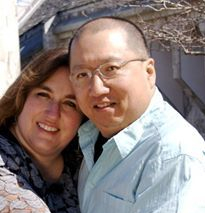
    Our engagement photo taken by Denise de la Foye, 2009.

    Now I have a confession to make. I am in a bi-racial marriage. Mine is not the first. It won’t be the last, but when we find such a thing among our ancestors it is not only a talking point, but often a source of contention. My husband was born in Hong Kong, China and came to the United States when he was just three months old. He grew up in the near suburbs of Chicago, and when people ask him what country he comes from, his answer is always the same, “The United States.” He grew up here. He knows nothing else, but unlike European Americans, his skin color and distinct facial features belie the fact that he was not born here. He goes by the distinctly Western name of Anthony, so when I tell people who have never met him that my husband is an immigrant and his name is Anthony (“Tony”), they nearly always say, “Oh, he’s Italian, right?” No.

    It seems pretty common for Chinese immigrants to take on an “American” identity when they come here. Most I have met go by names like David, Catherine, Alexander, and Marie. On his birth certificate, his name is Sai Fung, but on his naturalization papers, social security card, and other official documents, he has always been Anthony. We didn’t think anything of it until he brought his Illinois driver’s license into a Utah DMV to exchange for a new one. I was able to exchange mine within a matter of minutes. For Tony, it was a matter of months. Six years  and a move to Kentucky later, all of his legal documents identify him by a name no one but his siblings recognize. I blame xenophobia cloaked in our Patriot Act signed into law on my 36th birthday.

    As Tony was nearing the end of his legal paperwork nightmare, a casual encounter with a drunk man at a bus station revealed a side to Tony’s life that I had not yet seen or understood. The drunk man approached my husband, and said, “Fried rice on the side?” Giggling to himself, the man staggered off. It was not the first time my husband had encountered such ignorance, but it sure helped me understand Tony’s lament, “Sometimes I wish I was white.”

    We can’t deny that xenophobia exists all around us, and it would take willful blindness to claim that there is no racism in the midst of our families and ancestors. But we have to face it as it happens, and learn to acknowledge it. It is so easy to claim superiority based on the color of our skin and country of origin, but we must be wary as it happens to us. To be clear, my surname is Kwiatkowski, an obviously Polish name. As happened with the Italians in my father’s grade school, it would be just as easy to group together and claim racial superiority based on pure Polish blood. That is, until one encounters another who has had different experiences and sees life from a different narrowly appointed point of view.

    Yesterday, my dear cousin Bernie illustrated this point in a Facebook post quoting Thomas E. Watson, an American politician from Georgia. As Bernie pointed out, Watson is “Talking about [our mutual] ancestors from some hole* in Eastern Europe.
    *That would be Poland.”

    So here it is:

    “The scum of creation has been dumped on us. Some of our principal cities are more foreign than American. The most dangerous and corrupting horde of the Old World have invaded us. The vice and crime they planted in our midst are sickening and terrifying.” Thomas E. Watson, 1912

    It has not been my intent to preach or to politicize my family history. I simply want to create awareness. After events such as those in Charlottesville, West Virginia, last summer, I have become hyper-aware that xenophobia in the United States seethes barely beneath our surface.  We need a new way of looking at things, and I believe the best way to start is by acknowledging our mistakes of the past. We could also look to places, like Hawaii, that have managed to become true melting pots. As my cousin Ski explains, “Hang loose is an expression we use to say “Just chill, take it easy, there’s no need to rush” and it befits the island lifestyle.” We could learn a few things from the Hawaiians.

  • Cousin Connection #6: Hauʻoli Makahiki Hou (Happy New Year!)

    Cousin Connection #6: Hauʻoli Makahiki Hou (Happy New Year!)

    Aloha, Olean Kwiatkowskis! This marks the last of the Kwiatkowski Cousin Connections for a while. Time to focus on other branches of the family tree, especially Rothsprack; I’m completely stumped on that one. But first, let me introduce you to my Hawaiian cousins. I’ve got plenty of them, thanks to a cousin named Leo (or Leon, as he told it).

    While Cousins in New York experienced a typically white Christmas snuggled warmly at home away from outside temperatures well below freezing, cousins in Hawaii had temperatures right around 80 degrees fahrenheit.  A great day for some Christmas hula. And since the temperature won’t be changing much this weekend, I’m betting plenty more hula is planned for the New Year as well, even if the Hawaii Kwiatkowskis don’t plan to attend.

    Michael Thaddeus “Tod” Kwiatkowski, and Philibert Francis “Ski” Kwiatkowski are respectively the oldest and youngest of five children born to Leo Michael Kwiatkowski and his wife Catherine Ku’uleilani Guerreiro in Honolulu. Although they are in my father’s social generation, the three men have never met in person. All five of  Catherine and Leo’s children were born in Hawaii, and Dad had moved from Olean before the cousins from HI visited in 1952.

    My first question to both Tod and Ski, was “How did this group of Kwiatkowskis end up in Hawaii?” The answer is pretty simple, really: the U.S. Army. As Tod tells it,

    My father joined the Army and was shipped to Honolulu, sometime in 1935, or so. There, he met my mother, Catherine Ku’uleilani Guerreiro of Waialua, Territory of Hawaii. They were married in 1937, I think, and he mustered out of the Army in Honolulu, rather than mustering out in New York.”

    Catherine Ku’uleilani Guerreiro and Leo Michael Kwiatkowski.jpg
    Catherine Ku’uleilani Guerreiro and Leon Kwiatkowski as they must have looked when they first met.

    All five of Leo and Catherine’s children were born on the “Big Island” (Honolulu), except for a very short stint in 1952 after Catherine died. She was just 43 years old. It was a very rough time for the family. Tod explains,

    Hawaii Kwiatkowskis c1952
    Circa 1950 or 1951. L-R: Bernadette, Phil (“Ski”), Tod, Noel, and Larry.

    We saw our first snowfall in Olean, on October 12, 1952. Because of the burden five children placed on my grandmother and my Aunt Jenny, we all returned to Hawaii sometime in October or November of 1952. That was a tragic and confusing time for five children, ages 14 to 5, and a single Father with no job, and no income. That episode will fill a book.

    Because he was so young at the time. Ski has a more colorful memory of his short time in New York:

    Family connections to the mainland U.S. Kwiatkowskis that lived in Olean, N.Y. are very sketchy for me. . .  I was 5 at the time and remember meeting many cousins, uncles and aunts, but most of them faded from memory aside from photographs that we would get from time to time.  I remember “Bu” quite well and my dad’s sister, Aunt Jenny.  My dad’s brother, John and his other sister Helen I also remember.  I remember Olean as a very typical foothill town of East New York state, not a large town, but a quaint one  with all the trappings of a 1950’s town.  I remember going down to the “crick” near the railroad trestle to skip stones in the water and things like that, but for the most part, faded memories.

    We stayed about 3 months on that trip as we were planning to live in Olean.  Many obstacles came up, one of which was racial and the others I was too young to remember.  My experiences in St. Augustine Elementary were different than Michael as I was sent home for punching a ninny of a nun because she wanted to whack my hands.  I was having none of that, so I punched her in the stomach.  That was the beginning of a few lickings.

    I got a kick out of that last part. My father’s stories of his childhood in Olean are very similar. The family was staunchly Catholic, but that didn’t stop kids from being kids and nuns from doing what nuns did at the time. I went to public school myself, but my father and husband were both raised Catholic, along with several of my friends. All of their stories have a very similar ring to them. One of these days I’ll have to tell the story of the time my husband and his schoolmates spiked the holy water with red Kool-Aid.

    Ukulele by Ski
    A ukulele in the making. By Ski Kwiatkowski

    Now that I know the reasons for the Hawaii cousins remaining in Hawaii, it makes sense. By their Hawaiian heritage bestowed by their mother, these Kwiatkowskis are firmly Hawaiian. Hawaii was the last state to join the Union in 1959, long after the children’s return from their last family trip to the mainland. Ski, who is the youngest, has been making traditional Hawaiian woodwork for many years. He even makes ukuleles.

    As a mainlander who’s never been to Hawaii, I can only base my knowledge of Hawaiians on what I’ve learned through school and the media. Which isn’t much. Aside from my new-found cousins, Pearl Harbor is always the first thing that comes to mind when thinking of Hawaii, and since their father came to the islands with the U.S. Army, I had to ask.

    Ski was very obliging with details.

    My dad told it to me that he was home when the attack on Pearl Harbor began.  He was a policeman and we did not have a phone yet so the police department called the neighbor (the contact number) neighbor told him about the attack and to go immediately to the police headquarters.  When he got there, he and one other officer were given a shotgun each and a box of shells and told to report to the area somewhere near an area called Iwilei.  Up the street from them was the OR & L train depot and roundhouse, but they were told to go to the pier and supposedly hold off any Japanese invasion of the harbor with a shotgun apiece, a box of shells and their .38 caliber service revolvers.  Once at the pier my dad recalled a Zero coming in on them and strafing the pier with bullets.  He said that it was close enough that splinters from the wood were hitting them.  It was at that time that he and his partner decided they would be better protected by staging at the OR&L depot, which they did.  There were several more strafing runs in that area and my dad said that he emptied his revolver on one Zero, but knew that it was like shooting spitballs at a tank.

    At least he got to shoot at them, which is more than others did.

    Tod provided another interesting Hawaiian link to the Olean Kwiatkowskis. It turns out that my cousin Bernie’s uncle, Bernie, was brother not only to Bernie’s mother, but Leo as well, which makes their Cousin Connection chart nearly identical to Bernie’s. Not only that, but it seems that Leo’s brother spent some time in the island as a sergeant in the Army Air Corps while Leo was on the Honolulu police force.


    So now I have even more questions for Bernie, Tod, and Ski. I definitely want to ask about “Uncle Bernie’s” Pearl Harbor experience, so I’ll have to plan a new post for next Dec. 7.

    Even more curious for me, though, is that all three cousins claim that their grandmother’s maiden name (“Babci Mary“), Conkle, actually derives from the surname Krysztofiak.  Conkle is a Germanic surname, but Krysztofiak is definitely Slavic. So which is it, Conkle or Krystofiak? The geographical boundaries are blurred in Poland and Germany by the rise and fall of the Prussian empire, and I think there may be some answers in the geography. This is going to take a bit of digging, but I’ve got eleven months to do it. It will be fun to see what I come up with.

    In the meantime, Happy New Year, and STAY WARM! (Hawaii Cousins can ignore that last part.)


  • Cousin Connection #5: Family Lost and Found

    Cousin Connection #5: Family Lost and Found

    In honor of Mexico’s Dia de los Muertos (Day of the Dead), which officially begins at midnight, November’s Cousin Connection comes one day early. Coinciding with the the Catholic All Saints Day, and incorporating garish costumes resembling skeletons, Dia de los Muertos is not Mexican Halloween, but a much more elaborate version of Memorial Day in the U.S.

    In Mexico, this year’s commemoration began a few days ago with a large parade including a salute to rescue workers who worked tirelessly to save family, friends, and fellow countrymen from the rubble of recent earthquakes.

    When Pete, a Mexican friend from college, entered a Facebook post celebrating his recent connection to cousins he never knew he had, I decided that this week’s holiday is the perfect time to include it.


    Pete tells his own story:

    I have become obsessed with making a family tree. It did not just happen out of nowhere. It started when I submitted my son’s DNA to Ancestry.com. I wanted to show him his multi-ethnic background. We were not disappointed. He is from all over the world–every continent except Antarctica and Australia.

    Ancestry told us that he is mostly Native American from the area of Zacatecas and Aguacalientes. His ethnicity estimate is also 24% Great Britain with Western Europe, the Iberian Peninsula, Scandinavia, Ireland, Finland, European Jewish, Polynesia, the Middle East, Senegal, and Africa North all vying for a slice of the genetic pie.

    But this smorgasbord of the world is not what compelled me to create a family tree. It was a feature of Ancestry that I did not expect. Our DNA was matched with other people who submitted their DNA with Ancestry.

    There was a small group of people who were listed as close relatives. Some of these were easy to figure out. They were: a sister of my wife, a first cousin of my wife and his daughter, and a first cousin of my son. Then, there was a man and a woman who had a majority of Native American ethnicity in their report. They had to be related to my side.

    But how?

    My father was the only member of his family who came to this country. That was in 1948. How could he have close relatives in this country? My mother was raised as an only child. I was the only Mexican in the world who did not have a cousin, an uncle, or an aunt. We held our family reunions inside a closet. But, on the bright side, there were more tamales for us during the holidays. We did not have to share them with relatives.

    But who are these people that Ancestry claims are closely related to my family?

    Did my father stray, and now the evidence is coming back Maury Povich style to say that “The DNA evidence is in, you are the father?” Did my mother’s parents have a secret child? Did I have a close relative from Mexico who came unannounced to Chicago in the 1930s?

    I did some research and found that these two people listed on Ancestry are from Chicago. One was 73 years old. The other was in her 20s.

    The older man eliminated my father. My father was not here 73 years ago. He was still in Mexico.

    Was my mother’s lingering doubt that her parents are not her biological parents more than a doubt? Could she be related to this 73 year-old man?

    I found records for the younger woman. She had been arrested a couple of times in her early 20s. We have to be related and share the arrested development gene. My line has proven that this gene exists. It lingered in me into my twenties.

    She lives in a northern suburb of Chicago. The older man lived in an adjacent suburb. They lived near each other.

    I went to Facebook. I found a connection between the two people. I began to develop a hypothesis. These were the biological relatives of my mother, who was adopted in 1934. Now, I need to apply science to prove my hypothesis. I need evidence.

    I sent messages via Ancestry to both people. I did not receive a response. I tried again. I received the same result-no reply.

    I began to create my tree. I spent about 200 hours in September researching for my tree. September is our month off for home school. I needed to make progress and uncover these connections in one month before I started in October with Geometry, U.S. Government, Spanish, and Language Arts for my 13-year-old son. He takes three other classes in the regular school system.

    I was obsessed. I searched every clue. I looked under every rock. Researching my family is not an easy thing. My name is not Gonzalez. Anyone researching my family will come to an instant dead end.

    Our real family name may go back only a few generations. It may not be our real family name. Family legend has it that someone in the family line helped a gang rob a Zacatecas silver mine payroll. He then disappeared into another Mexican state with a new name and a richer, new life. I found nothing to prove or disprove that legend.

    I did hit a dead end with the family lineage in the mid 19th century.

    If my mother was adopted then there is another instant dead end. Could these two people be the key to answering the question about my mother’s biological parents?

    Maybe my mother was not adopted although I have always believed in that theory. My grandparents resemble no one in my family. None of them look like any of the ensuing offspring. I look like my dad. My son, Pete, looks like me.

    Did I really want to go down this road?

    In my mind, my grandparents will always be my grandparents no matter what I find out. My grandmother, in her late-60s, would take her rug muffin [sic] grandchildren to the movies and to the 12th Street beach. She had a folding chair, and she would sit and wait with us at the Roosevelt Street bus stop. She did a lot for us.

    I loved swimming in the 12th Street Beach. I never would have had that experience if not for my grandmother. She cared about us.

    I loved the movies except for a horror movie that was in Spanish. I was afraid for about a week after watching it. I was about six years old.

    She fed us when we visited her apartment down the street on Peoria. She fed me my first jalapeno when I was about five. She and her husband laughed about it. It was a rite of passage, and one of my dearest memories of them. She was performing an important ritual. I cannot live without jalapenos and spicy foods.

    I searched census forms from the 1930s, line by line, of every residence in the Taylor Street area. I looked at immigration records, marriage records, death records, and I sent out a few smoke signals and gave offerings of fried bread and jalapenos to the family tree gods.

    I made flowcharts comparing the DNA evidence and the relationship between these two people and me. I developed a hypothesis that the older man had to be either the first cousin of my mother or her brother.

    I hit dead ends in my search for more information. I felt hesitant to call to contact the man. What does one say?

    “I think that your mother or your aunt gave up your older sister/cousin for adoption. I have no evidence, it is just a hunch.”

    I do not think so.

    There was one other person who was listed as a close relative. She had a family tree with about 3,000 people listed on it, but it was private. I contacted her and asked for permission to look at her extensive family tree. I explained that we probably shared a common ancestor from one hundred years ago. I was hoping that her family tree would provide some vital clues to help me determine how we are related. She granted me permission, but she added that she doubted if we were related. She said that she had no Gonzalez in her tree.

    Neither did I.

    Looking at her tree was an eye opener. I immediately found a link between her and the two people who are closely related to me. I asked her about the two. One was the granddaughter of her aunt. The other, the 73 year-old man, was her first cousin.

    Let’s call her aunt Aunt Zuzu.

    If he was my mother’s first cousin, then this woman with the family tree was also my mother’s first cousin. I was on the right track.

    She said that all her family lived in the Taylor Street area. She was not sure if we were related.

    Her grandparents had one daughter who possibly could have been the mother of my mother. All the DNA evidence would fit if she was. There were two daughters who possibly could be the biological mother of my mother. One was pregnant with another child when my mother was born. It could not be her. The other would have been 14 when she was pregnant with my mother. I think it was this teen who gave birth to my mother.

    I asked my mother if she knew this Aunt Zuzu. My mother’s voice picked up with excitement when she heard Zuzu’s name. She said that Zuzu was her cousin.

    Cousin? But she had no relatives in Chicago. How could she be related? She said that my grandmother wanted her to address Zuzu as her cousin Zuzu and to call Zuzu’s mother dia Maria.

    I asked her the name of Zuzu’s mother. She answered. It was the exact name of the mother of the person who I hypothesized was the biological mother of my mother. Dia Maria most likely was my mother’s grandmother.

    It was a tangled web.

    Zuzu’s mother was a close friend of my grandmother. Who else would you trust with your grandchild but your good, trusted friend?

    It made sense. Was Aunt Zuzu my mother’s biological aunt? Was her sister the teen who gave up her daughter, my mother, for adoption? It was during the Great Depression. She came from a large family. She was only 14 when she became pregnant.

    Was I solving this puzzle that I thought was unsolvable? I had thought that anyone who would know the truth about my mother was long deceased. But here I am, on the cusp of putting in the last few pieces of this puzzle.

    Her mother was right there all the time. It was the older sister of her friend, Zuzu.

    The owner of the huge family tree confirmed that her aunt had given up her child for adoption. She had heard that family story.

    My mother is 83.

    Her parents will always be her parents.

    She finally found out the truth and received the answer to her doubt. It all fell into place like it was preordained. We were meant to know the truth while she was still alive.

    In her last response. the woman with the huge family tree addressed the message to cousin Pete. I smiled when I read it.

    I finally have a cousin. I am no longer the only Mexican in the world sin primos.

  • Are You My Cousin?

    Are You My Cousin?

    Stories From the Past is proud to present The Cousin Connection Project.

    I grew up without cousins. Well, I did have cousins. I knew I had cousins. I had even met three of them. But I didn’t know them well, and I didn’t even live in the same state as any of them. I was well into my 40s by the time I started getting to know the rest of my cousins, and I still haven’t met most of them in person.

    I met my midwestern cousins on my mother’s side when I moved to Chicago for graduate school. As I sat at Thanksgiving dinner with all those first cousins trying to figure out how my children were related to them and how our children were related to each other, my cousin Allen patiently explained the differences between first, second, third cousins, etc., and the numbers of removal. It was a bit confusing, but I retained enough of the information that I felt comfortable in exploring cousin relationships to others.

    in search of myself

    Thanks to Facebook, I have been able to connect with even more cousins I have never met in person. With their cooperation, I am getting to know them better one blog post at a time. When my newly discovered cousin Bernie posted a family recipe on Facebook, I decided the recipe would make a great blog post. I felt that I should also identify just how we were related, so with Bernie’s cooperation, and using Allen’s “formula” I created a chart showing my newly discovered relationship. Bernie was great, and the post was so personally rewarding that I offered to do it for all of my cousins on Facebook.

    Between Bernie’s post and my next cousin post, I was contacted by a complete stranger named Diedre in Michigan. Diedre gave me some information indicating that we have common ancestors from early colonial America and the Netherlands (AKA Holland at the time). Much of Diedre’s information pointed to a probable family connection by removals with an old family friend in Utah. I could see that I could easily make cousin connections throughout the United States on a regular basis by connecting through common ancestors. I’ll go more into detail about those common ancestors in another cousin connection post, but suffice it to say I can see that I have plenty to keep busy.

    Thanks to my U.S. immigrant ancestors, and the cousins I’ve already connected with, I can connect with my past in a completely new and exciting way. Next week I’m connecting with another New York cousin, our family genealogy expert, John Woodgie. After that, Diedre, and I still have plenty of ideas to keep me going well into the new year. This is very rewarding for me, so I am creating a database for these cousin connections, and I am calling it The Cousin Connection Project.

    The Cousin Connection Project uses a surname and location database of most ancestors I have been able to identify.  The database is organized alphabetically by surname, and should be pretty easy to identify links to common ancestors. If you come across a name, location, and date range that matches names, locations, and date ranges in your own family tree, you can contact me for a free consultation and a possible cousin connection post showing your relationship to me.

    I am also including separate databases for Mary Davis Skeen and any other family lines for other historical biographies I decide to tackle in the future. The separate databases will make it easier to identify your own personal relation to other bygone figures. I have already checked Mary Davis and her husband William Skeen (who was from Pennsylvania), against my own family tree, and I have no reason at all to believe that there is a connection to myself (so far).

    As the connections grow, I plan to include links to stories, recipes, and family traditions. This is exciting for me, a person who grew up without knowing most of my extended family, including three of my grandparents and most of my first cousins. Where before I felt that I had almost no extended family, suddenly the world is becoming my family. I know that we have often been told that the family of humankind is all related. Some of those estimates claim that we are related by as little as sixth cousins. Other, more scientific endeavors claim that everyone on the earth is related by at least fiftieth cousins. I don’t know how much truth there is to that claim, but I am pretty sure that I am related to enough amateur genealogists to keep my Cousin Connection Project alive for as long as I want to pursue it. Here’s to getting to know you!

  • Cousin Connection #2 My Cousin Married My Cousin

    Cousin Connection #2 My Cousin Married My Cousin

    This isn’t a William Faulkner novel, it’s reality. It’s also not like it sounds. When your family has deep roots in the same area where you were born and raised, it’s bound to happen, and it doesn’t take much digging to find family members marrying family members.  They probably don’t even know they were doing it.

    This case is different because my cousin on my grandfather’s side, married a cousin from my grandmother’s side. They are not related at all to each other, but it’s not totally coincidental that it happened. All of my New York cousins come from my great-great grandfather who was born in Poland. Their roots are not nearly as deep in American soil, and they know who most of them are, so the chances of marrying one of the Kwiatkowski cousins are pretty remote. My grandmother’s genealogy can be traced well into pre-revolutionary America though. They settled in Pennsylvania, a wild and untamed frontier, approximately two generations before my Chuck’s grandfather and my great-grandfather arrived with their parents from Poland.  (more…)

  • Places to Go and People to See

    Places to Go and People to See

    Four months ago, I began making plans to revive this blog. I began reorganizing my schedule, but just one week later, my plans were thwarted by the news that we were moving back across the country for my husband’s job. He had about two weeks’ notice, which meant he had to fly out and get started looking for a place in Kentucky immediately. I was the lucky one who got the job of managing the logistics of moving the whole household, including my daughter and granddaughter. (more…)

  • Babci Mary’s Polish Soup

    Babci Mary’s Polish Soup

    Happy Mother’s day!

    Okay; Mary is not my grandmother. In fact, we’re only related by marriage. Since I came across the existence of Babci Mary from a cousin I’ve never met in person, I decided that this would be a great opportunity to get to know my cousin. By proxy, I’ve gotten to know my own family better.

    1917 Kwiatkowski Joannes Mary children and possibly Michael
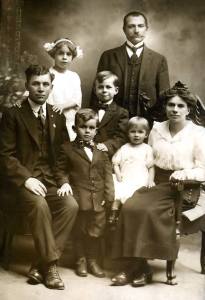
    “Babci” Mary is the beautiful woman seated to the far right. Bernie’s mother is the little blonde seated next to her; his grandfather Joannes “John” is seated on the left. We have speculated that the man standing on the right is my great-grandfather Michael. Michael and Joannes were brothers.

    Babci is a Polish word meaning grandmother. It is pronounced bob-chee with the emphasis on the last syllable, making the last consonant in the first syllable sound more like p. 

    I met my cousin Bernie on Facebook when I started this blog. Hoping to connect with other family researchers, I created a companion Stories From the Past Facebook group. Many researchers have joined the group, along with friends and childhood classmates. Thanks to my father’s familial connections on Facebook, I was further connected to many cousins from Southwestern New York and Northwestern Pennsylvania. Bernie is one of those cousins. (more…)