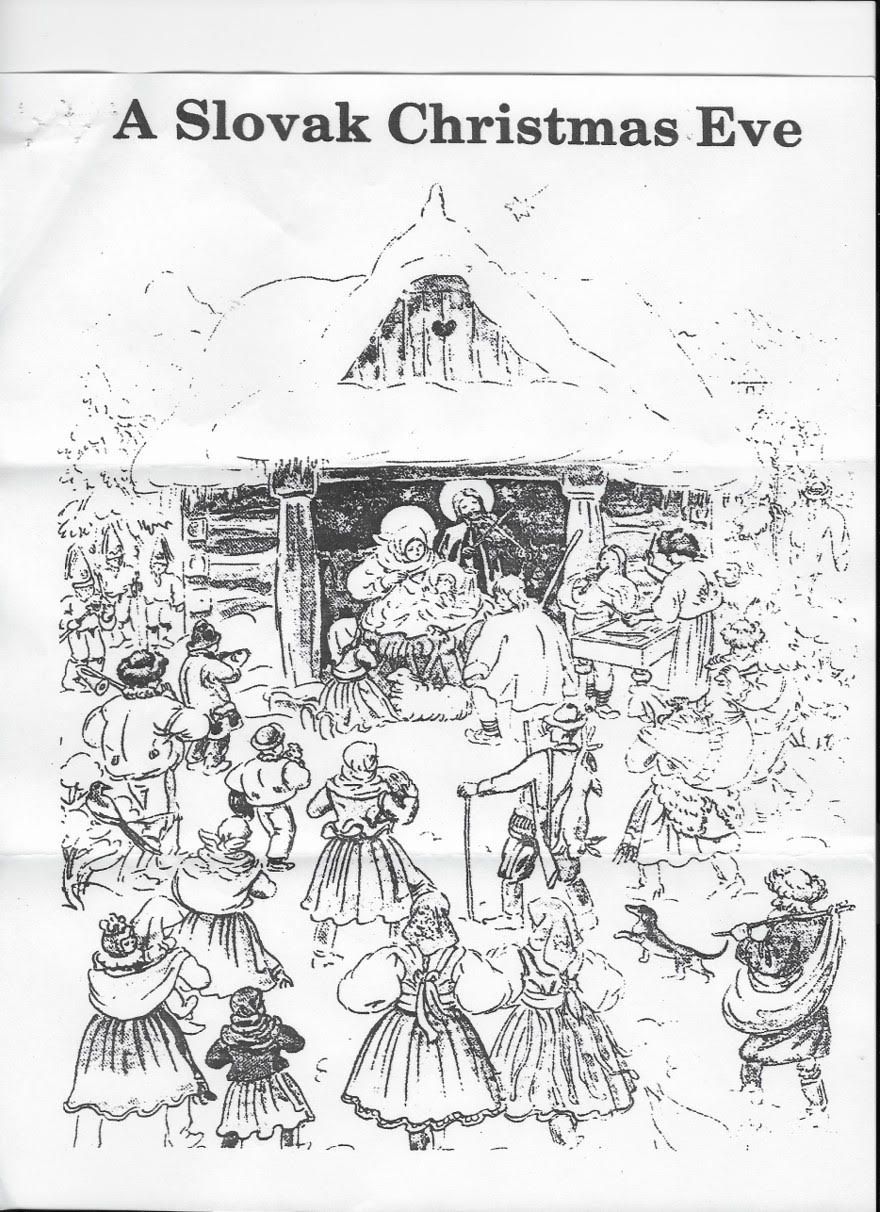
Today’s Christmas Eve tradition and recipe contributor and friend of mine, just happens to have been one of my professors at DePaul University in Chicago. At first I was surprised to learn that Gloria Simo and I have so much in common. After learning her family’s story, I am even more surprised to learn the reason for our commonalities.
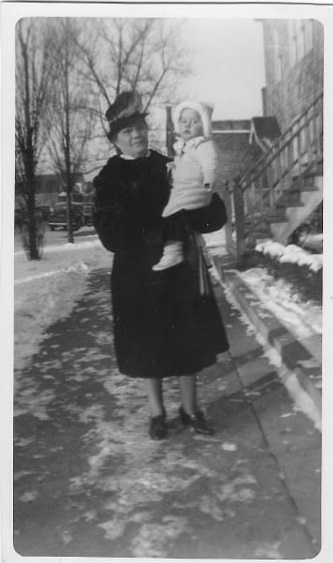
First, our grandmothers. Although they were born in different countries, they grew up less than 80 miles from each other. Both of them left their childhood homes at young ages and immigrated by boat to the United States alone. Josephine Daniel, my Grandma, was 21 and Anna Vitek, Gloria’s grandmother was just 16. Anna was just three years older than Josephine, they immigrated within eight years of each other, and both married fellow immigrants they met here in the United States. Josephine was raised Jewish in Austria, but she became a practicing Lutheran when she married my grandfather. Anna was also Lutheran, married to a man named John Stancik.
Anna Vitek Stancik with her granddaughter, Gloria Simo
Next, our genealogical origins. Anna was born and raised in Bratislava, Czechoslovakia. Today, Bratislava is the capital city of Slovakia. Josephine’s great-grandfather was a well-known rabbi from Pressburg, Austria-Hungary, the very same city known as Bratislava, Slovakia today. It is very likely that Josephine’s grandfather, my second great-grandfather, was born in Pressburg. I have Slavic roots as well on my Polish grandfather’s side.
Coincidence? Yeah, probably. But when Gloria described her family’s Christmas Eve meal, I said, “That sounds like something my mom used to make!” Well, we at least shared similar dietary preferences. I grew up on Polish and Austrian food. Slovakia is bordered by Poland to the North and Austria to the West. Naturally, they shared similar dinner menus.
It was the meal that featured so prominently in Gloria’s recollection of childhood:
One Christmas Eve meal tradition sticks in my head and was followed by almost every family in our small Lutheran Slovak congregation. And we wouldn’t dream of missing it. The matriarch of each family made a kind of stew of sauerkraut, pork ribs, Polish :sausage, potatoes, prunes, etc (I think whatever Grandma decided on) and paired it with honey/poppyseed biscuits. Before the meal we broke a communion like wafer called Oplatky smeared with honey and shared it around the table while saying grace. After the meal we went to candlelight services – where we knew everyone had just had the same meal – and then out Christmas caroling.
The “stew” Gloria describes is called Kapustnica, and is almost identical to a Polish dish called Bigos, or Hunter’s Stew. Trust me, it’s delicious. I have been thinking that I might want to get ambitious and start making it as part of our Christmas Eve tradition before we go to midnight mass (a Catholic tradition). Oplatky is also a Polish-Catholic tradition.
Click here for the Slavic recipe (Kapustnica), or here for the Polish version (Bigos). I think you’ll see they are quite similar!
Gloria also sent recipes along with detailed instructions for celebrating in the Slovak tradition. I will post them on their own page in the coming weeks. If you’d like to have a copy sooner, please contact me here.
That lean Christmas in a 19-foot travel trailer was a tough one for me, but it was great preparation for the next Christmas. The trailer was a temporary fix for my family, and even though we called it “home” for less than a year, it seemed like an eternity at the time. In the first few weeks, Mom and Dad slept on the sofa which folded out to a full-sized bed, while two of my brothers slept in a drop-down bunk that acted as a storage cupboard in its “up” position. Both of those beds were not quite full-sized, but they weren’t exactly cramped.
My sister and I, however, shared the bed over the drop-down dining table. It was not quite as wide as a twin bed, and yes, it was cramped; there was literally no room to roll over. But my four year-old brother had just a thin strip of foam laid down on the floor. He had it the worst. If anyone wanted to get to the bathroom near the entrance of the trailer at night, they would have to step over him (assuming they hadn’t already stepped on him).
As it was, Mom and Dad only stayed in the trailer long enough for Dad to put a lid of sorts over the cement foundation. It was to be quite a large home in its finished state, so the basement level functioned as a storage unit/work shed, with a corner sectioned off as a master bedroom of sorts. If I remember correctly, Mom kept the bed covered with plastic sheeting in an attempt to keep the sawdust out of the sheets. During that summer, Dad worked hard to get the upper floors framed in. He ran a power line from a transformer to the trailer and another to the house in order to keep an upright freezer and an old refrigerator running. Extension cords fed a work light and power tools, and we made a weekly drive to the nearest laundromat fifteen miles away . A laundry room and a bathroom with a full-sized tub were the first rooms finished.
By fall, the roof trusses were up and covered over with plywood and tar paper, and insulation in the form of shredded, recycled, fire retarded newspaper particles filled the walls. It was the best insulation to be found at the time, the wall studs were covered and it was blown into the walls through a layer of plastic. It was one of the very few projects on the house that Dad contracted out, and my brothers helped with most projects calling for more than two hands. This tough task was compounded by the fact that Dad was working a full-time job and functioning as a bishop in our local ward of the Church of Jesus Christ of Latter-day Saints. If Dad wasn’t at his paid job, he could be found attending meetings with church leaders or counseling church members. In his spare time, Friday evenings and Saturdays, he worked on the house. I’m amazed he got so much done during that first year.
As it was, there were still no windows installed and the roof shingles had not yet been laid on the roof as October neared its close. That fall, Dad spent nearly every waking moment either harnessed to the steeply pitched A-frame roof or installing windows. There would be no sitting down for a family meal during those weeks. Mom would often bring Dad’s dinner to him while he worked. He even tried working on the house one Sunday, but ran a two-by-four through a newly installed window as he was cleaning up the next Sunday. Dad never, ever, worked on a Sunday again after that, but he still managed to get the house fully closed in before the winter snow began to collect. Thankfully, Christmas of 1974 would be white.
America’s Problems get Personal
1974 was a tough year world-wide, but it was even tougher in the United States than in most nations. In response to its support of Israel during the 1973 Yom Kippur War, the United States was banned from oil trades with the world’s oil producing nations (OPEC). By the year’s end, As the country using the largest percentage of the world’s fossil fuel resources, the oil embargo hit hard, causing fuel prices to quadruple, followed by increased prices on imported products, including anything that could not be produced locally. Adding insult to injury, President of the U.S. Richard Nixon, resigned his position amidst allegations of White House involvement in a break-in of Democratic headquarters during an election year. To this day, Nixon is the only U.S. president to voluntarily resign, adding political upheaval to the nation’s deepening economic woes.
To avoid fuel shortages, people were asked to drive only when necessary. We lived a mile uphill from the nearest neighbor, five miles from church, ten miles to school and the nearest grocery store, and more than fifteen miles to work. Walking was out of the question.
Families across the United States were tightening their belts, including ours. Because of the increased strain on the family’s resources, Mom got a job working at a workshop/school for disabled adults. That really helped, and thanks to her, the building project was moving along as quickly as could be expected under the existing conditions. What wasn’t expected was the loss of Dad’s job in December. If last year’s Christmas was lean, this year’s would be worse.
Well, at least we had snow.
I’m Dreaming of Any Kind of Christmas
I had finally reconciled with Santa’s fall from Christmas grace, and I figured that nothing could be worse than the binder paper Christmas. The trailer had been moved closer to the basement entrance, and Dad’s tools and building materials went to to the second floor. With windows and insulation added, Mom and Dad’s “bedroom” was moved to it’s permanent home on the third floor despite the lack of carpeting, painted walls, or electrical amenities. Now there was plenty of room on the basement level for a dining/living area. We no longer had to use the trailer for bathroom purposes, and we could actually sit on a full-sized sofa and watch whatever channel might be getting reception on our thirteen-inch black and white television set.
It also meant room for a real Christmas tree. I didn’t care about presents, but I couldn’t face another year without a real tree. Apparently Mom felt the same way.
Mom’s Side of the Story
The only good news coming from Dad’s Christmastime lay-off was that he now had much more time to work on the house. Despite her meager salary, or perhaps to spite it, Mom felt the burden of Christmas falling directly upon her shoulders. Dad took a practical approach–stuff like this happens, and the world would not end without a tree or presents. His focus was on keeping a roof, unfinished as it was, over our heads, and getting a new job as quickly as possible so he could get everything under that roof finished.
Mom wasn’t quite so pragmatic about it.
Mom is the most creative person I know. If it’s too expensive or cheaply made, she figures out a way to create a better home-made version. The first thing Mom did was cut down a four-foot juniper tree from our six-acre property. It wasn’t the traditional fir tree we were used to, it had a fuzzy trunk, and it didn’t have that familiar Christmas tree smell. In addition, it was short. But it was still an evergreen, very nicely shaped, not school bus yellow, and it fit perfectly beneath the open staircase. I was thrilled. We had a Christmas tree.
Mom must have garnered a lot of trust at her job, because her boss gave her unlimited use of the scrap bins and let her use the shop’s power tools after hours. Mom made wooden ornaments in various shapes and drilled holes for red yarn. They looked so cute on the tree. She also gathered up some nice round branches from other trees on our property, and cut them into evenly shaped pieces. Using scraps of lumber from the building project and her workshop scraps, she built three sturdy lumber trucks–just as good or better than can be found in vintage toy shops today. I am not at all sure what my brothers thought of them, but I thought they were amazing. I’m pretty sure Dad helped some with that project, but I was impressed to learn that my mom actually had woodworking skills.
Woodwork wasn’t the only thing mom was good at. In her adolescence, She learned to sew; and from a very young age, she sewed her own clothes. She made her own wedding dress, and when I got married the first time, she remade it for me. I was aware of a stigma that came with having homemade clothes versus store-bought clothes, but I never worried about it. If mom could find nice affordable fabric, she could make any clothing look better than its commercial counterpart. That year, Mom made fabric dolls for my older sister and I, and although I no longer played with dolls, I thought mine would make a nice decoration when I finally moved in to my new bedroom.
There wasn’t much in the way of Christmas baking that year but there was one tradition Mom was determined that we would not go without–Stollen and hot cocoa. Stollen is a German sweet bread made with nuts, spices, and dried or candied fruit, coated with confectioner’s sugar icing. As the daughter of an authentic German baker, it just wouldn’t be Christmas without it. I don’t know how she managed to get all of the ingredients, and she does say that she knows the bread went without the usual, albeit expensive, pine-nuts, but I know I didn’t notice.
Love–The Best Gift of All
Along with wooden trucks and rag dolls, mom made a new pair of pajamas for each of us. I think, though, that most dazzling was the wide array of treats and trinkets to be found in our stockings. Mom said she scrounged around everywhere to find cool things to fill them up. My favorite gift that year came from a local automotive shop–a transistor radio that bore an uncanny resemblance to a car battery. It worked great, and even though I was no car enthusiast, I truly loved it.
My favorite gift in 1974. Not as tacky as a leg lamp.
When I asked Mom about that Christmas, she told me that year was such a hard one for her that she had forgotten much of it. She suffered so much angst that year, and I know we felt it, but I’m still so amazed at what she was able to pull off. It simply hadn’t occurred to me that it was the worst Christmas in her memory. Looking back at my own motherhood though, especially as a single mother, I now realize that tough times are difficult for kids, but they are always toughest on the parents because we worry that we cannot give our children so many of the things they need, and that at the very least, their innocence will be lost in the process.
Until I started writing this story it hadn’t even occurred to me that my two younger brothers would have had to come to terms with the man in the red suit that year. The youngest would have been just five or six years old at the time. If either of them believed in Santa before that year, they certainly would not have afterwards. I didn’t bother to ask for anything, and if my younger brothers asked, they definitely didn’t ask for wooden logging trucks. For me, the magic I had lost in the abrupt revelation that there is no Santa two years earlier had returned. For my brothers, the magic was definitely changing.
Lessons Learned
Christmas can be magical for children, but it’s not about Santa Claus or about the gifts we get. It’s about love and giving. There is no greater love than that of a parent to a child, and there is no better gift than one that comes from the heart. Homemade gifts are thoughtful gifts, and everyone knows it’s the thought that counts. Mom never stopped thinking in December of 1974. That Christmas was filled with so much love that I didn’t care weather or not we had eggnog for the New Year. I wasn’t thinking of what we had to do without, but of our fortune in being able to have the things that we had.
Dad found a new job by the next fall, and the next Christmas was celebrated in a nearly completed home. Dad received a huge Christmas bonus in thanks for helping his new boss maintain the trust of a very important client. It was big enough that we were able to help out two other families for Christmas. Gifts were more than plentiful, and we even had our very first full-sized color television set. But the most appreciated presents, once again, were the handmade ones from Mom.
I still have two wooden ornaments from that year– a star and an A-frame house. The star remains in its unpainted form just as it was that Christmas, but the little wooden house, along with many of those ornaments from the Christmas of 1974, is tole-painted to resemble an Austrian style chalet (painting–another one of my mother’s many talents). Mom had managed to capture the image of our mountain home in that ornament, and in the other, the true spirit of Christmas. I normally include them in my annual decorations, but after our cross-country move, and last summer’s bout of bed bugs, the ornaments have accidentally been relocated to a storage unit, and I haven’t yet gone to retrieve them. I’ll add a photo of them as soon as I am able.
It’s been more than a decade since I celebrated with a real Christmas tree, and these days I don’t even bother with a full-sized tree. Now I have a Christmas tree collection. I display miniature trees everywhere, and every year I add to it, knowing that no matter how lean the celebration, there will always be trees.
Before I moved to Page Arizona, I always thought the traditional Diné (Navajo) greeting was pronounced Yah-ta-hey.
Someone just smack me.
I came by it honestly, I guess. I learned my lousy pronunciation from the Brady Bunch. Sorry, folks, it was the only point of reference I had at the time.
I quickly learned, though, that pronunciation wasn’t the only thing I was struggling with. I had confusedly assumed, as I bet you do too, that Hello and Yá’át’ééh meant the same thing.
Well, they don’t.
First of all, hello is little more than a holler. You may have even guessed correctly that hello is actually a derivation of holler. But yá’át’ééh is a lot warmer and fuzzier than that. The greeting is an equalizer–a recognition that you approach your fellow human being with good intentions, and that you expect the same from them. The actual meaning of the term is it is good. As it was explained to me: it is good between us. So now that we have set the expectation, we can converse without animosity.
I love it.
Now back to pronunciation
It’s a good thing I listened a few times and actually asked someone to help me pronounce the word before I tried it on my students from the rez. As it was, I absolutely butchered it, but I am getting better at it, even though I now live in Kentucky and have absolutely no one to try it on.
As I was struggling to figure out how to help my grandchildren learn Dinè terms correctly, I ran across this awesome website called Navajo WOTD (word of the day). I’ll be using it a lot as I explain what I have learned about the Dinè language and culture.
It turns out that yá’át’ééh is two short syllables and one long one. Emphasis on the first and last. Take a listen:
Now say it again. Keep trying ’til you get it right. I think it’s gonna take me forever, but I’ll bet those smart grandkids of mine will get it right.
For the sake of those awesome grandkids, I’m gonna keep at it, so that as I learn, they can learn about their Diné grandmother and their family from the rez. Maybe one day they will be able to go back and actually put their native language to the test.
What does Brody have to do with this?
I knew you were gonna ask that.
I have decided that in honor of my grandchildren’s Native American heritage, I would post a story or fact to help them learn about, and to appreciate, their native ancestors on or near their birthdays, and it just so happens that today is Brody’s fourth birthday.
One thing that everyone said when they saw that big boy with piles of dark hair is that he looks like a little Navajo boy. I said it too. Because he is.
So Happy Birthday, Brody! I love you lots, and I can’t wait to practice this with you!
Like my previous newsletter, this is more for my benefit than anyone else (I’m still practicing).
Before I get this party started, I need to point out that today is the second day of Hanukkah! For Jews, this party is already well underway. Happy Hanukkah everyone!
November did not go as I planned. I started off gung-ho, but by the end of the month I was off track, and missed my most important post: Chapter One of The Second Wife’s Story. All I can say is hooray for a new month!
Maybe the holiday season was not the best time to be reviving and preparing for a relaunch of Stories From the Past. Maybe I should have started off slower. I could probably blame my missing first chapter of The Second Wife’s Story on the flu that I caught immediately after Thanksgiving. Or just maybe I could say, Well, I’m not quite there yet; take a closer look at where I went wrong, and start fresh.
So without any more excuses, and remembering that every day is a clean slate, I can take a look at the past, see where I went wrong, and try again.
Habit Building
As I think about the month of December, and my plans for the New Year, I am reminded that I am building new habits for the rest of my life. Habits don’t change overnight, and I have to be patient and not take on more than I can handle. I am building a blog, writing a book, and building a habit, so I need to take on one task a time.
In his article, How Long Does it Actually Take to Form a New Habit? (Backed by Science), James Clear debunks the 21-day habit myth and explains, “if you want to set your expectations appropriately, the truth is that it will probably take you anywhere from two months to eight months to build a new behavior into your life — not 21 days.” This is encouraging, and a bit daunting, as I was hoping to have my new daily routine set before the New Year begins.
There I go again, expecting perfection overnight. Well, that ain’t happening.
But eight months? I’m not expecting it to take that long, but at least I can be assured that with dedication and determination, my goals of regular, on-time posting and having Mary Davis Skeen’s biography, The Second Wife’s Story, ready for publishing will be accomplished within the new year. I CAN do this.
Re-launch
I have to remember that December is the busiest month of the year in the United States, and that my readers are probably just as overwhelmed with holiday preparations as I am. I still have a lot of planning and organizing to do in order to prepare for a professional New Year launch.
I intend to follow my own inner clock which tells me that December is a time for reflection while January is a time for renewal. This month I’ll be looking over what I have completed so far, and tweaking and preparing for a clean new start in January.
My posts will be simple, as my focus will be on completing two chapters of The Second Wife’s Story (appearing after Christmas), and cleaning up and preparing Stories From the Past for its new start in January.
To accommodate for the holidays, posts will not necessarily appear on their regularly scheduled days and times.
Fundraising for Austria:
New generations are already forgetting, and denying,
I’ve been invited to Austria for the inauguration of a museum housing exhibitions on the Jews in Bucklige Welt and Wechselland regions titled “With – Without Jews.” The museum will tell the stories of the many families who disappeared during the Holocaust–including mine.
I will be able to gather so many more stories of people who can’t tell them.
How to track family documents when different people share the same name.
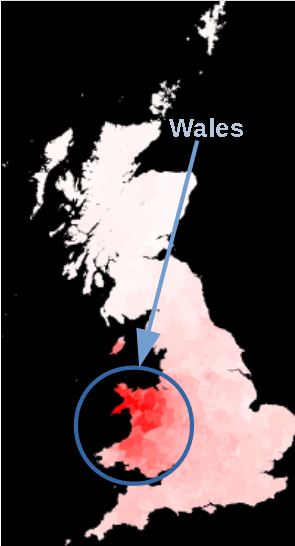
Each occurrence of the Jones surname is indicated by a red dot. Image by Barry Griffin at http://www.celticfamilymaps.com (2016)
I’ve been helping a friend work on her own family’s history. My friend’s maiden name is Jones, which is problematic simply because it is the most common surname in Wales. If you live in Wales, or even Southern England, you know exactly what I mean. The name is everywhere. My friend’s problem is tripled by the fact that each successive head of household bears the same first and last name (no middle) for four generations.
Welsh surnames are the results of an anglicized family tracking system called patronymics, meaning that all children, male and female took their father’s given name as their own surname for the duration of their lives. The surnames of following generations took the form of the family patriarch’s first name. For example, if your father’s name was David, you would take the surname ap Dafydd, Davis, Davies, or some other form of David. If David’s father was Daniel, he would be known by David ap Daniel, or David Daniels.
The patronymic system is not limited to Great Britain, though. Take a look at this example from my Dutch ancestry:
I haven’t figured out where the van Beveren name came from, but each surname changes by generation, based on the name of the father. It would be safe to assume that the senior Willem’s father was named Daniel.
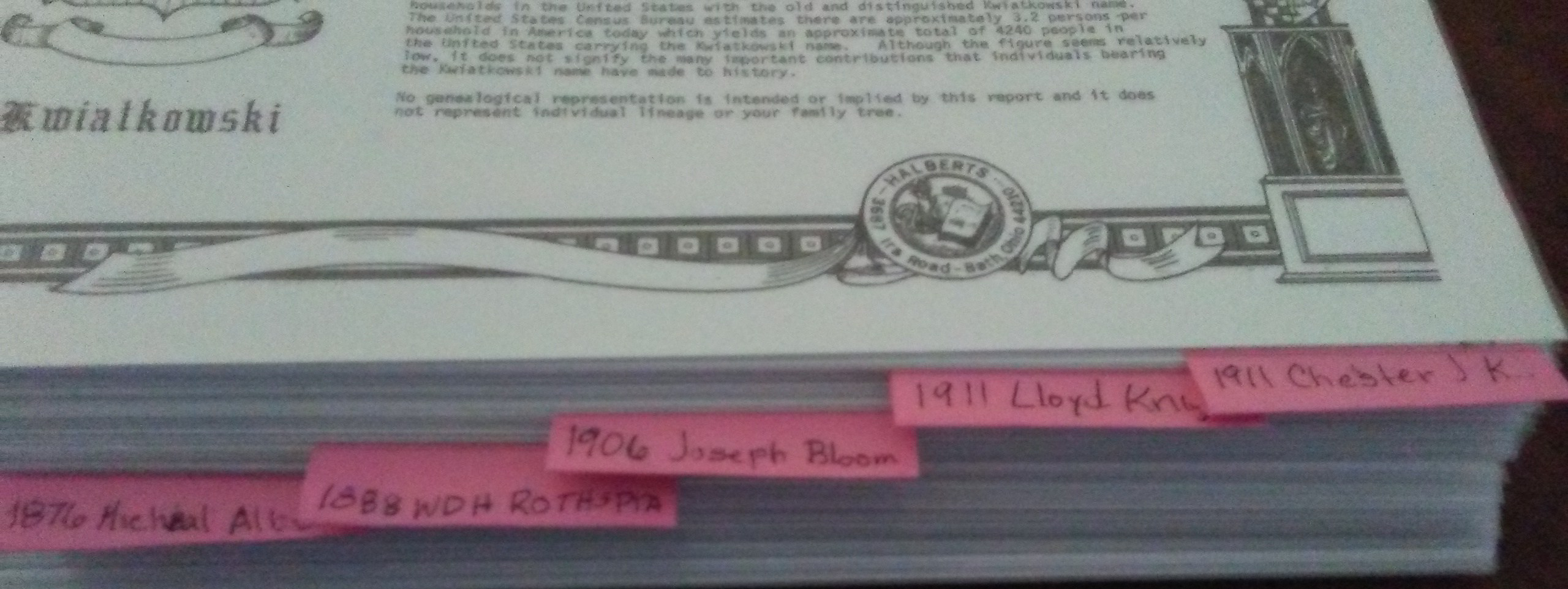
It’s pretty easy to organize electronic files by surname. When I have enough documents under the same surname, I simply create a file with that surname, and organize each file by year of occurrence, for example a birth certificate for John Davies, born in 1820, would be included in the Davies, or Davis, file. The record would be labeled 1820 DAVIES John, but a census record for John Davies would be labeled. That way, all records for John Davies would essentially end up together in the Davies file between the years of his birth and death. Any immediately family members would have records before or after him according to their year of occurrence.
KNIGHT file. Documents are organized by year, month, day, SURNAME, given name, and middle name or initial. Other relevant information follows date and name.
My friend is older, though, and prefers to keep each family’s file in a binder, which works too. I use both systems when I am dealing with primary sources (such as photographs and original documents like birth, marriage, and death certificates). It’s always good to have digital back-up. Her problem, she explained, was that she could not keep track of four individuals in her family tree named Benjamin Jones: Her great-great grandfather, her great grandfather, her grandfather, and her uncle. Using my system, I explained how to use birth years of each individual to organize them and to put documents for the most recent Benjamin Jones first. Instead of including creating a fourth file for her uncle, his documents were included with the rest of his siblings in her grandfather’s family group, so she only needed three new tabs.
documents ordered by birth year and given name, then surname. If each ancestor had the same given and surnames, I would have easily been able to distinguish between ancestors by looking at the birth year.
Tabbed inserts don’t work in binders where documents are kept in protective sleeves; they are too narrow to easily distinguish between family sections. I fold a 2×2 post-it note in half and tape it to both sides of a protective sleeve instead of tabbed pages for file sections. My friend chose to purchase adhesive tabs made expressly for that purpose. Either way, an attached tab works best anytime you are working with protective sleeves. All you need to write on each tab is the birth year and first name of the head of household and work backwards chronologically. It didn’t take long, and now my friend can see at a glance which Benjamin Jones is which.
This is exactly how I feel, and maybe even what I would say if Amy (the author) hadn’t taken the words right out of my mouth. But perhaps I feel a little less safe here than she does. I was already feeling on edge about my Jewish past before the Pittsburgh shooting.
As a Christian of Jewish descent, I feel it is my responsibility to share:
I’ve been researching and gathering information about the life of Mary Davis Skeen off and on for several years. Thanks to great record-keeping by Davis and Skeen family genealogists and local historians, I have plenty of information to tell a complete story from beginning to end.
But Mary Davis Skeen is not my family, and I want to honor her memory as best I can. I have been told by one of her great-grandchildren that Mary could not read or write, so she could not have written her own memoirs. Therefore, your knowledgeable input is the most valuable resource I have, especially if you are related to any of the players in Mary’s story.
What you will see of Mary’s life is my rough draft of her complete biography. There will be gaps and inaccuracies that you can help me fix. I would love to hear from you especially if you belong to any one of the following categories:
Descendant/s of
Thomas Davies (1816-1899 or Thomas Davis/Davies/David 1790-1865)
Mary Davis Skeen (The second wife)
Caroline Smart Smith Skeen (The first wife)
Abraham O Smoot
Have family from
Carmarthen, Wales
Llanelly, Wales
Burry Port, Wales
Plain City, Utah
Have family stories (especially written memoirs) of descendants regarding
Eisteddfod and the early Mormon Tabernacle Choir
Welsh customs, traditions, and recipes
LDS church history in Southern Wales
Welsh maritime history before 1860
1855 Voyage from Liverpool to New Orleans on HMS Clara Wheeler
Mormon Grove, Kansas
Abraham O Smoot missionary experiences in Wales 1850-1855
Abraham O Smoot 1856 pioneer company
Dry Creek, Deseret Territory (Lehi Utah)
Dry Creek water disputes
Plain City, Utah founders
Measles
Small Pox
Midwifery in Deseret Territory
Please remember that I have access to libraries and online resources. What I don’t have is insider knowledge–something that may have come through your ancestors to you. I am especially looking for primary sources but secondary sources can be very helpful too.
Finally, I want your corrections, suggestions, perspective, praise, and constructive criticism. You can comment below, send me a private message, or join our Facebook group for extended conversation on the subject.
Right now, I am putting together Mary’s family and early childhood in Wales for the first chapter to come in February 2020. Next week I am posting an ancestor landing page for Thomas Davies (b. 1816 Llanelly, Carmarthenshire, Wales – d .1899 Plain City, Utah.)
Thanks in advance for your interest and input! I hope we can make this a successful community effort.
At least at the Lindon Grove Cemetery in Covington, Kentucky, that is. The cemetery is named after the grove of Lindon trees that once grew naturally in this part of town, so trees are important here. Lindon Grove is not just a Cemetery. It’s also a city park and certified arboretum. Many of the older and larger trees in the cemetery are marked with plaques designating both species and native origination.
Of course tombstones aren’t intentionally planted in the trees, but as the trees grow they encroach upon nearby tombstones, nearly swallowing them. The photograph below is probably the most picturesque I found, but there are a great many tombstones growing in the trees here. Some are still identifiable; others are more tree than stone.
Of all the cemeteries I’ve ever visited, this one ranks among my favorites. It’s not a typical, run-down, Halloween-type graveyard, although it is one of the many I have seen that once suffered from neglect and vandalism. Despite the absence of play equipment, children feel welcome here. I brought my granddaughter with me, and she was just as entranced by the trees, tombstones, and gently rolling landscape as she would have been in a playground.
Fascinated by tombstones.
This particular graveyard sits on the northern edge of the former Confederate States of America. Just two miles away, across the Ohio River, lays the land of freedom for African Americans still in the bonds of slavery. This is Underground Railroad country and a former hotbed of strife where brother fought against brother. Kentucky was the first southern state to fall back in to Union control.
This particular cemetery does not hide its dark past; it embraces and rises above it. Set up as a public cemetery by a local Baptist Theological Institute, it began as a fully integrated cemetery including a pauper section where those who could not afford a proper burial were buried for free. A veteran’s section includes memorials for all United States’ wars since the cemetery’s establishment in 1843. Black and white, bond and free are all buried here.
Civil War history is prominent in Lindon Grove. Because Kentucky did not last long as a Confederate State, both Union and Confederate memorials are laid row by row with Union stones facing off against Confederates. A wide pathway separates the two in semblance of the uneasy front line of a battlefield. Interestingly, and certainly not intentionally, if one looks north towards Ohio, they can see the tips of Cincinnati’s towering skyline above the the war memorials as a reminder that freedom from the bonds of slavery was not far away.
At Linden Grove, contemporary life is inspired to mingle with the past. Pebbled walkways meander through the park encouraging foot traffic. Historic walking tours through the cemetery are occasionally offered. The serenity of the area is perfect for yoga enthusiasts. There are also picnic tables for a relaxing repast with family and friends. In the warmer months, the cemetery turns into a theater where theatrical performances and movies are provided for family entertainment. And of course the tombstones make great conversation pieces.
There is so much history here. The cemetery is actually included on the U.S. National Register of Historic Places. Among the prominent members of the cemetery, are the city’s founders, politicians, soldiers, and every day heroes including slaves, freed slaves, and their free progeny. One memorial marks the grave of B. F. Howard, a black railroad porter, and founder of the first African-American Elks Chapter in Cincinnati, Ohio. Another belongs to Dr. Louise Southgate, a female physician and early women’s rights activist.
It does not take much digging to find information on the many stories that are buried here. After just one visit and a quick Google search I had everything I needed for several blog posts. I could spend days digging through the mounds of historical information available at the Historic Linden Grove Cemetery & Arboretum website, and I could fill the rest of my lifetime telling stories from just this one cemetery. As Dave Schroeder, former director of Kenton County Public Library put it, “. . . If . . . you start writing down the names of some of the folks and look at the dates of birth and death and do a little research, you can learn so much about the community and what it was like at the time period just by taking your stroll through the cemetery.” My sentiments exactly.
If you try it, let me know! I’d love to share the stories you find.
This year’s cemetery month begins with graveyard poetry. For today’s post, I begin with the end: the final stanza of The Jewish Cemetery at Newport by Henry Wadsworth Longfellow. The poem was first published 160 years ago, in 1858, and contemplated an abandoned Jewish graveyard established nearly 200 years previously in 1677. Among Longfellow’s contemplation, he wondered about the first major Jewish settlement in the American Colonies and their subsequent disappearance from the streets of Newport Rhode Island a century after their arrival. In similitude, people around the world have wondered about the Jews who lived actively within thriving European communities but disappeared by the millions in less than a decade during the Holocaust. Longfellow’s final stanza is this lament:
But ah! what once has been shall be no more!
The groaning earth in travail and in pain
Brings forth its races, but does not restore,
And the dead nations never rise again
Perhaps Hitler and his Nazi sympathizers counted on the fact that the Jews lost in the Holocaust would remain lost and forgotten like the Jews of Newport. But thanks to the efforts of people like Ruth Contreras in Austria, the dead nations are rising again. Perhaps not literally, but they are being revived in the memories of towns across Europe like Pitten, Austria, and their names are being reconnected with family members who have lost contact. Those dead nations are indeed rising, one-by-one.
Four years ago, I posted the photograph of a tombstone in Europe. Like the tombstones of Longfellow’s poem, it was spelled “. . . backward, like a Hebrew book, Till life became a Legend of the Dead.” That tombstone was indeed a mystery to me and my family. We had been unable to find anyone to help us connect that tombstone with or own family story.
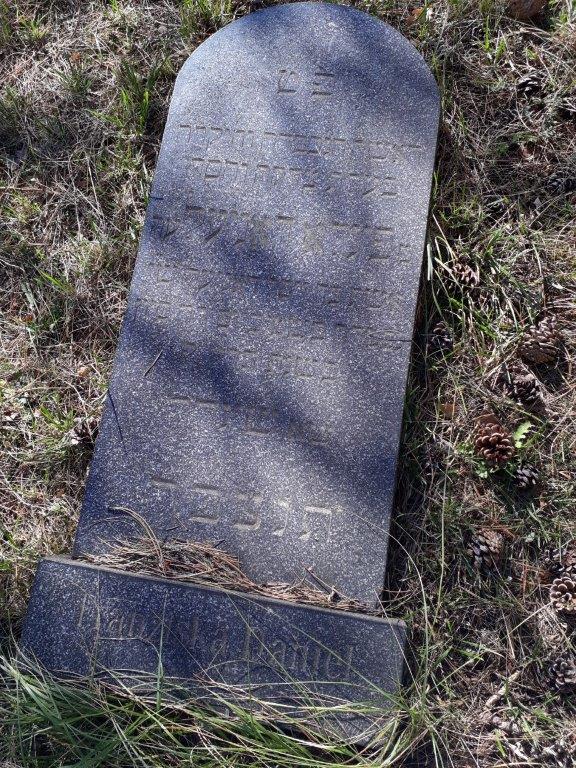
Until ten months ago, that is, when I received an email from Ruth Contreras referring to my blog, and asking about my post, How my Mormon Mom Learned She was a Jew. Attached to Ruth’s message was a photograph of a broken tombstone written in Hebrew and lying in the grass. The bottom of the tombstone bore my great-grandmother’s name in Roman lettering. I’d seen that tombstone before, but I didn’t recognize it in its dilapidated condition.
Ruth wanted to know if my grandmother was the same Josephine Daniel who was the daughter of Franziska Abeles Daniel from the tombstone and had lived in Pitten a century ago. If so, could I possibly help her get in touch with any of Josephine’s living relatives? As I read through the letter, I realized that this was a person who had done some in-depth research into my grandmother’s family. She mentioned dates, names, and places particular to my family, and in my intense overload of excitement, I missed the fact that she was even solving the mystery of the tombstone, like Longfellow’s “mystic volume of the dead.”
The tombstone, finally identified.
My great-grandmother, Franziska “Fanny” Abeles Daniel
My grandmother, Josephine Daniel, and her sister Sommer, at their mother’s tombstone.
I felt like an overexcited puppy being let out to play after a long day home alone. I was positively bouncing; and if I had a tail, I’m sure my whole back end would have been wagging. The first thing I did was call my parents in Utah to share the message. My mom was just as elated as I was. After all, she had spent years searching for information regarding my third great grandfather who had lived in Pitten all those years ago. This was a break-through for my family. My reply to Ruth’s first inquiry included a photograph of the woman belonging with the tombstone.
Over the next few weeks a flurry of emails went back and forth between Kentucky, Utah, and Austria. Each new message from Austria was followed up by a phone conversation with Mom and Dad. During that first flurry of messages I learned that Ruth was the granddaughter of the family that lived next door to my grandmother and third great-grandfather in Pitten in the years between the first world war and the Holocaust.
My first and most empowering understanding of the Holocaust was my study of The Diary of Anne Frank in eighth grade. To my young mind, Anne’s story explained so much of a grandmother I barely remember. My mother heard grandma speak of her Jewish past only once, and never again. I was able to learn of my own relationship to that Jewish past through a reel-to-reel tape recording of that same conversation. The recording, and my study of Anne Frank raised difficult questions: Who were my relatives in Austria? How many of Grandma’s close friends and cousins died among the six million in the Holocaust? How many others survived? Who were they? Where are they now?
Ruth’s mission, she explained, was to answer some of those questions. She was looking for the members of the former Jewish community in Pitten, Austria, in order to explain what had happened to them after the annexation of Austria to Nazi Germany in 1938. The Jewish community in Pitten was small, but given that out of the 9.5 million Jews living in Europe before 1938, only 1.4 remain, finding the descendants of those missing Jews is like finding a needle in a haystack . Six million died in the Holocaust, and the remaining 2.1 European Jews are scattered across the globe.
In the past ten months, Ruth has been collecting and organizing information, and I have not been telling my stories. I’ve been dealing with life, putting the “grand” into grandmothering, fighting bed bugs (The reason for no posts in September. WHY did we move here?), and feeling guilty for not telling stories. But I have not forgotten that one of the reasons I established this blog was to attract previously unknown family members looking to connect with their ancestors and their untold stories.
My family’s stories are largely unknown, but thanks to Ruth Contreras, I can begin by telling previously unknown stories from my own Jewish ancestors, aunts, uncles and cousins. I hope that Ruth will let me tell her family’s story as well. I’ll never be able to tell even close to six hundred stories of the Jews lost in the Holocaust (let alone six million), but as Ruth reminded me, “The generation of survivors of the Shoah [Holocaust] very often hesitates to speak about what happened, but I think it is the obligation of the second and third generation to find out as much as possible to ensure that this does not happen again.” Ruth is of the second generation. I am of the third. I take this obligation seriously.
Ruth was also able to tell me of some neighbors to my ancestors in Pitten, Austria:
Ruth’s mother and grandparents lived next door to my family before the Anschluss. They relocated to Columbia, and their property was Aryanized. The family returned to reclaim their property in 1948, and Ruth lives there now.
Johann Jaul and his wife Josephine, also victims of the Holocaust, owned the property my family lived in, and lived about ten minutes away by foot. The Jauls’ daughter and her husband escaped to Argentina, but their former properties no longer exist.
A fourth Pitten resident, Barbara Trimmel, was a victim of Nazi Eugenics (biological purification of the Aryan race). She was not Jewish, but fit into another category targeted by the Nazis.
Related results of Ruth’s efforts include:
Photo contributed by Ruth Contreras
A photo of my great-grandmother will be included in an exhibit of Jewish life in the Museum of Contemporary History in Bad Erlach.
Four bronze “Stumbling Blocks” laid next to the secondary school in Pitten, including one for my third great-aunt, Rosa Rebecca Abeles who died in Treblinka.
A commemorative event for the alumni of the secondary school in Pitten. Ruth reports that the event was quite successful. In her words, “I think the kids learned a lot about prejudices, marginalization of minorities and they will have to discuss a lot at home with their parents. Never again!”
An article published in Messenger from the Bucklige Welttelling of Ruth’s quest to identify Holocaust victims and their families, including the story of how she found my family through a web search leading her to Stories From the Past.
So the dead nations are rising one by one through the commemoration of their lives in museums, on the streets of their hometowns, magazine articles, and stories told on the internet.
May we never forget.
A special thanks to Pitten Mayor Helmut Berger, Stumbling Block artist Gunter Deming, project initiator Ruth Contreras, and research director Werner Sulzgruber.












 Christian of Jewish descent, I feel it is my responsibility to share:


 It does not take much digging to find information on the many stories that are buried here. After just one visit and a quick Google search I had everything I needed for several blog posts. I could spend days digging through the mounds of historical information available at the



 My first and most empowering understanding of the Holocaust was my study of The Diary of Anne Frank in eighth grade. To my young mind, Anne’s story explained so much of a grandmother I barely remember. My mother heard grandma speak of her Jewish past only once, and never again. I was able to learn of my own relationship to that Jewish past through a reel-to-reel tape recording of that same conversation. The recording, and my study of Anne Frank raised difficult questions: Who were my relatives in Austria? How many of Grandma’s close friends and cousins died among the six million in the Holocaust? How many others survived? Who were they? Where are they now?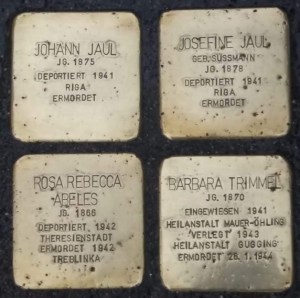
 StoriesFromthePast.com