Category: Rosa Daniel

  • A Renewed Tribute to Tante Rosa

    A Renewed Tribute to Tante Rosa

    A couple of months ago I had to delete one of my blog posts: “A Tribute to Tante Rosa.”  I had linked the post to the Shoah Foundation at the University of Southern California because I would not have been able to write my tribute without access to their research on the Holocaust.  Unfortunately, the Shoah Foundation attracted malicious hackers, and my blog post had to be removed in order to protect the rest of my web site.  Why is it that tragedy attracts malevolence?

    Rosa Daniel as a child
    Tante Rosa as a child

    Today I am rewriting my tribute to Tante Rosa (Rosa Daniel), since I did not save it in any other form. I will not be linking my site again to theirs, but I do recommend looking up USC Shoah Foundation.  It does a great job at personalizing genocide, something we should all make personal.

    If we can’t relate to it, we have no reason to put an end to it.

    Tante Rosa’s story has been intrinsically connected to my appetite for genealogy.  I truly believe that we are all products of our past, and that those who came before us help to define who we are today.  For example, my mom tells me that my brother walks with the same swagger that my grandfather had; and I know that my daughter suffers from the same anxiety and depression that I believe came from Rosa’s sister: my grandmother.  My mother and I have it too. As I learn more about each of my ancestors, I begin to understand how customs, traditions, physical characteristics, and yes, behaviors, are kept alive in myself. (more…)

  • She looks just like me. But who is she?

    She looks just like me. But who is she?

    I missed posting on Wednesday. Writing about my Tante Rosa was important, but it took a lot out of me.  By the time I had completed the post, I was emotionally worn down.  I didn’t feel like I was just blogging about my aunt; I was writing for all of  the families of the holocaust. As a parent and grandparent, I imagined being forcefully separated from my young children and grandchildren.  From a child’s standpoint, I imagined the horror of discovery that the people whom I put my deepest faith in could not keep me from being snatched away from my family and sent to an unimaginable doom. It was tough and I needed a break. So Wednesday’s blog comes today.

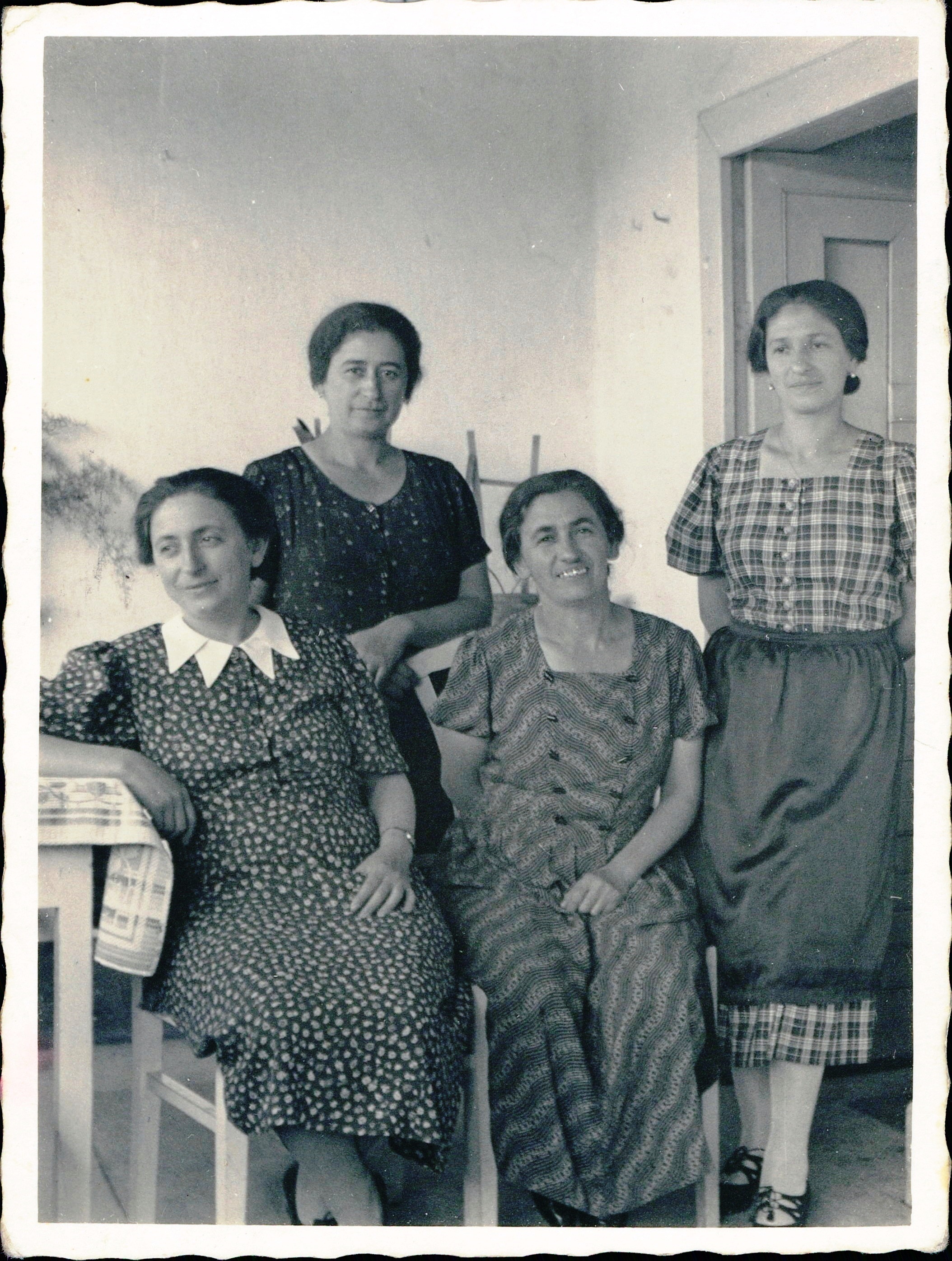
    We are pretty sure that the woman on the left is Gisela. Standing in the back is Helene (we knew her). But the woman sitting to the right and the one in the doorway–we are unsure of . They are most likely Rosa and Sommer (Hermine?), but which is which?

    I talked with my mother at length regarding September 3rd’s post (Why Grandma Cried). But memory is a fickle thing, coming and going without permission as we get older.  From my childhood I remember mom talking about Grandma’s four sisters; but as I started putting records together and gathering photos, I was only able to find evidence of three.  I told my mother this, and she began questioning her own memory.  Together, we decided that our memory had failed us. We labeled the photo of the four women according to this discussion, despite Mom’s insistence that her mother had four sisters.

    A few days after my post appeared I got a phone call. It was my dad. “Your Grandma Rothsprack had four sisters. The one that was missing was named Hermine.”  Okay, now the story is starting to make more sense.  I remember Mom saying that Grandma had four sisters. So I did a little more digging and sure enough, it came out of my own Grandmother’s mouth.  My father had tape-recorded my grandma’s life story when I was just a baby and had made type-written transcripts for each of his children.  This is what Grandma said:

    “I am one of five girls in the family–no boys. [She lists them] Gisela who lives in Austria. Rosa: killed in Auschwitz (sic). Not Married. Helen: Lives in Graten [California]. Sommer – lives in Austria.”

    Wait.

    Didn’t dad say the other sister’s name was Hermine?  This is confusing. Tante Leni didn’t have any children, I’ve never met my Austrian cousins, and Tante Leni and Grandma are not around to help us get it straightened out.

    Same eyes, same nose, same smile, same tilt of the head. Even the same eyebrows!
    Same eyes, same nose, same smile, same tilt of the head. Even the same eyebrows!

    As we were looking at the photograph I noticed something interesting.

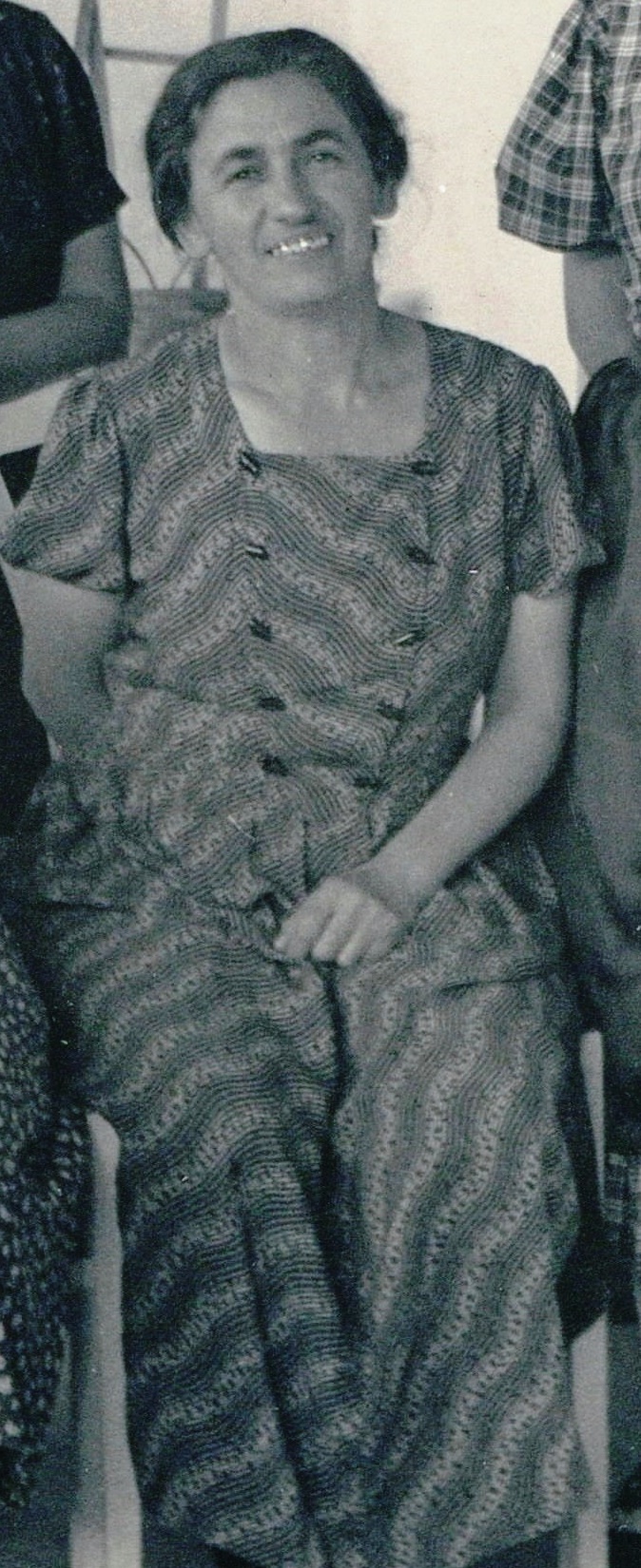
    She is either Rosa or Sommer (or Hermine?)
    She is either Rosa or Sommer (or Hermine?)

    When I pointed it out to my husband he disagreed. I kept thinking about it, and I was pretty sure that he was wrong. Until last night.  I was at our local family history library because I was trying to solve the mystery of the missing sister. I showed the genealogist my information and the photograph from my blog; as she looked at the photo, her jaw dropped open, her eyes got big, and she pointed at the photograph. “Do you see this woman?” She asked. I laughed with relief. She saw it too.  We know it is my grandmother’s sister. Because Rosa and Giselle were the oldest, I think it is my Tante Rosa. And she looks like me!

    For me, this is the most awesome thing about genealogy.  I am living proof that I am related to this woman, and she is an integral part of my past. My dad tells me that he just uncovered several more photographs of Rosa.  I can’t wait to get the copies and make the comparisons.

  • Why Grandma Cried

    Why Grandma Cried

    My mother was born in 1940, one month after Germany began it’s attack on Great Britain. A few months later, Pearl Harbor was attacked, and the United States entered the war. By that time, Hitler had been rampaging through Europe for more than four years. Two days after Mom’s fifth birthday, Emperor Hirohito agreed to unconditional surrender and Hitler had been dead five months. Mom was very young when she heard her mother crying late at night when she thought no one could hear.  Grandma was heart-broken, but it would be at least another twenty years before Mom would learn why.

    Josephine Daniel Rothsprack, my grandmother, grew up in Austria with her four sisters, Giselle, Hermine, Rosa, and Helene.  I usually hear them referred to as “Tante” (German for “aunt”). Although Grandma was close to her family, she was tired of being poor.  “All our clothes were rags,” she told my dad. “They were patched and patched until there were patches on top of patches,” she complained. Grandma told of a friend who had gone to New York and was living as a maid making $50.00 a month. “That was a fortune to us in Austria,” she said. So Grandma left her three sisters behind to seek her fortune in the United States.

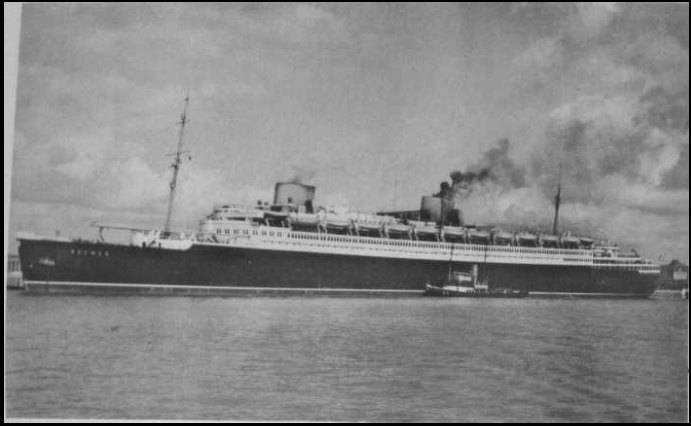
    Grandma was on the Manifest for the “Bremen” arriving in September 1923. The Bremerhaven was renamed Bremen in March of that year.

    Grandma arrived in Boston September 14, 1923 (National Archives and Records Administration (Ancestry.com), Passenger Ships and Images database). From Boston, she took a train to San Fransisco where she stayed with friends until she could make a living on her own.  That’s where Grandma met my grandfather, Wilhelm (“Willie” or “Bill”) Rothsprack.  They were married,  settled into a home of their own, and had three girls. My mother was the youngest.

    Grandma's sisters in Austria
    Grandma’s sisters in Austria. Tante Leni is standing in the back. I can’tbe certain, but I believe the woman seated to the right is Tante Rosa.

    Back in Austria, things were getting worse for the Jews.  Giselle and Hermine had married  influential Germans who kept them safe from harm; but news reports, letters and phone calls told Grandma that Rosa and Helene (Leni), her two other sisters, were still in danger. Grandma began saving money to bring them to the United States.

    Hitler invaded Austria in March of 1938, and with very little violence, annexed it, declaring Austria part of Germany.  Jews and Gypies were not allowed to vote in the annexation, making the vote nearly unanimous.  At that time, what was tough became even tougher. When Kristallnacht came in November, Rosa and Helene remained safe due to the fact that they were the only Jews in a very small town.  But things did get worse when my Tante Leni’s boyfriend turned the family in to the Nazis.  My mother tells me that Tante Leni’s boyfriend was himself a Nazi. (more…)