A few months ago, I began researching and preparing to re-open Stories from The Past with a fully fleshed out version of The Second Wife’s Story written written as a series of posts to be prepared for publication by 2027. As I neared the end of 2025, and the holidays approached, I found it necessary to focus on home and family for a few weeks. . I had come to the end of my research topics and was already organizing the very large set of files into chapters and putting details into the timeline. I wasn’t worried, though, by November I only had to tie up a few loose ends and thought I could take my time doing it.
I planned my new year beginning with my Epiphany post and clarification. The Rebirth of Stories From the Past was set to begin on the Christian Holy Day of Epiphany because the connection between finding something important and the significance of the day were filed in my memory waiting to be fleshed out some January when I would explain the connection. Thanks to the 2025 “Super-flu” which extended into the new year, that post was only partially completed and not in the least well-explained when it automatically posted without my knowledge, a day late.
Oops.
To be fair, I was on my third week of battling the aforementioned flu and I still didn’t know I had it. I just thought I had overdone it, bringing on a vestibular migraine that that reused to go away and was steadily getting worse. On top of that, I thought I had caught a bad cold. In fact, on the very day my Epiphany post published, I was in the emergency room with a mindboggling set of symptoms. When you’re that sick, you don’t know to think of course I have the flu!
So the holidays came and went with their usual fanfare thanks to the fact that I’d prepared well, but The Second Wife’s Story and blogging were left untouched. By the time I knew I had the flu it was too late for all of that. I just figured I’d get caught up when I finally started feeling better and thinking straight.
That was yesterday; the day I found the accidental Epiphany post.
You might be wondering what Epiphany has to do with Mary Davis. I’ll have to say a whole lot and not much at all, depending on how you look at it.
As far as Mary’s story is concerned, my epiphany was just those two words: Industrial Revolution. It was the sudden realization that Mary’s life was inextricably and intimately linked to the beginning and end of the first of several industrial revolutions. My research following that first epiphany led me down the proverbial rabbit hole, but the continuing epiphanies coming out of that one revelation, led me to understand Mary better, and even more importantly, the human conditions leading the Skeen Family, and later the Davis family, down the Mormon Trail. Six months later I had my story from beginning to end.
The day of Epiphany showed up as the perfect day to revive Stories From the Past along with a lost tradition, so I focused on that day. Unfortunately my body had other ideas and the day came and went. But I’m back now and only a couple of weeks behind.
I guess I’ll have to flesh out a new Epiphany post next holiday season. I’m not even sure if it will post to this particular blog. (I have others.) I’ll be sure to link it to Stories From the Past for those who want to follow along.
As far as the Industrial Revolution and it’s accompanying epiphanies go, I’ll have that list along with my plans for Stories From the Past ready for preview next week.
Thanks for sticking with me. It’s good to be back!
I’m back to Wednesday blog posts: and I mean it! No excuses.
This website is really old, and never has reached its full potential. It’s in desperate need of updating; so here’s what’s up:
January 2026: Thanks to Super-flu 2025, this newsletter, which should have posted the last year, didn’t make it out on time. So STORIES FROM THE PAST is already two weeks behind and I already have some catching up to do.
Here’s what you can expect this year:
New Theme, Logo, letterhead, and other organizational updates. (You should already see some of them.)
About Us focusing less on beginnings and more on readers. (This keeps you involved.)
Research for Mary Damron’s story (untitled) and at least one more story I can’t wait to get started on.
Austria report from 2019
Family History Conference reviews
Added post days
New Social media connections
February 2026: New research on a new biography. This is near and dear to my heart. but I am quite sure that many of my existing readers and even more of my new readers will be able to find a personal connection or two along the way.
I can’t wait to tell you about it! Stay tuned; preliminary details will be released on January 28.
You will see changes every week, and I’ll be sure to keep you updated.
Truth is often stranger than fiction. Maybe that’s why I like historical fiction. Even though the story line isn’t true, the background of the story is truthful and accurate. This is the case with most novel ideas that have come to me. In this case, the truth is that I developed a close relationship with a man fourteen years younger than myself. Josh had become my best friend. I warned him that I was falling in love with him, but he ignored my warning and the warnings of others until it was too late. Just over a year after we first met, Josh finally admitted that it wouldn’t be possible to marry me. He blamed the age difference, but I was angry with his mom for standing in our way. Although I knew that I should have blamed Josh, I was just sad, because he couldn’t stand up to her.
I learned so much about love with Josh. I was convinced that I had found my soulmate. I was hurt that he couldn’t see it. I am confident that this will make an excellent story, but I needed Josh’s permission to write it. Heaven forbid it should appear in print without his consent. Josh, being the understanding spirit that he is, read the story based on one of my journal entries as it appears in this multi-genre work, and gave me his blessing. It’s no wonder that I love him.
Any Man of Mine
Shania Twain
Any man of mine better be proud of me Even when I’m ugly, he still better love me And I can be late for a date that’s fine But he better be on time
Any man of mine’ll say it fits just right When last year’s dress is just a little too tight And anything I do or say better be okay When I have a bad hair day
Well any man of mine better disagree When I say another woman’s lookin’ better than me And when I cook him dinner and I burn it black He better say, mmmm, I like it like that.
And if I change my mind A million times I wanna hear him say Yeah, yeah, yeah, yeah, Yeah, I like it that way.
Any man of mine better walk the line Better show me a teasin’ squeezin’ pleasin’ kinda time I need a man who knows, how the story goes He’s gotta be a heartbeatin’ fine treatin’ Breathtakin’ earthquakin’ kind
Any man of mine.
First
Impressions
I had been married. Got divorced. After a controlled marriage, I had to be the one in control.
I went back to school. Something I wasn’t allowed to do– When I was married.
I liked my freedom. I liked being in control. I didn’t like men.
The absolute truth? I could trust no man with my heart.
Summer term, Students raved about the new math tutor– Said his name was Josh And he could do math in his sleep.
This man looked nothing like the typical 21 year-old Utah boy. He certainly looked like a math tutor, though.
“Are you tutoring, or can I sit here?”
“Please sit.”
“So Josh, how was your weekend?”
“… Marianne, just what is it that you’re after?”
“I beg your pardon?”
“What are you after?”
“Um… I don’t know, Josh, what am I supposed to be after?
“My mom says that women like you are only after one thing, so what is it?”
“Maybe you should ask your mom, cuz I have no clue. Apparently you find this more amusing than I do; and how do you raise just one eyebrow at a time like that? Are you going to tell me?”
“Don’t be offended, but I really do think it’s funny. When I came home on Friday I was raving about you. When Jim came over on Saturday, I was still going on about you, and my mom finally asked, ‘So Josh, just who is this Marianne?’ So I told her about you.”
“And what exactly did you tell her?”
“Everything.”
“What did she say?”
“She didn’t say anything for a minute, and then she got mad. The next thing I knew, she was the one raving. By Sunday, my dad was trying to calm her down.”
“So she thinks I’m after something.”
“Yep. She told me I should stay away from you.”
“So what are you doing here with me, Josh?”
“You approached me, remember? Should I stay away from you?”
“I don’t know, should you? Tell your mom I’m after your body and your money.”
“I’m not staying away from you, Marianne.”
“You’re a glutton for punishment.”
“It’s all good.”
March 16, 2001
Dear Peppi,
I’m so confused. Josh knows that I’m falling for him, and he says that we’ll always be friends, but I think I want more than that. I have no clue what he wants, but everything he does points straight to eternity.
I tried to hide in a corner study room with my headphones and CDs today, but Josh found me. He walked in, closed the door, sat down next to me and raised one eyebrow. I burst into tears, and he pulled me to him. I wanted so much more than just a hug, but I didn’t do anything but lay my head on his shoulder. He let me go, and asked what was wrong. I shook my head and didn’t say anything for a minute. He just sat there with his hand on my knee and watched and waited. Josh is so patient.
I know how his mom feels about us, and it frustrates me that she gets so upset when she knows we’re together. It bugs me, because Josh and I really do spend a lot of time together, but most of the time we’re with other people, and we’ve never done anything that either one of us would ever be ashamed of. I’ve never even kissed him.
I finally told him that I was frustrated because he is going to be such an awesome husband. It hurts to know that I spent thirteen years in an abusive marriage, and now that I’m free, and have found the perfect man for me, the age difference seems insurmountable. It doesn’t matter who Josh marries, he is going to treat that woman the same way that he’s treated me and every other woman I’ve seen him interact with. I so want to be that woman, and I can’t see it happening.
Josh did nothing more than pat my knee and say, “I know.” Why can’t he just say Marianne, will you marry me? I would say yes. He says his mother’s opinion doesn’t mean anything, because she just doesn’t know me, but I know that if he wasn’t so worried about disappointing his mom, that we could get past the age difference. I know that if his mom knew me like Josh knows me, she wouldn’t be having this problem. She’s never even met me!
I left my CDs with Josh while I went to class. He likes my music, and I never mind sharing. When I came back, Josh had returned to the corner room. I walked in, and he pointed to the headphones on his ears and said “John.” He meant John Denver. I grabbed the headphones and said “Mine.” He grabbed them back and said, “Can’t you share?” I know that Josh understood I was teasing, but I was still hurting, and all I really wanted to do was sit with my CDs and feel sorry for myself. I gave up, and just sank into my seat. Josh put the headphones on my head and said, “Let’s take turns.”
I listened to a couple of songs, then passed them back. Josh loves digging through my CDs and listens to a variety of stuff. Sometimes he brings his own music and we share that too. Once he brought Michael Boulton, and I was thinking about How am I Supposed to Live Without You? It’s one of Josh’s favorites. I wanted to stick the music in, and make him listen to it, but he didn’t have it with him today. Why doesn’t he get it?
We studied, passing the headphones back and forth, for more than an hour. Maybe I should say that we tried to study, but most of the time we spent talking about music and comparing homework. Josh is taking a Shakespeare class, and he loves to tell me about it. I didn’t get much done, and now, I’ve spent the last hour writing in my journal. I hope I don’t fall behind.
I was actually relieved when he glanced at his watch and said, “Uh Oh, I’m supposed to be tutoring!” I thought I might finally get some homework done, but Josh grabbed the headphones off my head, took Shania Twain out, put the headphones back on his head, and stuck John Denver back in the CD player. He did it all so fast that I didn’t even have time to ask what are you doing? He started pushing buttons madly, then slowed down, listened for a second, took the headphones off and put them back on my head, pushed a couple more buttons and then ran out of the room.
There’s no way I could do any more homework today, anyway. When Josh left the room and the music started playing, the message came loud and clear; “Lady, are you crying, do the tears belong to me?” Obviously, Josh understands more than I think he does. Now I’m more confused and frustrated than before. Why would he want to send that message to me?
Josh knew that I had to leave during his tutoring session so I could get home to my kids. I couldn’t ask him what he meant. This is so not fair!!!
My Sweet Lady
John Denver
Lady, are you crying? Do the tears belong to me? Did you think our time together was all gone? Lady, you’ve been dreaming, I’m as close as I can be. I swear to you our time has just begun.
Close your eyes and rest your weary mind. I promise I will stay right here beside you. Today our lives were joined, became entwined; I wish you could know how much I love you.
Lady, are you happy, do you feel the way I do? Are there meanings that you’ve never seen before? Lady, my sweet lady, I just can’t believe it’s true And it’s like I’ve never ever loved before.
Close your eyes and rest your weary mind. I promise I will stay right here beside you. Today our lives were joined, became entwined. I wish you could know how much I love you.
Lady, are you crying, do the tears belong to me. Did you think our time together was all gone. Lady, my sweet lady, I’m as close as I can be. I swear to you our time has just begun.
How do You Love Me? Let Me Count the Ways
Apologies to Elizabeth Barrett Browning
You look at me and one raise one eyebrow.
You sing loudly and off-key in while assembling my new computer desk.
You play with my hair from the seat behind me in our Book of Mormon class.
You whisper John Denver lyrics in my ear as I catnap in the student union building.
You lead me by the hand to your secret hideaway to calm my nerves after I locked my keys in the car.
You try to hold my hand from the back seat of Sandra’s car while I ride shotgun. It’s awkward, but we make it work.
You ask a question that only my heart can answer while gazing into my eyes and replying with your own.
You lay your head on my shoulder until my tears slow.
You fold my laundry as you wait for me to get ready for a Michael McLean concert.
You bring me a miniscule piggy bank with my name printed in tiny letters from your weekend trip to California.
You interrupt a study session to drag me down the hallway to a “found” penny for my new piggy bank.
You present a downy duck feather to me halfway through one of our many walks around the duck pond.
You brag to our co-workers that you can outrun my ex-husband.
If outrunning him doesn’t work, you say you will hide under a table because he is six inches taller than you and won’t fit.
You sit quietly next to me without saying a word.
You nurse my injured foot on a broken-down pier while everyone else is splashing and playing in the lake.
You throw your arms around me saying “I missed my Marianne” when I come back from a month in Europe.
You say, “I’m right here.” in a voice so low only I can hear through the encroaching crowd.
You eat cherries with me and spit the pits in the bushes as we discuss more serious matters.
You lay next to me on the grass and watch the stars for 45 minutes after the post-fireworks traffic has cleared.
You play with my children as if I weren’t even there.
You hug a tree to show me you’re on my side because my family thinks I’m a crazy tree-hugger.
You stay with me as I wait for the last bus of the day, then hop on your bike for a seven-mile ride into an oncoming storm.
You call to tell me you’ve made it home safely.
When You Say Nothing at All
Ronan Keating
It’s amazing how you can speak right to my heart. Without saying a word, you can light up the dark. Try as I may, I could never explain What I hear when you don’t say a thing.
All day long I can hear people talking out loud, But when you hold me near, you drown out the crowd. Old Mr. Webster could never define What’s being said between your heart and mine.
The smile on your face lets me know that you need me. There’s a truth in your eyes saying you’ll never leave me. The touch of your hand says you’ll catch me if ever I fall. You say it best when you say nothing at all.
A Broken Pipe
It was Josh’s silence that caused so much trouble that summer. Josh was always willing, even eager, to listen to anything and everything that Marianne had to say, but when it came to revealing himself to her, he was disturbingly silent.
It took a discussion about a broken pipe in his uncle’s lawn to get Josh to open up. The pair sat at the top of a man-made waterfall on a large stone. Marianne’s children were spending the weekend with their father, so she had invited Josh to visit Utah State University with her. She had made it sound so innocent, but she desperately needed to talk.
Josh was going on about his uncle who wouldn’t fix a broken water pipe in his lawn. Marianne seized the moment, “I have a broken pipe.”
Curiosity piqued, “Is it a big pipe or a little pipe?” Josh asked.
Marianne swallowed. “It’s a big pipe.”
“That’s a real problem.” She could tell that Josh was thinking about a broken water pipe, and she continued to let him think that. She needed him to understand the enormity of her problem.
“You should get it fixed as soon as possible.” he said.
“That’s what I’m trying to do.”
“Is it inside or outside?”
Marianne was tempted keep the charade going and tell him that it was inside. Instead, she swallowed again, “It’s an emotional pipe.”
“Oh, I see.” Josh grew quiet. He could see where she was going with the conversation. “Do you need some help fixing it?”
“Josh,” Marianne choked, “I can’t fix it without your help.”
Another significant silence. She didn’t dare look at him; her vision was clouded by brimming tears.
“Did I break the pipe?” Josh asked.
It takes two to play in the game of love, and Marianne knew that she was not an innocent bystander, “You helped.” It still wasn’t easy to tell him, even though it was clear to both of them that he already knew the answer. She decided to get straight to the point by explaining that she needed to communicate, and he didn’t see the need. She reminded him of similar talks that they’d had in the past, and of the age difference.
“If I were fourteen years younger . . .”
“There’d be no question.”
Marianne was cut to the very core of her soul. “None whatsoever?”
“I’d marry you in a heartbeat.”
Ouch. That hurt. That was it. She had to tell him, but it was still so hard. Marianne was so sure that he already knew. “Josh, I thought that I had made my feelings for you very clear when we talked before.”
“You made them very clear.”
“Very clear?” From Josh’s recent behavior, she wasn’t sure she’d been clear enough.
“Very clear.”
“Well, I need to be sure, so I have to make them perfectly clear, okay?”
Josh smiled and sat back. “Go ahead.”
Go ahead. Just like that. She decided she was a glutton for punishment; “This is so difficult. . . “
“Marianne, just say it.”
She gulped. The tears were running down her cheeks, and she so desperately wanted to think clearly. She couldn’t. “Josh, I love you more than I have ever loved any man in my life.”
The truth of the matter was that she hadn’t even known what true love was until now. Why did it have to be this way?
Silence. Except for a few muffled hiccoughs.
“Was that perfectly clear?” She had her glasses in her hand, and she couldn’t see him through her watery eyes, but she looked at him anyway.
“Perfectly.” His reply was quiet as he wrapped an arm around her and laid his head upon her shoulder. The tears continued to flow as she laid her head on his.
“Josh, this has been the most difficult summer of my life.” It was the happiest, hardest, saddest time of her life.
“It’s because of me, isn’t it?”
“I tried to warn you…”
“But I wasn’t listening.”
“Is it possible that I was saying something you didn’t want to hear?”
“No, but it is possible that I just can’t figure out how to fast forward or reverse time.” They talked about time, eternity, and the age difference.
“Josh, you don’t see time the way I do. I don’t separate eternal time from worldly time.”
“I don’t see how you can live in this world without separating it from God’s time.”
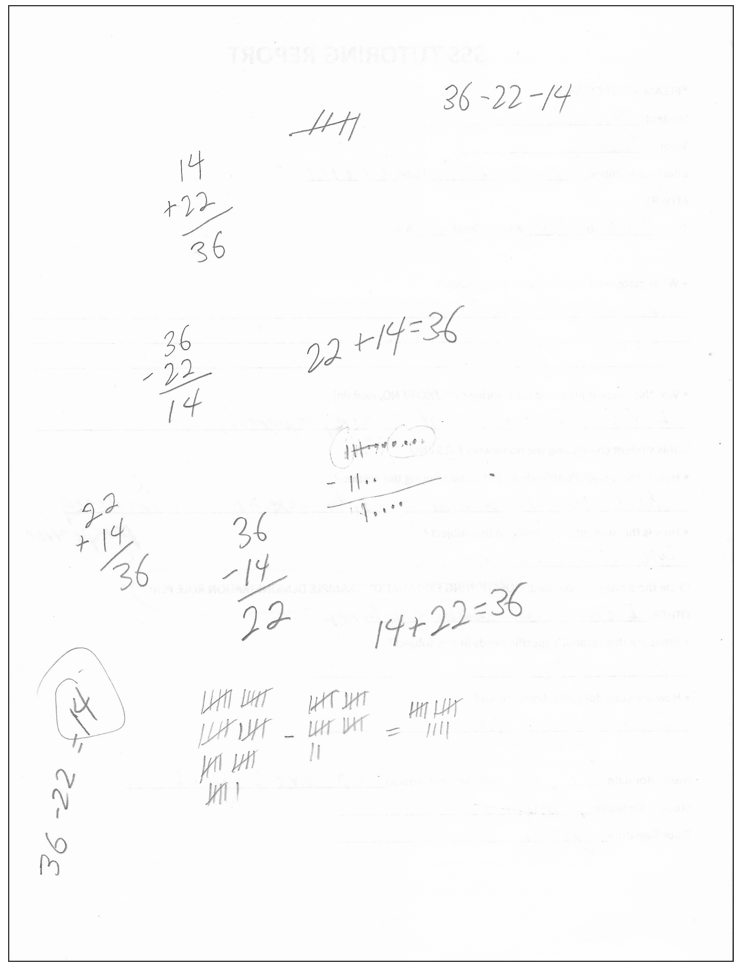
“You think like a mathematician.” Thirty-six, minus twenty-two, equals fourteen. . .
“It’s not going to work, is it?”
“I don’t see how it can.”
Marianne was completely devastated. How was she supposed to live without him? Even though She had already learned that she could get along just fine without a man, she just didn’t want to get along without the companionship of her best friend. He wasn’t even gone but she was already missing him. For a while she just sat, snuggled in his arms until the tears slowed.
“Josh, you’re going to go on with your life. You’ll get married, be a fantastic husband, make some lucky girl incredibly happy, and I’m going to remain single for the rest of my life.”
“How can you say that? You’ll get married again.”
“Josh, you can’t really believe that.”
“What do you mean? You’re an awesome lady; someone will want to marry you.”
“That’s not the point, Josh. I could easily find a man, but I don’t want just any man, I want the right man, and it’s taken thirty-six years to find him. I don’t want to spend another thirty-six years looking.”
“Marianne, you’ll find someone.”
“Yeah, when Hell freezes over.”
“I hear they’ve been having a cold snap…”
She laughed a funny little hiccuppy laugh spawned by a breaking heart. Then sighed, and said flatly, “Josh, you just go on with your life. I’ll be right here waiting.” She placed her palm over her heart.
“Right here?” He looked down at the rock and patted it. “This isn’t the most comfortable place in the world. Where will you sleep at night? It might rain or snow. You’ll get cold. You’re gonna want an umbrella and a jacket.”
“Oh Josh, you know what I mean. “For the next few days, the tears fell freely until Marianne had to admit to herself that the emotions she was experiencing felt too similar to the pain of divorcing Bob. Because she had loved Josh so much more deeply than she had loved Bob, her immediate fear was that the deep emotional pain would last a lifetime.
It was useless; that pipe was never getting fixed.
Right Here Waiting For You
Richard Marx
Oceans apart day after day And I slowly go insane I hear your voice on the line But it doesn’t stop the pain.
Wherever you go, Whatever you do, I will be right here waiting for you. Whatever it takes, Or how my heart breaks, I will be right here waiting for you.
I took for granted, all the times That I thought would last somehow. I hear the laughter, I taste the tears, But I can’t get near you now.
Wherever you go, Whatever you do, I will be right here waiting for you. Whatever it takes, Or how my heart breaks, I will be right here waiting for you.
I wonder how we can survive This romance. But in the end if I’m with you, I’ll take the chance.
Wherever you go, Whatever you do, I will be right here waiting for you. Whatever it takes, Or how my heart breaks, I will be right here waiting for you.
Profound Loss
Josh and I were introduced by one of the students he was tutoring. In fact, I would have to say that Jenni went on and on about Josh just about the same as he would soon be going on and on about me. Like me, Jenni was a single mom, and just a year older than me. And like me, she found him to be a good friend. Unlike me, her friendship with Josh never changed. Because I was also a tutor, I knew I would soon know him as well, so I asked her to describe him to me. From Jenni’s nondescript description, I really couldn’t figure who he was. But I ran into her a few days later on her way to her appointment with Josh while I was on my way to work, so I asked her to show him to me. The poem, “First Impressions,” appears exactly how I saw him, and yes, even though it’s a stock photo, the cover photo is pretty true to my first impression of Josh.
That was Summer Term 2000, and the “What are You After?” conversation occurred at the beginning of Fall Semester after I’d set him up on a lunch date with the hottest girl in the room. We had a strong bond, and soon found ourselves doing nearly everything together during our school hours. During winter break, we even went on a double date. I was with another tutor closer to my age, and I’d fixed him up with a younger friend of mine from the bus we rode. It was a weird date because by the end of the night, Josh and I somehow ended up together deep in conversation while our dates sat awkwardly at either end of the room. It was Josh that got the goodbye hug while I don’t think my date even got a handshake.
I don’t recall when my physical attraction to him changed, but I do know it was after I found myself falling in love with him sometime in midwinter of 2001. I remember when the sudden realization hit me. Josh and I were on our way back to campus after attending an LDS temple session together. We’d already been talking about the age difference because I knew his mom flew into a rage every time my name came up or she found out we’d been spending time together. We were stopped at a traffic light, and it hit me like a punch in the gut. That was the first time the tears fell, and even though I didn’t actually say the words, it was at that moment we both realized I was falling in love with him. It was also when I began to feel the pain from the well-found fear of losing him.
That summer I spent a month in Europe immersing myself in the German language. I’m sure I was driving the students in my group a bit nuts over the fact that I couldn’t help myself from bringing him up in nearly every conversation. Either that or talking about my kids. Although we’d gone together on the same plane, a large portion of the students extended their stay to visit other countries, while I was more than happy to get home to my kids. I was homesick nearly the whole trip.
I remember quite vividly my flight over New York City on the way into Newark. It was my first time seeing the Statue of Liberty, the Empire State Building, and the Twin Towers. I’d never in my life been that far East, let alone to Europe, so I was more than happy to have seen them up close even though it was from the air.
When I came back on campus, I was pleasantly surprised at Josh’s welcome home hug. It was the first time he’d ever called me My Marianne.
I so wanted to be his.
But there was something in the air that day, telling me it was the beginning of the end. There were two new women in the room, both with their eyes on Josh. Sandra had been hanging out with Josh while I was away, and she had set her sights on him. Yes, she’s the same Sandra driving the car while Josh held my hand from the back seat. She was none the wiser. The other, I might describe as mousy but not in a derogatory way. She was quiet and I don’t know if I’d say shy, but there was nothing more than ordinary about her. Looking back, she was the kind of woman who deserved a man like Josh.
At the end of that summer, I found myself sitting on the rock talking about a broken pipe. It was my last attempt to make him put up or shut up. He did neither. I’d say the Broken Pipe story was the day we broke up, but Josh didn’t see it like that. For me, it was that day that I knew for a certainty it was over.
Fall semester of my senior year came a week later. I found myself weeping from a broken heart whenever I was alone. But I also found myself looking for hiding places where I could study alone. It was so tough for me because Josh seemed to know where to look and I had to get more creative as time went on, and the more I needed to be left alone. I still loved being with him, but it was torture for me to feel that tiny glimmer of hope all the while knowing it was hopeless.
Just three or four weeks later, I remember crying a bit in the early morning hours while the kids were still asleep. Wiping my tears, I headed down the stairs to start my morning routine of switching the TV on to the morning news, more as background noise than anything else, while I woke the kids up for school. Dressed and nearly ready to go, I started back down the stairs to find the TV screen filled with the image of the North Tower with a gaping hole and black smoke billowing into the beautiful blue September sky. The complete irony of that day was not lost on me. It is the only day I remember where the skies were blue, and the weather was perfect from coast to coast.
My daughter seemed completely nonplussed when I pointed out the billowing tower on the screen, so I didn’t bother to bring it up to her five year-old brother. I shooed them into the car, turned the TV off, and headed out the door where my next-door neighbor informed me that the second tower had been hit. By that time, it was obvious to everyone that it was a terrorist attack. I didn’t know what to do, so I dropped the kids off at school and decided not to take the bus in that day. I wasn’t sure if I’d want to turn back around and go home. Despite those blue skies and temperate weather, a gray pall hung in the atmosphere and there was absolutely nothing normal about the traffic.
Regardless of the complete lack of accidents, road work, or emergency vehicles, traffic was going at a crawl and no one, including myself, seemed to care; we were all transfixed by the narrative replacing the music on every radio station. The first tower fell about halfway through my commute, and I suddenly found myself in a quandary: Do I go home to my children who were already at school, or do I keep going even though I was already an hour late for work? I was sure the kids didn’t care one way or another (they didn’t), so I kept going. From the parking lot, I called the tutoring center to tell them I would not come in that day, and was told that everyone was cancelling, both students and tutors, so it really didn’t matter anyway.
On campus, TVs had been brought out from everywhere, and every screen, including the theatres, displayed the same scene. Passageways, though filled with students, were eerily quiet except for the commentary from the screens. Some teachers canceled classes, but most kept their schedules in case students needed to talk. It didn’t matter whether or not I’d done my homework; it was irrelevant that day. I decided I didn’t want to be alone, so I headed to our favorite haunt– the nontraditional student center. Josh’s age and marital status may have made him a traditional student, but there was nothing traditional about him. He was there waiting for me. He took me by the hand and led me to the theater next door where we sat with my head on his shoulder crying and watching the horrific aftermath unfold. I still feel the irony of that day with the two of us snuggled in the theater like lovebirds at the movies. I cried and cried that day as I felt the double loss over and over again.
After that day, I marveled at the fact that my first time flying over New York came so close to the day when the towers fell. I wondered about other students doing study abroad who suddenly found their way home blocked by closed airways. I’m so glad it wasn’t me. I was so glad to be home with my kids when it happened, and even happier to know that I had gotten my chance to see the towers in person, even if it was from the air.
By the end of Fall Semester Josh was dating that sweet quiet girl, and I was looking even harder for better places to hide. I didn’t bother to deny the fact that I was hiding from him when he confronted me, and I was glad that to have finally found one place where he never looked in the Art building.
At the end of Spring semester, 2002, Josh and I went our separate ways. Josh married that girl the next year and they moved to Logan to finish school at Utah State. I did the graduation walk, with one incomplete class and took a two-year break while trying to focus on family issues. It was a disaster, and I fell into a deep depression. When I came back to Weber State, I completed that class, entered the teaching program, resumed work as a tutor, and tried to get used to the old familiar places without the old familiar face. I was grateful that I no longer thought of him on a daily basis, but the familiar places and faces often brought back raw hurt.
Loving Josh was sweet, beautiful, and painful. I fought that depression for another three years, but finally found my way out when I moved to Chicago for grad school and met and married Tony. Tony read this story before I married him, and said he’d love to meet Josh someday. That was when I knew I’d found a great guy. I haven’t shed any tears over Josh for more than fifteen years, except when one of those songs catches me unaware. Even then, I think I’m finally truly done with the tears.
Why They Call it Falling
Lee Ann Womack
It’s like jumpin’ It’s like leapin’ It’s like walkin on the ceiling It’s like floatin’ It’s like flying through the air It’s like soarin’ It’s like glidin’ It’s a rocket ship you’re ridin’ It’s a feeling that can take you anywhere
So why they call it fallin’ Why they call it fallin’ Why they call it fallin’ I don’t know
There was passion There was laughter The first mornin’ after I just couldn’t get my feet to touch the ground Every time we were together We talked about forever I was certain it was Heaven we had found
So why they call it fallin’ Why they call it fallin’ Why they call it fallin’ I don’t know
But you can’t live your life Walkin’ in the clouds Sooner or later You have to come down
It’s like a knife Through the heart When it all comes apart It’s like someone takes a pin to your balloon
It’s a hole It’s a cave It’s kinda like a grave When he tells you that he’s found somebody new
So why they call it fallin’ Why they call it fallin’ Why they call it fallin’ Now I know.
Ooh, why they call it fallin’ Why they call it fallin’ Now I know.
Music is a powerful memory keeper. My husband Tony, who is six years older than me, likes an oldies station, and when we are in the car together with the radio on, we inevitably end up talking about his college years or old beaus and my high school football games. Queen was big in my high school years; Another One Bites the Dust and WeAre the Champions always pull me back to the stadium and cool autumn evenings.
I was a single mother in my senior year of college when the twin towers fell. That particular day was doubly hard on me because it happened at the tail end of a failed relationship. We stayed good friends, and on that day in 2001 we sat together in the college theater watching the whole thing unfold in real time with his arm around me and my head on his shoulder because good friends comfort each other. I cried so much that day, not only from the devastation appearing on every screen, but for my lost love.
There was no music on the air that day, and when my favorite country station returned to music in the following days, One More Day by Diamond Rio featured heavily on their playlist. Every time I heard it, I not only went back to the people who lost so much on 9.11, but the love that I had lost just two weeks before. Even writing about it today brings a lump to my throat and I find myself pausing to wipe my eyes, take slow deep breaths blowing the air out in a whoosh in attempts to release the pain in my heart from so long ago. AND I’M NOT EVEN LISTENING TO THE MUSIC RIGHT NOW!
I wrote the story in my journal as it happened. I had hoped that somehow putting pen to paper might force our relationship in a better direction. I turned one entry into a short story regarding our “break up” discussion. I titled it Love Lost on the Rock. I asked him if he would mind if someday I put our story into a full-length novel. Surprisingly, but not surprisingly if you know Josh, he gave me his consent.
I did finally write that story about three years after it happened. I was back in school two years later to get a teaching certificate when I was given the assignment to write a multi-genre paper. Given the amount of music Josh and I shared in that one year, I thought it would be the perfect bridge from one genre to the next, but as I wrote, the tears fell freely and abundantly. A myriad of emotions filled me with each word or phrase I put to laptop screen, from frustration and sadness to happiness and comfort. I don’t know if you can call pain an emotion, but I felt it from beginning to end of that assignment. I got an A, but I knew a full-length novel would be put on hold for some time.
Six years after the multi-genre story I met Tony. I love him in a different way than I did Josh, and even though a part of my heart still belongs to Josh, I didn’t have any problem telling Tony. Even though he’s never met Josh, he says he would like to meet him someday.
I was alone driving on the freeway when the familiar piano solo leading into Richard Marx’s song, Right Here Waitingfor You came on. I didn’t realize it was an oldie, but I was catapulted back to that Day in August 2001 when I finally knew our relationship was irrevocably over. It was suddenly like it happened yesterday. My heart skipped a beat, and I really wondered if I should just turn it off. My right hand seemed frozen on the wheel. I was sure I was going to cry, but as the song went on, my eyes stayed dry. Instead, I felt searing pain starting at the roof of my mouth, meandering through my sinuses, and down my throat filling my chest and settling in the pit of my stomach. It was then that I realized that this was one story I did not want to tell again. This was the result of that one time in my life that I had truly madly deeply fallen in love (apologies to Savage Garden).
The date? September 11, 2023.
The irony was not lost on me.
On that day, I knew it was time to publish the story in its original form and move on to other stories. I tried to do it yesterday, but I’m still struggling with WordPress’s new editor. It did not turn out the way I intended, so I trashed it. I’ll try again later today If I get my work for the Garden of Hope done. If not, I’ll post it tomorrow.
After 22 years, I wonder what would happen if Josh and I suddenly found ourselves single again. Would I still be right here waiting for him?
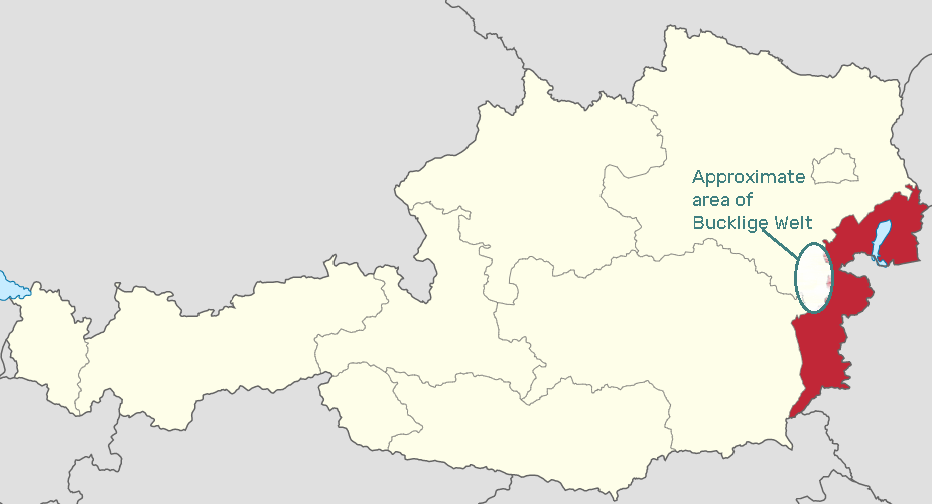
Burgenland is a state of Austria encompassing the entire eastern border adjacent to Hungary. The Bucklige Welt, or Hunchback World, is a region of foothills situated in the southeastern corner of Lower Austria particularly suited to hiking and biking. Also called “The Land of a Thousand Hills,” Bucklige Welt shares the northern corner of Burgenland. As an American “tourist,” I’d describe the area as Austria’s best-kept secret.
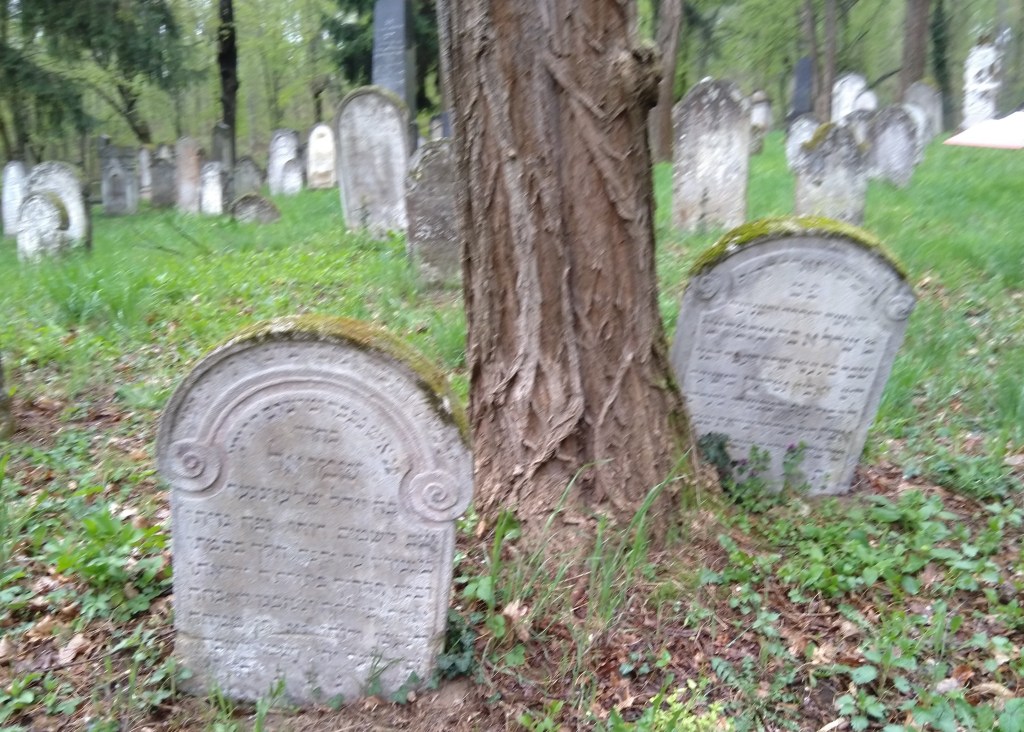
The secrets to my Semitic past have been left behind in the remaining homes, synagogues, and cemeteries of the Austrian Jews from the former Austro-Hungarian Empire. The unfortunate tides of history have forever altered access to those secrets. Homes and synagogues were torn down and aryanized while cemeteries were desecrated and/or destroyed. Larger cemeteries in key cities were often lost to the ravages of war. Many of those cities, such as Wiener Neustadt, have made quite successful attempts at restoring their historical town centers to their former glory, despite the loss of vibrant and thriving Jewish sectors. (more…)
I first learned about Edward Wightman from David Damron, a member of Stories From the Past‘s Facebook group. Wightman is Damron’s 12th great-grandfather, and holds the dubious distinction of being the last man burned at the stake for heresy in England. But if there’s any justice in this world, Wightman’s great-grandson Valentine was it.
Edward Wightman was born in 1566 in Burbage, Leicestershire, England. Edward’s family were members of the Church of England, the approved church in England at the time, but Roman Catholicism was at least tolerated, if not accepted. The family had no special leanings outside of the church.
In a time where it was uncommon for a married woman to hold a job, both of Edward’s parents were employed. Edward’s mother was a draper (someone who sells cloth), and his father, a schoolteacher. As Wightman grew into adulthood, he followed his mother’s footsteps and moved to Shrewsbury to apprentice as a draper.
It was in Shrewsbury where Edward was introduced to, and began exploring, a radical type of Protestantism rejecting the divinity of Jesus Christ and the holy trinity. Wightman was admitted as a master draper into the Shrewsbury Draper’s Company in 1590, and he opened his own clothing business at Burton-on-Trent.
Edward’s puritanical turn from both the Church of England and the Roman Catholic church would have been problematic anywhere in England during the early 17th century after King James I took the throne. King James tolerated Catholics while pushing for a more liberal Church of England, but puritans were looked upon with scorn and suspicion. But Edward wasn’t alone in his change. Many of the town’s other business leaders had become involved in a town-wide transformation to puritanism despite the greater established, “acceptable,” religious community.
In the late 1590’s England hit an economic downturn, and Edward’s clothing shop was no longer able to turn a profit. Edward then opened an alehouse, likely borrowing money for it. And although Edward was still looked upon as a community leader, by 1603 he was completely impoverished.
Five years later, Edward’s luck in the religious community also began to change. In January 1608, Edward told guests staying in his home that it was his belief that the soul stays with the body even after death, and will only be released upon Judgement Day, when all souls will stand before God and be assigned either to heaven or hell. This was Edward’s first step away from the religious community of Burton who barely tolerated puritans in the first place, and took a solid stance of either Catholicism or Anglicanism.
Edward continued to voice his disagreement with established theology, and quit attending services at the Burton Parish Church. Religious leaders of the area began meeting with Edward privately in an attempt to convince Edward of the “wrongness” of his ways. But Edward continued to persist in openly challenging the crown’s religious norms. It was not long before Edward became locked in public heated exchanges with community religious leaders. Those same leaders began writing and preaching sermons in opposition to Edward’s views in attempt to quell the exodus of their own followers.
As Edward’s public outcries continued, so did his determination to share his beliefs. Although he was never anything more than a lay leader, he developed a following which further enraged the officially recognized religious leaders in the area. He spent large amounts of time writing manuscripts detailing his views. It was even said that he would never leave home without his books which he would preach from whenever he could find a listening ear.
Because of Edward’s refusal to align with both Catholicism and Anglicanism, he was seen as a direct opponent to the King. Knowing he was borrowing trouble, Edward compiled a detailed explanation of his theology, and delivered copies to the clergy. It was most unfortunate that he even chose to deliver a copy to King James himself. While open exchanges of opinion and peaceful demonstrations are part of the human discourse in the 21st century, the only opinions that accounted for anything in 17th century England were those of the King and his trusted advisers. Edward had just handed the king a detailed summary of evidence to be used against him.
None of Edward’s many writings survived to tell Edward’s side of the story. It is unknown how much is actually accurate, but at least sixteen charges were leveled at him:
There is no Trinity;
Jesus Christ is not God, perfect God and of the same substance, eternity and majesty with the Father in respect of his God-head;
Jesus Christ is only man and a mere creature and not both God and man in one person ;
Christ was never incarnate and did not fulfill the promise that the seed of the woman shall break the serpents head;
The Holy Ghost is not God, co-equal, co-eternal and co-essential with the Father and the Son;
The three creeds of the apostolic church are the heresies of the Nicolaitanes;
He, Edward Wightman, is the prophet spoken of in Deuteronomy 18 in the words “I will raise them up a prophet” and in Isaiah “I alone have trodden the wine press” and in that place “Whose fan is in his hand”;
He was the Holy Spirit, the Comforter spoken of in John 16;
The words of Jesus on the sin of blasphemy against the Holy Spirit refer to him;
The fourth of Malachi refers to his person (the prophecy of Elijah);
The soul and body does sleep and this sleep is the first death, and that the soul and body of Jesus did also sleep in the sleep of death;
The souls of the elect departed (that is dead) are not in heaven;
The baptizing of infants is an abominable custom;
The practice of the Church of England in reference to the Lords Supper and baptism are incorrect and baptism of water should be administered only to those with sufficient age and understanding;
God has ordained and sent him, Edward Wightman, to do his part in the work of the Salvation of the world, (to admonish the heresy of the Nicolaitanes); in comparison to Christ who was sent to save the world and by his death to deliver it from sin and to reconcile it to God;
Christianity is not wholly professed and preached in the Church of England, but only in part.
I actually agree with at least a couple of Edward’s “heresies,” but whether one believes or does not is of no consequence today. Our world today is full of varying opinions of God or of no God. Most subscribe to the belief that all people should be allowed to worship, or not, according to the dictates of their own conscience. Perhaps I would have joined Edward’s funereal pyre if I had lived back then.
The Sentence
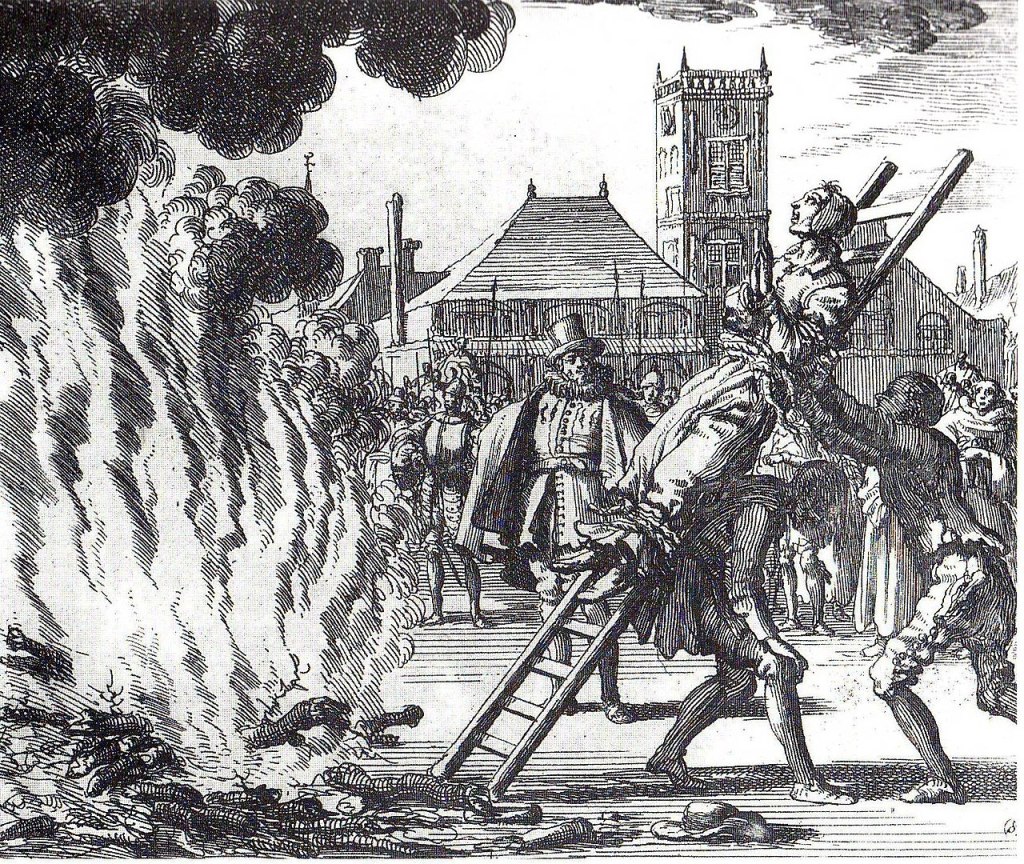
Edward’s sentence was pronounced on December 14, 1611. He was to be burned at the stake on March 20, 1612. On that day, Edward was tied to a post in the midst of a pile of fast-burning sticks. As the fire licked at his legs and feet, he cried out in pain, begging to recant his heresy. People in the crowd waded in to relieve Edward, pulling at the burning wood to reach him. Several were severely burned in the process, but Edward, also badly burned, was released from his scorching prison.
Edward’s relief was only temporary. While he recovered, a recantation was written and Edward agreed orally. But when he could finally use his burned hands well enough to put pen to parchment, he refused to sign. He was sent back to the fire on April 11, 1612. Once again, Edward screamed out in pain as the fire reached him, again begging to recant. This time, the sheriff was having none of it and ordered more bundles of sticks to be added to the raging inferno.
Edward was reduced to ashes, but he’d just been made a martyr for the puritan cause. King James was quickly learning that the threat of death meant nothing to the religious rebels, and that martyrdom increased uprising. With more and more puritan sects arising, it was decided that it would be better send the guilty quietly off to spend the remainder of their lives in prison rather than make a public spectacle of the outspoken believers. After Edward, it was agreed that convicted heretics should no longer be burned at the stake. However, it took another 65 years to finally secure an act of Parliament forbidding the burning of heretics.
Edward was married to Francis Darbye during his early years as a draper. They had seven children, two boys and five girls. Little is known about the fate of most of Edward’s descendants, but Edward’s oldest son, John Wightman, emigrated with four of his five sons to Rhode Island Colony in America in 1654. John’s wife, and mother to the five sons, most likely died in England before the family’s departure.
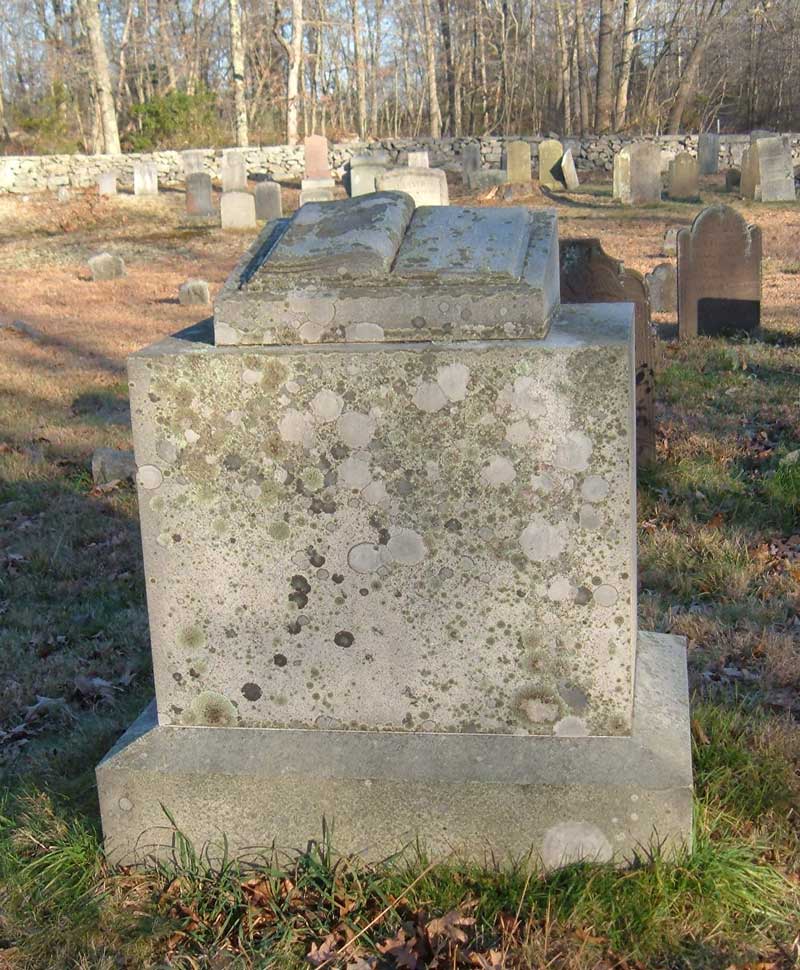
John’s youngest son, George Wightman (1632–1722), had at least four sons and one daughter. Most of George’s children remained in Rhode Island, but George’s youngest, Valentine Wightman (1681-1747), struck out on his own, making a name for himself and his family in both Connecticut and New York.
Edward’s great-grandson Valentine turned out to be Edward’s saving grace. Like Edward, Valentine had a passion for both politics and religion, and at just 18, found himself in the midst of a political uprising in North Kingstown. At 20, Valentine joined the Free Will Baptist Church of Kingstown. The next year, Valentine married Susannah Holmes, granddaughter of the well-known Baptist minister, Reverend Obadiah Holmes who refused to quit his Baptist ways and had been publicly whipped for his “heretical” beliefs.
When Valentine was just 23, he was called upon to lead a small group of religious dissenters from Groton Connecticut. Valentine agreed, becoming Connecticut’s very first Baptist minister and initiator of the colony’s lasting Baptist heritage. In return for his service, Valentine and his new family were given twenty acres of farmland and a house which served as the first Baptist parsonage in Connecticut.
Like his great-grandfather, Valentine became a leader in the face of political oppression. Puritanism was the only accepted religious order allowed in Connecticut Colony. He was subpoenaed in 1707 to answer charges of heresy, and ordered to leave the colony. Valentine refused, and was once again called to court where he was fined 20 shillings for his obstinacy. The harassment continued until 1708 when a law was passed banning religious itolerance.
For the remainder of his years, Valentine found favor within the religious community and spent much of his time as a traveling minister. He established baptist churches throughout the area, and is even credited with the establishment of the first Baptist church in New York City.
I think Edward and Valentine would have found much to disagree with on the subject of Christianity, and had they known each other, there may have even been some animosity between them. But Edward’s great sacrifice was the beginning of a new era in Anglican Christianity, and Valentine lived to see the rewards of it. It’s quite possible that Valentine held his great-grandfather’s determination and commitment in great respect, and vowed to follow his example. Valentine lived to be an active participant in the Great Awakening, and by the time he died in 1747, religion was no longer compulsive by law but a personal freedom.
Last month, one of my readers commented on my newsletter that readers are an audience, and that I can do what I want without consulting them. Please don’t get me wrong, it is valuable advice for many blogs, but when I started Stories From the Past, I meant for it to be something bigger than that. I wanted this to be a place to revive the stories of “average” people who slipped out of this life and into obscurity. While their lives may have seemed unimportant and mundane to them, following generations don’t necessarily agree. There are stories of heroism left unwritten, lessons to be learned, entertaining insights, and great ideas that are otherwise lost to the world if they are not put into words and made accessible, so input from my readers is extremely valuable to me.
For history nuts like myself, reading and telling stories of bygone days is fun, but I am repeatedly told that telling the true stories of past generations is a valuable service. There are plenty of biographical tidbits all over the internet, in books and other published media, but I wanted this to be a place where otherwise untold stories could find a home.
What I really want is for this to be an interactive site where I am not only telling stories from my own family’s past, but incorporating stories from readers, collecting stories from friends, inviting others to submit their own stories, and reaching out in search of lost stories. It’s done well by me so far, and I want to do well by my contributors, so the monthly newsletter will continue to act as a way to reach out to family, old friends, new friends, and new-found cousins for feedback and more stories. And, of course, it will always continue to function as foundation for accountability on my part.
What am I Doing Wrong?
Last month I set up a Go-Fund-Me fundraiser to help me get to Austria. I was so excited when less than five minutes after publication I had a $100 donation. Great! I thought, I’m on my way. Then nothing. I posted to Facebook, LinkedIn, made an individual Facebook message for many of my friends, and still got nothing other than that one original donation. I would really love for someone with Go-Fund-Me experience to give me some advice. I must be doing something wrong . . .
In the meantime, my Fundraiser will stay open until I have received enough donations and/or saved enough to go to Austria. Even if I have to go later. I may miss the museum inauguration, but I can still go when I can afford it.
Still in the Race
I didn’t get a whole lot done last month, but I am still plugging along on two or three hours a day, five days a week. I’m definitely not moving at Stephen King pace, but I am happy that I’m still going.
February 5 is Chinese New Year. I don’t want it to be forgotten. In fact, I intend to include a series of stories for my husband’s Chinese family. However, I have rarely mentioned my husband. This is mostly due to the fact that my husband is a high-functioning adult with autism. Anyone with autistic family members may be quite aware that people with autism have little to no interest in thoughts, ideas, activities, or events that do not directly affect them, so when I brought up the idea of researching his ancestors, he told me, “Why don’t you just leave them alone? They’re dead. They don’t care.” LOL. I ignored him and kept on researching and writing.
So in honor of my husband, I intend to make this month’s Raising Voices about something that directly affects him: disability, and the misuse of terms like idiot, retard, and even disability. In the future, I’ll be focusing more on stories from his Chinese background.
So here’s what’s going on this month:
January Review:
Mary Eynon ancestor profile page (not a post) -incomplete
Living in Northern Kentucky, the lap of the Underground Railroad, has been an eye-opener for me. Since moving here I have learned that Kentucky has the unique distinction as the land where the civil struggle between the Union and Confederate states reaches much deeper than North vs. South.
Kentucky was a slave state before the Civil War, but it never fell to Confederate control. In fact, it was the first of the four “border states” between North and South to succumb to Union control. Because the commonwealth of Kentucky had both a Union and a Confederate constitution, the struggle between the opposing forces reached not only into neighborhoods, but into the very hearts of families where brother fought against brother, and cousin against cousin. In fact, Kentucky’s most infamous family feud, Hatfields vs. McCoys, is said to have begun over family members fighting on opposite sides of the Civil War.
Isaac Johnson, 1844-1905
Some families were even further divided by race. Isaac Johnson’s autobiography, Slavery Days in Old Kentucky. A True Story of a Father Who Sold His Wife and Four Children. By One of the Children, is the story of a child born into a family with a white father and a black mother. Isaac’s family began in the traditional sense with a mother and father living as a happy family in nearly every sense but one: Isaac’s parents were never married, and even though they lived as husband and wife, Isaac’s mother, Jane Johnson, was actually Richard Yeager’s slave.
Yeager had originally desired nothing more than a simple family life with his common-law wife and their four boys, but he eventually gave in to the social constraints bearing down on him and made the fateful decision abandon pretense and sell off Jane and her children. Isaac’s oldest brother, Louis was nine and Isaac was seven years-old at the time.
The auctioneer continued his cry for bids and Louis was at last sold for eight hundred dollars. By this time we had taken in the situation, and it seemed as though my mother’s heart would break. Such despair I hope I may never again witness. We children knew something terrible was being done, but were not old enough to fully understand.
Isaac’s youngest brother was just two when he was separated from his father, mother, and older brothers for two hundred dollars.
Following his separation from his family, Isaac went through several owners and even made a couple of unsuccessful attempts to escape. His second escape attempt was met with the torture and murder of his fellow slave and good friend who was blamed for inciting the attempted escape.
It was the Civil War that offered Isaac his third escape attempt leading to his freedom. He found refuge with a Union regiment marching through Kentucky, and eventually enlisted in the First Michigan Colored Infantry which became part of 102nd United States Colored Regiment. Isaac stayed with his regiment until the war ended.
Upon war’s end, Isaac’s desire to see his final master amidst the destruction of his livelihood as as a slave owner led him to return to Kentucky one last time. He found his former master paralyzed and bedridden, but despite his debilitation, the master was happy to see his former slave. He welcomed Isaac as an old friend, telling him that he was the first of his slaves to leave and the first to return. He even offered Isaac a job with wages if he were to stay. Isaac. of course, could not forget the murder of his friend, and turned down the offer.
Despite his service to the Union, Isaac believed he would never be free until he left the States behind, so he moved to Ontario, Canada where he married Theodocia Allen. Isaac did finally return to the States, albeit just across the St. Lawrence river from Canada. Isaac stayed as a free man with his wife and seven children in Waddington, New York, where he worked as a stone cutter and mason on Waddington’s Town Hall.
Looking back at Stories from the Past in 2018, I have learned that monthly newsletters are my greatest success. Although I am still writing them more for my own benefit than that of others, they truly are a guideline for what to expect for the month. More importantly, my newsletters give me the opportunity to identify what went well and illuminate my trouble areas. Making them public invites my readers to cheer me on and/or provide helpful suggestions and constructive criticisms.
My newsletters have become my boardroom. Welcome to the board!
The Race is not Necessarily Won by the Swiftest
2019 certainly has not begun as I envisioned for Stories From the Past. I have encountered a few obstacles, and rather than let them keep me down, I am choosing to accept the stumble, and even the fall. As long as I am willing to pick myself up, dust myself off, and apply band-aids where necessary, I can make it to the finish line.
The transition between 2018 and 2019 reminds me of Aesop’s fable, The Tortoise and the Hare. The tortoise won the race by continually moving forward while the hare napped. I moved much slower than I wanted to last year. Sometimes I was more like the hare, and I am not at all happy about that. What I am happy about is that I finally started moving again as the year came to its close and that I am still moving.
Facing Obstacles
An unexpected, but very welcome, obstacle means that I’ll be postponing my official launch for a few months. I am planning a trip to Austria where I can meet my story-telling face-to-face. I have been invited to the opening ceremony of a museum exhibit featuring the people that once thrived in the Bucklige Welt-Wechselland Region of Austria before Hitler’s reign of terror and the Shoah. Not only will I be able to learn more about my own family’s stories, but I will hopefully gather the stories of their friends and neighbors as well.
I have a lot to do to prepare for the trip. This week alone, I’ll be applying for a new passport (I haven’t been out of the country for more than 17 years!), beginning a new course in German from Rosetta Stone, and creating a Go-Fund-Me account to help with basic expenses for the trip. Of course, I’ll also need to forward my acceptance to the invitation, arrange for lodging and travel while I am there, etc. The only other time I’ve been to Europe was when I was doing study abroad, and most of the arrangements were done for me. There’s much more to trip planning than I remembered.
I also need to go back through my records in an attempt to trace the funds donated through Facebook last year. At this point, I am not recommending that anyone donate to Facebook’s charitable causes. I’ll be happy to let you know if my opinion changes.
What Happened to the Second Wife’s Story?
December was a huge struggle for me. With barely a nod to Hanukkah, I found myself mired in four stories originally intended to be just one. Although I am glad that I decided to tell the stories separately, the final story came after Christmas when I was supposed to be wrapping up the second Chapter of Mary Davis Skeen’s biography.
As December drew to a close, I found myself mired in research for Mary Eynon Davies, mother of Mary Davis Skeen. I was supposed to have had Mary Eynon’s profile page up by the end of the month, along with a first and second chapter of the story. Instead, nothing was posted in regards to The Second Wife’s Story.
I am behind on my writing, but that doesn’t mean I am behind on my goal to publish the Second Wife’s Story by the end of 2019. It just means that I need to find a better way to accomplish that goal. I CAN STILL do this.
I need a better way to accomplish that goal. Like most of my profile pages, Mary Eynon’s will be incomplete when I post it tomorrow. A new post will appear when new profiles appear and when changes are made to existing profiles. I may also have to post chapters in parts (Why not? I did it with my Christmas Tree stories.), and they may even appear out of order, but at least my progress will be evident on Chapter One, and maybe even Chapter 2 by the end of January. Everything will be linked in order on The Second Wife Story’s book page.
My new focus is to be on The Second Wife’s Story first, ancestral stories second, and stories found along the way third. Each month will have a social-historical focus, and for each monthly focus, I will provide a short summary or review along with link/s to the original story/ies.
Since January’s focus is black history month, I’ll be looking at a story from North American Slave Narratives: a collection of books, articles, and journals telling the stories of Black America’s quest for freedom and equality, beginning with my home state: Kentucky.
Reassessment
Once again, I am reminded of James Clear’s prescription, “if you want to set your expectations appropriately, the truth is that it will probably take you anywhere from two months to eight months to build a new behavior into your life — not 21 days.”
I have learned that the early morning writing routine does not work for me because I am usually picking my daughter up from work at midnight. By the time I wake up around eight or nine, everyone else is getting up too. My best time to focus without interruptions is during the middle of the day when my granddaughter is at school and my husband is at work. This is not my morning job; it is my day job.
“It’s failure that gives you the proper perspective on success.”
– Ellen DeGeneres
I’ll be making a few minor changes as well:
Monthly Headers (a cosmetic change–you’ll know it when you see it)
Story Teasers (I’m already using these, but I need to update past posts)
Newsletters will be posted on the last Monday of the previous month when the first day of the month falls on a Tuesday or Wednesday.
December Review
Objectives met are crossed out.
Navajo Greetings and exploration of the name (Navajo vs. Diné)
Hanukkah for non-Jews (with a nod to rembembering the Shoah)
A Slovenian Christmas Eve (Recipe and Tradition)
(n)O Christimas Tree (Stories from Olean, New York, and Lark, Utah)
I hope you had a Merry Christmas. Today’s post might seem anticlimactic, but I think I just got too ambitious by adding Midnight Mass to my Christmas celebrations. (It was truly beautiful, though.) I gave serious thought to saving the fourth Christmas tree story for next year, but I promised a fourth story, so here it is.
I saved the best for last.
Dad is the only person I know who laughs harder when telling his stories than anyone else does. His laughter is contagious, which makes his stories all the more entertaining. Dad is also the only Pollack I know who told Pollack jokes when Pollack Jokes were trendy. His light bulb joke comes to mind:
Dad: How many Pollacks does it take to screw in a light bulb?
Me: I dunno. How many?
Dad: Five. One to hold the light bulb, and four to turn the chair.
Ba dum bum ching.
I think the best Pollack joke told by Dad, is actually a story that happened to him. It happened just before a staff meeting at work several decades ago. A man had come from out of town, and when introduced to my father, said, “Oh, yer a Pollack, eh?” Of course, the man had to follow up with a Pollack joke. Dad laughed. He could appreciate a good joke after all. But the poor man couldn’t be stopped. He continued telling every Pollack joke in his repertoire, and as time went on, the jokes became more off-color and inappropriate.
Dad was no longer laughing, and finally interrupted with a question, “Do you speak Polish?”
“No.” The man replied.
“How does it feel to be dumber than a Pollack?”
That put an effective end to the Pollack jokes.
Dad’s Christmas tree story is a story that sounds more like a Pollack joke, but it really is a story. It’s also more my grandfather’s story than my dad’s; but I never knew my grandfather. Dad told the story many times over the years, usually around Christmas time, and I never got tired of hearing it. Of course, I had him retell it at least three times this year in preparation for this blog post.
The story happened in Olean, New York before my father was born and before my grandparents were married in 1931. Grandma was seventeen and my grandfather was nineteen when they were wed, so he would have been a teenager at the time. Probably in the late 1920s. Grandma was not involved in the story, but it would not surprise me if she had also been one of the storytellers over the years.
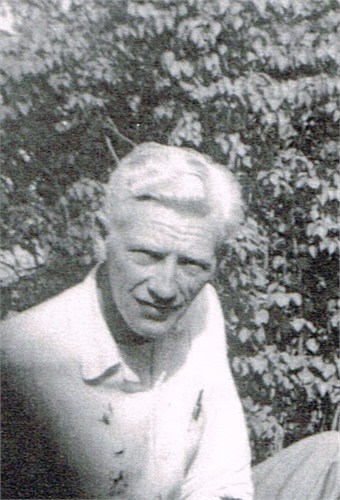
Chester John Kwiatkowski, “Chet” This is currently the only photograph I have available of my grandfather.
In the Kwiatkowski family, the boys were responsible for getting all the trees for heads of households. This was quite a big job because the family included households on the Szadlowski side (my great-grandmother’s side). It probably included living grandparents, married brothers, and uncles. In all, the amount of trees required numbered about fifteen. That’s just an educated guess from counting all the males older than my grandfather who were living at the time.
As was the tradition, Chester John Kwiatkowski (“Chet”) and his brother, Dad can’t remember whether it was Edward or Michael, set off to locate and chop down suitable trees for the whole family. I’m guessing that they must have driven to the hills nearby, because it certainly would not have been easy for two young men to get fifteen trees home in one trip. Either way, it would have taken the better part of a day.
Their job wasn’t done when Chet and his brother arrived home, though. They still had to allocate each tree to each family. I can imagine the brothers breathing a sigh of relief when the last tree was handed out. Maybe the brothers were getting ready for bed. Or more likely, since the job probably took at least a couple of days, the brothers were getting ready to head off to other activities when a knock came to the door.
It was Uncle Matt Szadlowski.
Matt had come to collect his tree. I’m sure the boys exchanged guilty looks. They told Matt they’d be right back with his tree and headed for the back door. Uncle Matt must’ve wondered what took the boys so long.
At the back door, the boys scanned the horizon, wondering how to come up with a suitable tree, and fast. It was at this point where one brother turned to the other and said, “What are we gonna do? It’s too late to go back to the hills for another tree.”
After a bit of thinking, one of them pointed out, “Matt’s got two trees in his front yard lining his walk. He won’t miss one of them.” Off the boys ran to Matt’s house. After a longer than usual wait for Uncle Matt, the boys came back in with a very nice tree.
I don’t know if Matt noticed right away, or if he figured it out when he arrived home, but Dad tells me that Uncle Matt was no dummy. It did not escape his notice that there was a sawed-off stump in his yard where a tree had once been. It wasn’t the stump that Matt brought up to the boys, though. It was the tree’s uncanny resemblance to the one that used to be in his front yard. It was a perfect tree, Matt told them; just the right size and shape for a Christmas tree, but it did look an awful lot like the missing tree.
Not so, the boys told their uncle. The tree in Matt’s living room was shorter and had been chopped. The stump in the yard had been sawed. Matt verbally accepted the explanation, but I’m pretty sure that both my grandfather and his uncle Matt knew that they couldn’t hide the truth that they had chopped the tree down, cut it to size with the ax, then sawed the stump in an attempt to provide an alibi.
I wonder if uncle Matt ever replaced the missing tree?
Now that Christmas is over, and the majority of us have made it through the season with our landscape intact, I hope you have a very Happy New Year!

























 StoriesFromthePast.com