Category: Daniel

  • 2019 Meeting of the Board

    2019 Meeting of the Board

    Looking back at Stories from the Past in 2018, I have learned that monthly newsletters are my greatest success. Although I am still writing them more for my own benefit than that of others, they truly are a guideline for what to expect for the month. More importantly, my newsletters give me the opportunity to identify what went well and illuminate my trouble areas. Making them public invites my readers to cheer me on and/or provide helpful suggestions and constructive criticisms.

    Photo by rawpixel.com on Pexels.com

    My newsletters have become my boardroom. Welcome to the board!

    The Race is not Necessarily Won by the Swiftest

    2019 certainly has not begun as I envisioned for Stories From the Past. I have encountered a few obstacles, and rather than let them keep me down, I am choosing to accept the stumble, and even the fall. As long as I am willing to pick myself up, dust myself off, and apply band-aids where necessary, I can make it to the finish line.

    The transition between 2018 and 2019 reminds me of Aesop’s fable, The Tortoise and the Hare. The tortoise won the race by continually moving forward while the hare napped. I moved much slower than I wanted to last year. Sometimes I was more like the hare, and I am not at all happy about that. What I am happy about is that I finally started moving again as the year came to its close and that I am still moving.

    Facing Obstacles

    An unexpected, but very welcome, obstacle means that I’ll be postponing my official launch for a few months. I am planning a trip to Austria where I can meet my story-telling face-to-face. I have been invited to the opening ceremony of a museum exhibit featuring the people that once thrived in the Bucklige Welt-Wechselland Region of Austria before Hitler’s reign of terror and the Shoah. Not only will I be able to learn more about my own family’s stories, but I will hopefully gather the stories of their friends and neighbors as well.

    I have a lot to do to prepare for the trip. This week alone, I’ll be applying for a new passport (I haven’t been out of the country for more than 17 years!), beginning a new course in German from Rosetta Stone, and creating a Go-Fund-Me account to help with basic expenses for the trip. Of course, I’ll also need to forward my acceptance to the invitation, arrange for lodging and travel while I am there, etc. The only other time I’ve been to Europe was when I was doing study abroad, and most of the arrangements were done for me. There’s much more to trip planning than I remembered.

    I also need to go back through my records in an attempt to trace the funds donated through Facebook last year. At this point, I am not recommending that anyone donate to Facebook’s charitable causes. I’ll be happy to let you know if my opinion changes.

    What Happened to the Second Wife’s Story?

    December was a huge struggle for me. With barely a nod to Hanukkah, I found myself mired in four stories originally intended to be just one. Although I am glad that I decided to tell the stories separately, the final story came after Christmas when I was supposed to be wrapping up the second Chapter of Mary Davis Skeen’s biography.

    As December drew to a close, I found myself mired in research for Mary Eynon Davies, mother of Mary Davis Skeen. I was supposed to have had Mary Eynon’s profile page up by the end of the month, along with a first and second chapter of the story. Instead, nothing was posted in regards to The Second Wife’s Story.

    I am behind on my writing, but that doesn’t mean I am behind on my goal to publish the Second Wife’s Story by the end of 2019. It just means that I need to find a better way to accomplish that goal. I CAN STILL do this.

    I need a better way to accomplish that goal. Like most of my profile pages, Mary Eynon’s will be incomplete when I post it tomorrow. A new post will appear when new profiles appear and when changes are made to existing profiles. I may also have to post chapters in parts (Why not? I did it with my Christmas Tree stories.), and they may even appear out of order, but at least my progress will be evident on Chapter One, and maybe even Chapter 2 by the end of January. Everything will be linked in order on The Second Wife Story’s book page.

    My new focus is to be on The Second Wife’s Story first, ancestral stories second, and stories found along the way third. Each month will have a social-historical focus, and for each monthly focus, I will provide a short summary or review along with link/s to the original story/ies.

    Since January’s focus is black history month, I’ll be looking at a story from North American Slave Narratives: a collection of books, articles, and journals telling the stories of Black America’s quest for freedom and equality, beginning with my home state: Kentucky.

    Reassessment

    Once again, I am reminded of James Clear’s prescription, “if you want to set your expectations appropriately, the truth is that it will probably take you anywhere from two months to eight months to build a new behavior into your life — not 21 days.”

    I have learned that the early morning writing routine does not work for me because I am usually picking my daughter up from work at midnight. By the time I wake up around eight or nine, everyone else is getting up too. My best time to focus without interruptions is during the middle of the day when my granddaughter is at school and my husband is at work. This is not my morning job; it is my day job.

     “It’s failure that gives you the proper perspective on success.”

    – Ellen DeGeneres

    I’ll be making a few minor changes as well:

    • Monthly Headers (a cosmetic change–you’ll know it when you see it)
    • Story Teasers (I’m already using these, but I need to update past posts)
    • Newsletters will be posted on the last Monday of the previous month when the first day of the month falls on a Tuesday or Wednesday.

    December Review

    Objectives met are crossed out.

    • Navajo Greetings and exploration of the name (Navajo vs. Diné)
    • Hanukkah for non-Jews (with a nod to rembembering the Shoah)
    • A Slovenian Christmas Eve (Recipe and Tradition)
    • (n)O Christimas Tree (Stories from Olean, New York, and Lark, Utah)
    • Mary Eynon ancestor profile page (not a post)
    • The Second Wife’s Story, Chapter 1, Wales
    • The Second Wife’s Story, Chapter 2, Aboard the Clara Wheeler: from Liverpool to New Orleans

    January Preview

    • Mary Eynon ancestor profile page (not a post)
    • The Second Wife’s Story, Chapter 1, Wales
    • The Second Wife’s Story, Chapter 2, Aboard the Clara Wheeler: from Liverpool to New Orleans
    • North American Slave Narrative: the story of Thomas W. Burton
    • Tante Rosa and Tante Rosa’s stories
    • February’s Newsletter

    Tentative stories for the upcoming months:

  • . . . and I’m back.

    . . . and I’m back.

    Over the summer, Stories From the Past was never far from my mind. In fact, I felt a lot of anxiety over no posts, but between two grandkids and a broken PC (I have six grandkids but two were staying with me), my ability to blog was reduced to bits and snatches of time with a tablet or a phone. Have you ever tried to blog from your tablet or phone? Well, I’m a perfectionist, so I wasn’t even going to attempt it. In fact, I suffer from perfection paralysis. It’s a real thing, which means that if I can’t do something right, I’m not going to do it at all. Thankfully, knowing you have a problem is the first step in solving it, and I am now working hard to get over my fear of doing a less-than-perfect job. Now that both grandkids are back at home and in school, and I have a new PC,  Stories From the Past is ready to roll, and I’m gearing up to launch a professional, remodeled, website for 2019.

    back at work
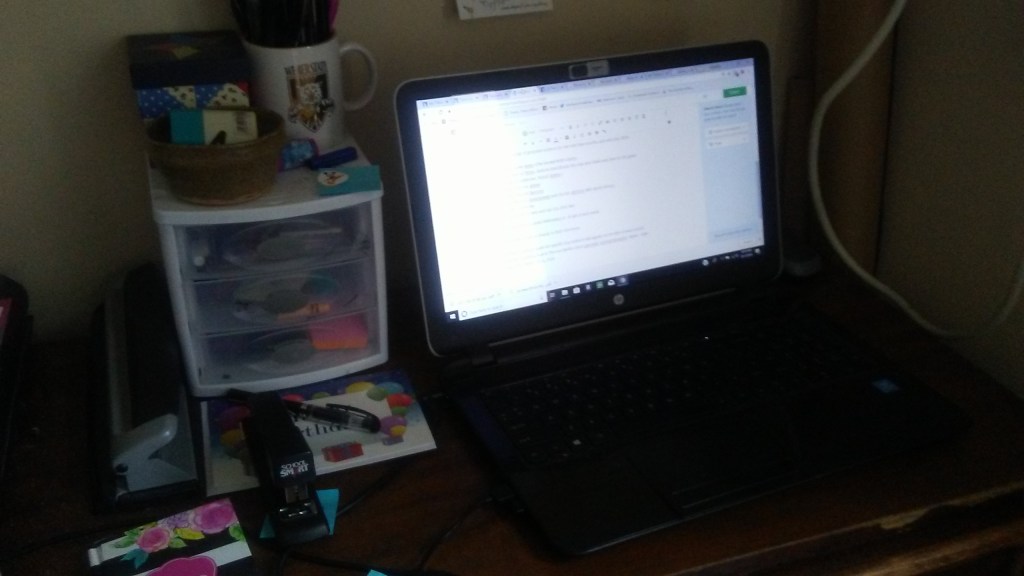
    back at work  ( I hope it’s true that a messy desk is a sign of a genius mind.)

    Many of you are waiting for stories about your own ancestors, and if I told you I’d be writing about them, I WILL. In fact, I hope to be turning several of them into books. I’m getting started right away on at least one of them, but I consider this just the beginning, knowing it can only get better from here.

    I don’t have a set priority list, with the exception of the story that started it all, and that will be The Second Wife’s Story. Mary Davis Skeen is the subject of my first book, so all of you Davis/Davies/Skeen progeny can look forward to getting the first read. I plan to publish the unedited book one chapter at a time. I’ve been planning to author a book for more than three decades now, so all I can say about that is it’s ABOUT time!

    So here is my list of proposed subjects for the next few months and well into 2019:

    • Mary Davis Skeen (The Second Wife’s Story)
    • The Jews of Pitten, Austria (Specifically the ones who lived next door to my great-great-grandfather, Rudolf Abeles.)
    • Rosa Rebecca Abeles
    • Mary Rogers Damron
    • Sgt. Bernard Kwiatkowski and the WWII 5th Airforce 90th Bomb Group
    • new cemeteries
    • Kentucky slavery and the U.S. Civil War

    Blog posts are scheduled Wednesday at 10 AM of each week.

    Next Week: A special thanks to Ruth Contreras

    Ancestor Landing pages for specific blog subjects will appear on the first of each month. October’s Landing page is Thomas Davies (1816 Llannelly, Carmarthenshire, Wales – 1899 Plain City, Weber, Utah, USA)

  • Family Xenophobia

    Family Xenophobia

    Today marks the 32nd anniversary of the first official observance of Martin Luther King, Jr., Day as a national holiday in the United States, and on this day I felt it important to tell the stories of “othering” in our own personal family trees.

    Before I get started, let me make a disclaimer. In no way do I intend to downplay the significance of discrimination experienced by Americans of  African descent. There can be no excuse made for the maltreatment of Black Americans today and in the history of the United States. It’s just that today seems like the best time to focus on xenophobia in my own family history. Not that it matters to me, but there is no evidence of African blood in my DNA, and I have simply not found any such stories to tell.  Not yet anyway.

    I was raised in a community where the “others” were often those of different religions. I grew up in Utah as a member of the Church of Jesus Christ of Latter-day Saints (LDS or “Mormons”). I wasn’t necessarily taught this othering at home, but I saw it and learned it from the discourse around me: at school, in social gatherings, in the workplace, and at church. Many Utah LDS families inherited a deep distrust of outsiders from their ancestors who experienced persecution and intense harassment leading to an official extermination order from the state of Missouri and their eventual exodus from Illinois to what was then Mexican Territory.  Terms like prejudice and racism never entered the conversation, and I was well into adulthood before I learned to put a name to the fear that governed that public discourse. The name is xenophobia, an intense and irrational fear of aliens. I’m not talking about little green guys with antennae growing out of their heads coming from distant planets; I am talking about human beings coming into our communities from different places, cultures, and religions.  Here in the United States, that can be anyone.

    Dad’s Story

    So I begin with a simple story from my father’s childhood. Dad was born in Olean, New York and lived there until he was thirteen. During the 1940s, he attended Olean Public School no. 7. As Dad tells it, there were two doors serving students in the school, the main door on the East, and a side door on the South. The side door had been claimed by a large group of Italian students at “the Italian door,” and when teachers weren’t looking, they patrolled the door for encroachments upon their self-proclaimed territory. The “Italian” door was closer to Dad’s route home, so one day he decided to leave through it. As he heard the door latch behind him, he knew he was in trouble; there was a group of kids waiting at the bottom of the steps. Dad took off at a run and managed to escape, but looking back at that day, Dad said, “I learned to run real fast.”

    Even though many Italian Americans share similar physical features, their mostly fair skin and European facial features keep them firmly entrenched in white-American society. The only way those schoolchildren truly knew whether one came from one European background or another, was to be well aware of families in the neighborhood and the other students attending their school. So when the Hawaiian Kwiatkowskis came to stay with family following their mother’s death in 1952, their unfamiliar faces and tanned complexions immediately identified them as alien.

    Tod and Ski’s Story

    Being the youngest of the Hawaiian clan, Ski doesn’t remember much about his trip to New York in 1952, and he does acknowledge that there are many reasons why resettling in New York didn’t work for Leo Kwiatkowski and his five children. However, the one obstacle to the widowed father and his family that Ski remembers well is the othering of himself and his siblings by New Yorkers who could not accept mixed marriages. As Ski put it,

    It was almost scandalous that a white man from New York was marrying a dark skinned Hawaiian woman.  But it was not at all as scandalous as some might have thought as a lot of us newer generation Hawaiians are mostly of mixed blood, so inter racial marriages started way back in Hawaii, where there really is no racial bias or prejudice. [sic.]  The only bias, if one could call it that, was a form of reverse discrimination where the Hawaiians were very wary of any white man and how he would fit into “our” society.  Our society is very, very different from that of the mainland U.S.  The most glaring difference is the mixture of races and the harmony in which we all live.  Japanese, Caucasian, Negro, Hawaiian, Filipino, Chinese, Korean, Puerto Rican, Portuguese, and the list goes on with as many ethnic groupings as the earth holds.

    Tod remembers that time as “a tragic and confusing time for five children, ages 14 to 5, and a single Father with no job, and no income.” Although both brothers admit that racism was just a part of the issues facing the young Hawaiians in New York, xenophobia often has the effect of further alienating families from the very places where they go to seek refuge, just as it did for this family.

    Mom’s Story

    The Jews of Europe know that story well. Those who survived the Holocaust and chose to return to their European homes faced an uphill battle to reclaim their ravaged property and maintain an uneasy peace among many of their neighbors. Their numbers are significantly reduced from pre-Holocaust days. Those who chose to seek asylum in the reformed nation of Israel have yet to find peace. Still others who scattered to the Americas denied their identity as a form of protection to their progeny. Such was my mother’s case, as she was in her early twenties when her mother finally revealed her Jewish identity.

    I grew up believing that racism and cultural bias did not exist in my Utah home. It wasn’t until I returned to Utah after living in California for two years that I could truly see the extent of xenophobia in my beloved mountain home. Although that’s another story for another time (and maybe a different blog), the most profound example came when my empty-nester parents moved into a typical Utah suburban home. One neighbor who came to welcome them into the neighborhood, exclaimed to my mother, “Thank goodness you are not blacks or Jews!” I’m sure she explained her reasoning that neither group could be trusted to my mother, but by that time, Mom was no longer listening and had firmly decided to look elsewhere for new friends.

    Tony’s story

    mixed race marriage
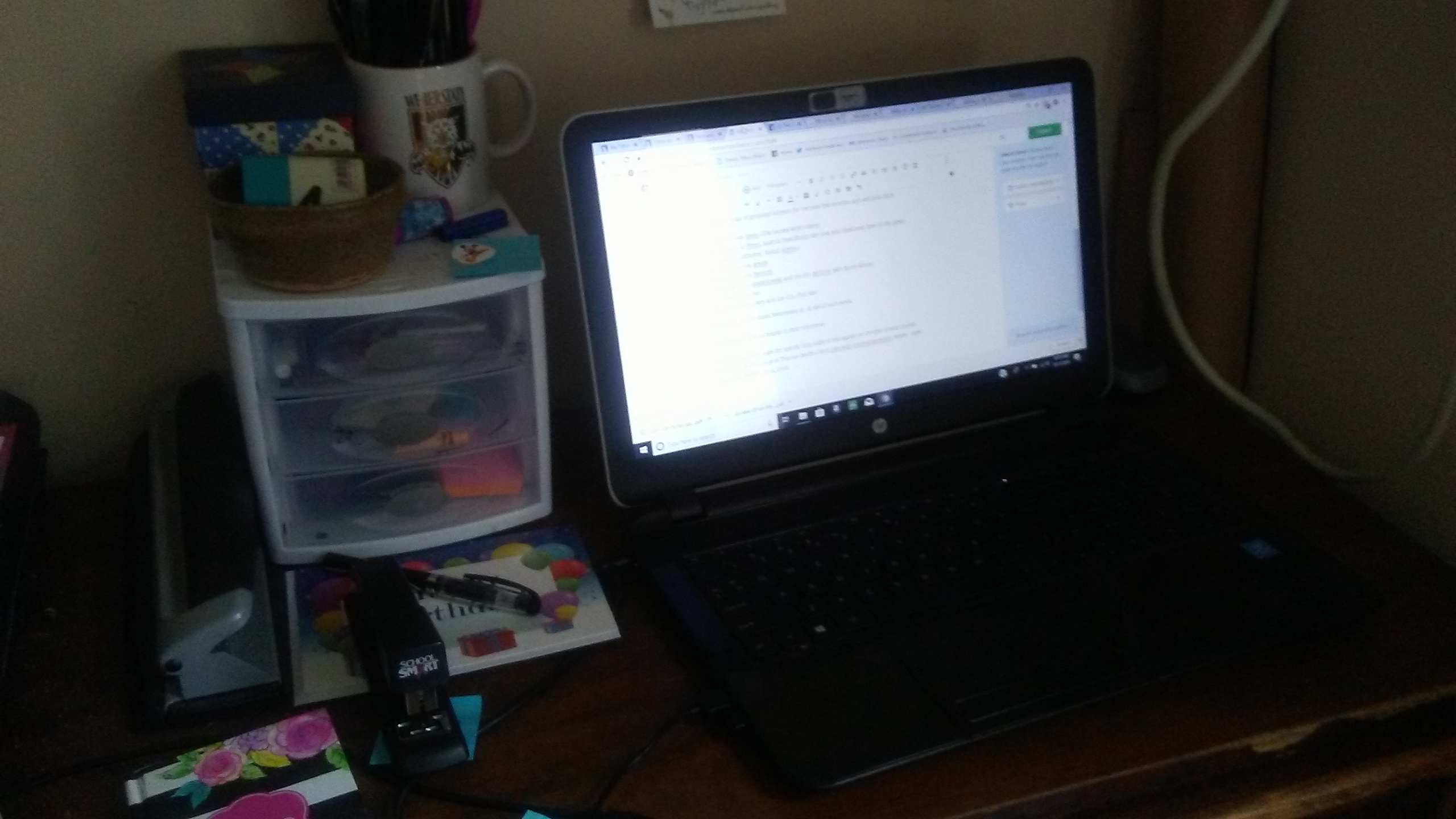
    Our engagement photo taken by Denise de la Foye, 2009.

    Now I have a confession to make. I am in a bi-racial marriage. Mine is not the first. It won’t be the last, but when we find such a thing among our ancestors it is not only a talking point, but often a source of contention. My husband was born in Hong Kong, China and came to the United States when he was just three months old. He grew up in the near suburbs of Chicago, and when people ask him what country he comes from, his answer is always the same, “The United States.” He grew up here. He knows nothing else, but unlike European Americans, his skin color and distinct facial features belie the fact that he was not born here. He goes by the distinctly Western name of Anthony, so when I tell people who have never met him that my husband is an immigrant and his name is Anthony (“Tony”), they nearly always say, “Oh, he’s Italian, right?” No.

    It seems pretty common for Chinese immigrants to take on an “American” identity when they come here. Most I have met go by names like David, Catherine, Alexander, and Marie. On his birth certificate, his name is Sai Fung, but on his naturalization papers, social security card, and other official documents, he has always been Anthony. We didn’t think anything of it until he brought his Illinois driver’s license into a Utah DMV to exchange for a new one. I was able to exchange mine within a matter of minutes. For Tony, it was a matter of months. Six years  and a move to Kentucky later, all of his legal documents identify him by a name no one but his siblings recognize. I blame xenophobia cloaked in our Patriot Act signed into law on my 36th birthday.

    As Tony was nearing the end of his legal paperwork nightmare, a casual encounter with a drunk man at a bus station revealed a side to Tony’s life that I had not yet seen or understood. The drunk man approached my husband, and said, “Fried rice on the side?” Giggling to himself, the man staggered off. It was not the first time my husband had encountered such ignorance, but it sure helped me understand Tony’s lament, “Sometimes I wish I was white.”

    We can’t deny that xenophobia exists all around us, and it would take willful blindness to claim that there is no racism in the midst of our families and ancestors. But we have to face it as it happens, and learn to acknowledge it. It is so easy to claim superiority based on the color of our skin and country of origin, but we must be wary as it happens to us. To be clear, my surname is Kwiatkowski, an obviously Polish name. As happened with the Italians in my father’s grade school, it would be just as easy to group together and claim racial superiority based on pure Polish blood. That is, until one encounters another who has had different experiences and sees life from a different narrowly appointed point of view.

    Yesterday, my dear cousin Bernie illustrated this point in a Facebook post quoting Thomas E. Watson, an American politician from Georgia. As Bernie pointed out, Watson is “Talking about [our mutual] ancestors from some hole* in Eastern Europe.
    *That would be Poland.”

    So here it is:

    “The scum of creation has been dumped on us. Some of our principal cities are more foreign than American. The most dangerous and corrupting horde of the Old World have invaded us. The vice and crime they planted in our midst are sickening and terrifying.” Thomas E. Watson, 1912

    It has not been my intent to preach or to politicize my family history. I simply want to create awareness. After events such as those in Charlottesville, West Virginia, last summer, I have become hyper-aware that xenophobia in the United States seethes barely beneath our surface.  We need a new way of looking at things, and I believe the best way to start is by acknowledging our mistakes of the past. We could also look to places, like Hawaii, that have managed to become true melting pots. As my cousin Ski explains, “Hang loose is an expression we use to say “Just chill, take it easy, there’s no need to rush” and it befits the island lifestyle.” We could learn a few things from the Hawaiians.

  • Life Gets in the Way

    Life Gets in the Way

    The hardest part of telling the stories of dead people is that it requires a living person to do it.  But sometimes life gets in the way, and that is what is going on with me right now. In fact, I had a plan way back in November, and I was well on the way to have it in place and moving smoothly by 2018. Then life happened.

    I have a lot to tell you, and it won’t take much time to tell that part of my story, but I just can’t fit it into my schedule for a few days. Please bear with me until I can get everything compartmentalized and reorganized.

    notfoundWhile some of this might have to do with procrastination (i’m good at that), most of it has to do with unexpected communication from my readers and just life in general. I’ll tell all; don’t worry. But before I go today, I really want to give a shout out to my three groups of readers, plus two individuals, that are helping pave the way for new and exciting changes for the new year:
    • Descendants of William Dolby Skeen and his two wives: Carolyn Smart Smith and Mary Davis. Theirs is the story that started it all, and I have not forgotten them by any means.
    • Descendants of Johannes (John) Kwiatkowski from Olean New York. Without your support and encouragement, I would not be contemplating a big step. An extra special thanks goes to my new-found cousin, Chuck, who’s caught the passion for telling the story that deserves to be told.
    • Ruth Contreras and the people of Bucklige Welt. I haven’t forgotten you, and I have no intention of doing so. I consider it my responsibility to play a part in making sure that the Jews of Bucklige Welt are not forgotten. I am still looking for those lost family members, and will let you know every time I find another one. And Ruth, I haven’t forgotten that I still owe you an email response.
    •  Diedre McLean, who alerted me to the many family stories that could be told for our ancestors right here in the United States.
    • And Dad. His dedication and passion for genealogy have led directly to an extension of my Cousin Connection project that I never thought possible. I can’t wait to tell you about it!

    I have a post planned for Martin Luther King jr. Day, so that comes first. After that, I’m pretty sure I’ll be more than ready to get caught up. See you in a few days!


  • A Great Miracle Happened Here

    A Great Miracle Happened Here

    Shalom and Hanukkah Sameach!  Hanukkah 2017 begins this evening.  And because I do identify as Jewish by virtue of my ancestral birthright, we find no problem with fitting it in among our celebrations of the season.

    Being Jewish has everything to do with my passion for Family History. I grew up knowing that my grandmother was a Jew, but I did not feel its impact until I was required to read The Diary of Anne Frank in junior high school. The connections I made between my grandmother, Anne, and the Holocaust suddenly became very real to me, and I longed to know more about my own family’s experiences during those dark days, but it would be several decades before the truths of those times would come to light.

    I know that my personal commitment to religious, cultural, and racial tolerance had its beginnings in those early literature and history lessons. I was solidly struck by the fact that I would have been targeted for death camps had I lived in Europe during those rough times, simply because my grandmother was born into Judaism. I could not wrap my mind around the fact that my whole family could have been slaughtered based on the identity of one grandparent. I still can’t.

    Those early lessons in prejudice and religious/racial tension led me to want to know more. As I learned, the desire to understand that extreme commitment to birthright and religious heritage led me to make connections between my parents’ chosen religion and the tenets of faith espoused by my third great grandfather, Rabbi Heinrich Abeles.

    For the longest time, the only things I knew about my Jewish predecessors were related to what I could learn through my history classes at school and church. Unfortunately, those lessons were limited to the Spanish Inquisition, the Holocaust, and the older-than-dirt-and-twice-as-dusty Old Testament, the latter of which I found beyond boring. In the intervening years between high school and the advent of the internet, I was able to glean a few more insights into Judaism, but really only enough to help me to understand the basic differences between Christmas and Hanukkah, along with the fact that all of those “potato pancakes” I’d been eating over the years as a side dish to Mom’s Christmas Saurbraten, were really Latkes, the traditional food of Hanukkah.

    day-1-hanukkah 2016
    This photo was taken from our 2016 celebration. Tonight, Jews all over the world will light the first candle to begin their festivities.

    Thanks to the internet though, I have been able to bring to life the Jewish commitment to God and tradition, and to intertwine them with my past and present. It was during those early days of inquiry that led me to understand myself as a Messianic Jew. I think there is an actual established religion out there that identifies as such, but for me, Messianic Jew is simply a way to identify my personal faith in Jesus Christ as the god of the Old Testament (“Yahweh”—whose name is too sacred to be spoken aloud). Since then, I have not only learned how to make Hanukkah an annual tradition in my home, but I have learned how music, prayer, and practice come together to make religion an integral part of daily life as a Jew. I have even been able to participate in, and appreciate, the deeply spiritual Passover Seder. Those early days of inquiry and discovery brought that dusty Old Testament back to life for me.

    But doing Jewish genealogy has not been so easy. This has a lot to do with the Holocaust and the intersection of German, Hebrew, and Yiddish languages, upon none of which anyone in my family has much of a grasp. We have struggled to make connections between my grandmother’s verbal history and the truth of her past as a European Jew with not much to go on. Were it not for a handful of trinkets, photographs, and letters in a handwritten language we have yet to decipher, that past would have been nothing more than rumor.

    All of that changed exactly one month ago when I received an email from a woman I’ve never met by the name of Ruth Contreras. Ruth’s letter asked about the family of Rudolf and Charlotte Abeles. She implored, “If there is the possibility to get into contact with someone of the descendants of the Abeles Family you may give them my e-mail address . . . so they can decide if they want to contact me.” Ruth not only provided the names of my great-great grandparents, but the name of my great grandmother along with the name and birthdate of my grandmother, all of whom had lived in Pitten, Austria at one point or another. This was information we already had on record, but her letter indicated that she could provide even more that we did not have. I was so overcome with excitement I had to read the email three times before I could actually believe what I was reading. The first thing I did was call my mother, after which I swiftly replied, “We are very pleased to report that you have made direct contact with descendants of the Abeles family in the United States.”

    rc portrait
    Ruth Contreras, the lovely woman who would not give up her search until we were found. (Photo Courtesy of Ruth Contreras).

    After a series of back and forth emails in which we both asked and answered questions, I asked Ruth for a candid interview regarding her background and interest in finding my family. To my delight she was completely forthcoming in her answers. Ruth’s family had been next door neighbors to my family before all of the residents in the Jewish sector of Pitten were displaced or murdered in the dark days of the Holocaust. As I told her, “We must not let the world forget.” Ruth agreed, and the interview proceeded as follows:

    Q:     Would you prefer to be called just Ruth, or may I also share your surname?

    A:      You may do as you like and feel better.

    Q:     I have noticed that your official title is “Mag. Dr.” Does the Mag. stand for magistrate? Is the Dr. a Doctrate of Philosophy or some other kind of doctor? If magistrate, are you a magistrate for the town of Pitten? 

    A:     My titles are „Master of science“ (I studied biology and have been teaching for some year in Vienna at a highschool.) and Dr. phil. Yes, indeed when I studied in spite of studying a branch of natural sciences the degree was Dr. phil. I have been working as an entomologist at the Natural History Museum in Vienna since 1972. From 1995 to 2003 (my retirement) I was the Head of the Department of Entomology at the Natural History Museum. After my retirement I did some terms of Jewish Studies at the University in Vienna.

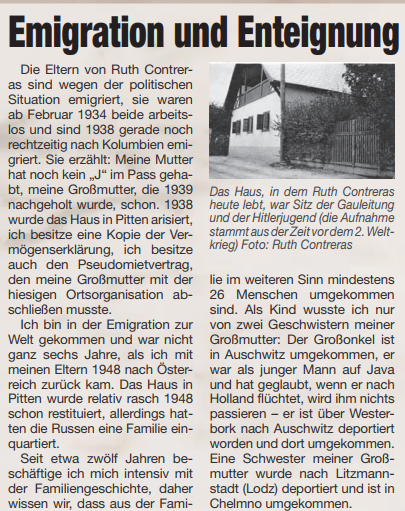
    Ruth Contreras Home and Family
    A more detailed biography of Ruth Contreras along with a photograph of her family’s home in Pitten.

    Q:     I can see that you have a personal vestment in this project, but do you also have a more official role in the Jews of Bucklige Welt project? What is your role?

    A:     One of my interests is the history of Jews in Austria before the Shoah. I am working since several years on a project about the Jews that lived in the 10th district of Vienna and so I learned first about Rosa Rebecca Abeles who was deported from Alxingergasse 97 to Theresienstadt.

    Some years ago I was interviewed for a book on the history of our family and the house where we are living: Johann Hagenhofer, Gert Dressel (editors) (2014) „Eine Bucklige Welt – Krieg und Verfolgung im Land der Tausend Hügel.“ ISBN: 978-3200037342 . Publisher:Alois Mayrhofer.

    Q:     What is the official name of the project, and how did it come about?

    A:      Last year I was invited by Dr. Hagenhofer to participate in the team that is doing research for a project „Die jüdische Bevölkerung der Region Bucklige Welt – Wechselland  

    (English translation: The Jewish Population of the Bucklige Welt Region – Wechselland.  Bucklige Welt covers more than 23 villages with approximately 39,000 inhabitants. Wechselland is a region of mountains and valleys in Lower Austria, South of Vienna. )

    Q:     Will there be a museum? A book? A website?

    A:     This project is part of the preparation for a regional Jewish Museum in Bad Erlach, which will be inaugurated in on occasion of the Lower Austrian Provincial Exhibition 2019 and yes, there are also plans for a book.

    Q:     How many towns in the region does the project cover?

    A:     We are 17 working on this project on about 25 villages and their former Jewish fellow citizens. As I am living in Pitten and had already some information, I was invited to participate in this project.

    Q:     How did you know to look for the Abeles family, and what was important about Rudolf, Lotti, and their children?

    A:     The history of the Jaul- Family in Pitten was known as well as the history of our house. In order to get more information I started with the permission of the Mayor of Pitten to check old registries at the school in Pitten where I found the information on Josefine Daniel and Heinrich Abeles. The other children of Rudolf have been added with the help of the archive of the Jewish Community in Vienna and by using the Austrian genealogical website https://www.genteam.at/.

    The other important source where the registration forms where I found Rosa Rebecca repeatedly also hosting people at her home and this last document when she had to leave Pitten..

    From the registration forms at the municipal archive in Wr. Neustadt I learned that Jakob Abeles had changed his name into Aldor.

    The next step was to go to the Jewish Cemetery in Neunkirchen where I found the gravestone of Franziska Daniel. There is also a grave stone of a Ruben Abeles. The letters are in Hebrew, do you know the Hebrew name of your great great grandfather?

    (The only name we have for my great-great grandfather is Rudolph)

    Q:     What was the surname of your family living next door to the Abeles family?

    A:     My grandparents who bought the house in 1917 were Rosa and Fritz Weiss. My parents were Elfi Lichtenberg (maiden name Weiss) and Franz Lichtenberg.

    Q:     Do you have any details of comradery or community between the families that can be shared?

    A. I have no information if there was any contact between the families. As I told you, my mother did not talk much about this. My grandmother was born in 1880 (she was two years younger than the youngest son of Rudolf Abeles who was born in 1878) Maybe he did not even live there anymore. My mother was born in 1904 and my dad was born in 1907 so I think there was too much difference in the ages of them.

    Q:  How difficult was it to find us, and what led you to my website?

    A: As Rosa Rebecca was the third person directly deported from Pitten I considered it important to find more information about this family. And yes, it was not easy at all to find your blog. After having contacted several groups of 2nd generation of survivors of the Shoah without success it was really by incident that I tried by using Google to look if I could find something about Josephine Daniel Wimpassing and came to your article A Renewed Tribute to Tante Rosa – Stories From the Past .

    (Rosa Rebecca was a previously unidentified daughter of Rudolph Abeles. She was my great-great aunt)


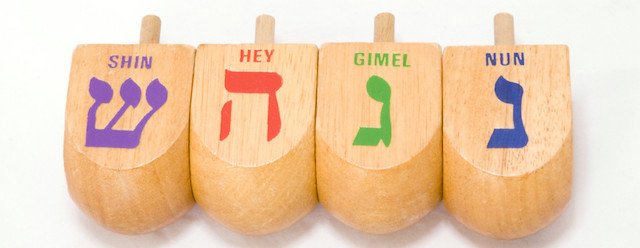
    nun gimmel hei shin
    This is what our dreidels look like.

    One of the most fun parts of the Hanukkah celebration is the dreidel game. The dreidel is a four-sided spinner with the Hebrew letters nun, gimmel, hey, shin; one letter appears on each side. My children have very fond memories of that game which we played as a family. The letters stand for the Hebrew words, nes gadol haya sham, meaning “a great miracle happened there.” For my family, connecting with Ruth is a great miracle, and we are so very thankful to welcome her as a new part of our continued quest to discover the truth of our Judaistic past.


  • Updates and Ready for the New Year

    Updates and Ready for the New Year

    Most of my followers read my blog for just one reason: to find information regarding their own family history. This post is simply to update you on my situation and when you can expect to hear more about the family history interests that brought you to me in the first place.

    Since my post regarding Grave’s disease a couple of years ago, I have undergone radiation therapy to shut down my thyroid. Living without a thyroid requires daily synthetic replacement. In the past couple of months I have suffered from hypothyroid symptoms that severely affect my general mental alertness. It is difficult to focus, stay awake, and remain pain and symptom free if I sit at the computer for more than just a few minutes. Hence my recent post regarding tennis elbow  (just one symptom of the larger disorder). To make my long story short, I have been back to the doctor and am having my medication adjusted. In the meantime, my blog has suffered.

    Please accept my sincere apologies. Many of the posts I had planned for the past few weeks just haven’t happened. I do expect my blog to return to normal function as my body responds accordingly. So here is what you can expect over the next few weeks and into the new year:

    • An introduction to my new friend from Austria, Ruth Contreras. She was just as anxious to find me as I have been anxious to find family members in Austria. We are both very grateful to have found each other. Ruth’s project, a recovery of pre-holocaust Jewish families from the Bucklige Welt region in Austria is a very exciting development.

      Fall in the Bucklige Welt
      Bucklige Welt, “Land of 1,000 Hills,” Austria https://www.immobilienscout24.at
    • Another Cousin Connection to Kwiatkowski brothers living in Hawaii, along with their holiday traditions.
    • My very first ancestor landing page featuring my great-great grandfather, Rudolf Abeles from Austria. My grandmother was very close to him, and even lived with him in Pitten during his later years where she attended primary school and helped him with daily tasks. We believe he lived to be 99 years old!
    • An exploration of Sephardic Jews in Europe, and how one particular Sephardic family ended up in Austtria. (My mother always said she would take a hard look into the mirror looking for evidence of her Spanish heritage).
    • My second ancestor landing page featuring Aucke Wykoff. He was a Colonel in the American Revolution, and was credited with saving the life of a fellow POW in the infamous New York Sugar House Prison. The man he saved was more than just a friend, he was a member of the family.
    • An exploration of life in the Sugar House prison and how Aucke Wykoff was related to Toby Polhemus.
    • In the next year, I’ll be updating and revisiting the life of Mary Davis Skeen, the woman who started my journey to learn more about Plain

      stone fences KY
      Just one example of Kentucky’s historical stone fences.

      City Utah’s Pioneer History, and the inspiration for this website.

    • A deeper look into the people and events that make up this place that is my new home. I’ll begin with a close look at the historical “Slave Fences” of Kentucky and the efforts to preserve them. I see evidence of this Irish stonecraft everywhere around here.

    In the meantime, I have discovered some exciting information about Family History in Kentucky. I was able to visit the public library for the first time yesterday, and found some amazing help for family historians. There is tons of information available through their resources, and I want to showcase their upcoming Tuesday afternoon online events from 3-4 pm Eastern Standard Time:

    P.S. You don’t need to have a library card or even live in Kentucky for these online events.  To view online, tune into @KentonLibrary on Periscope (available on your smartphone or tablet), or at periscope.tv/kentonlibrary. Dec. 5 and 12 events look like they’d be interesting for people everywhere, especially those with German and/or Christian backgrounds. 


  • Unknown Family Members Identified

    Unknown Family Members Identified

    We interrupt your regularly scheduled blog post for this important announcement:please stand by

    I am pleased to report that I have made a very special connection to family, friends, and neighbors who were lost in the Holocaust.

    In the past few days a flurry of emails have gone back and forth between my parents, myself, and a new acquaintance from Austria.

    It began with a message coming directly through this website. (Hooray for contact forms!) A woman in Austria has found my posts regarding my grandmother and my great-aunts who were members of the pre-holocaust Jewish community in Lower Austria. She wanted to know if I could put her in contact with surviving members of the Abeles family from Pitten, Austria.

    Hey, that’s me!

    Completely stunned, I had to read the message three times before I could comprehend that this woman not only knew of my family, but even had some information regarding my family that I did not yet have. I did not quite understand why she was contacting me, but the fact that she knew so much about my grandmother and great-great grandfather was enough to spur me to respond–right after making a very excited phone call to my mother in Utah.

    It turns out that this Austrian woman seems just as excited to have gotten a positive response from me. You see, her family lived next door to my family before both families were sent fleeing from imminent Nazi threat. She was eager to know if there were survivors of her family’s old-time friends. The good news is yes, there were several survivors, and the fact that she was able to find me is evidence.

    I. Am. Ecstatic.

    off the airAs a result of my excitement over this new contact, I accidentally closed out all of the renewed pages I had open for research on this week’s new page and corresponding blog post. Once again, I am having to start over to gather resources for the page and article on Aucke Wikoff that was supposed to have been posted last week.


    Thanks to this new information, my family was able to update existing family members and add another we were unaware of. On top of that, we now know where my great-grandmother was buried and have a photo of her grave. I think the new page and blog post are going to be put on the back burner for the next couple of weeks as I converse with my new family friend and sort out this new story from the past.


    Luckily, this new information came before the post I had planned for next week on the Daniel family. It looks like I’ll be doing something a little different now that I have new information that actually helps to clarify the blog post I had planned for next week. I am really looking forward to sharing all of this with you.

    Hooray for Geneablogging and the internet!


  • A Renewed Tribute to Tante Rosa

    A Renewed Tribute to Tante Rosa

    A couple of months ago I had to delete one of my blog posts: “A Tribute to Tante Rosa.”  I had linked the post to the Shoah Foundation at the University of Southern California because I would not have been able to write my tribute without access to their research on the Holocaust.  Unfortunately, the Shoah Foundation attracted malicious hackers, and my blog post had to be removed in order to protect the rest of my web site.  Why is it that tragedy attracts malevolence?

    Rosa Daniel as a child
    Tante Rosa as a child

    Today I am rewriting my tribute to Tante Rosa (Rosa Daniel), since I did not save it in any other form. I will not be linking my site again to theirs, but I do recommend looking up USC Shoah Foundation.  It does a great job at personalizing genocide, something we should all make personal.

    If we can’t relate to it, we have no reason to put an end to it.

    Tante Rosa’s story has been intrinsically connected to my appetite for genealogy.  I truly believe that we are all products of our past, and that those who came before us help to define who we are today.  For example, my mom tells me that my brother walks with the same swagger that my grandfather had; and I know that my daughter suffers from the same anxiety and depression that I believe came from Rosa’s sister: my grandmother.  My mother and I have it too. As I learn more about each of my ancestors, I begin to understand how customs, traditions, physical characteristics, and yes, behaviors, are kept alive in myself. (more…)

  • She looks just like me. But who is she?

    She looks just like me. But who is she?

    I missed posting on Wednesday. Writing about my Tante Rosa was important, but it took a lot out of me.  By the time I had completed the post, I was emotionally worn down.  I didn’t feel like I was just blogging about my aunt; I was writing for all of  the families of the holocaust. As a parent and grandparent, I imagined being forcefully separated from my young children and grandchildren.  From a child’s standpoint, I imagined the horror of discovery that the people whom I put my deepest faith in could not keep me from being snatched away from my family and sent to an unimaginable doom. It was tough and I needed a break. So Wednesday’s blog comes today.

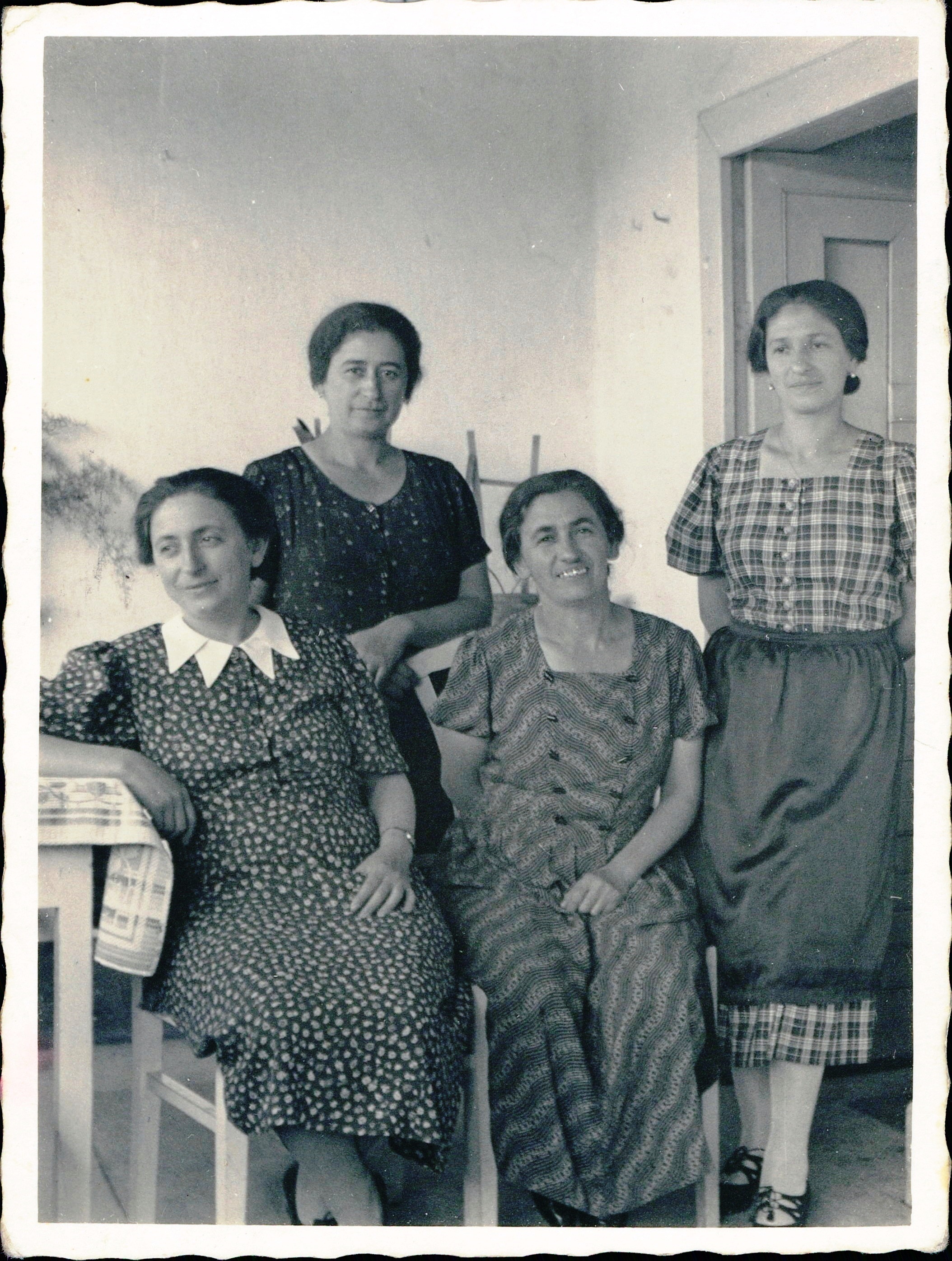
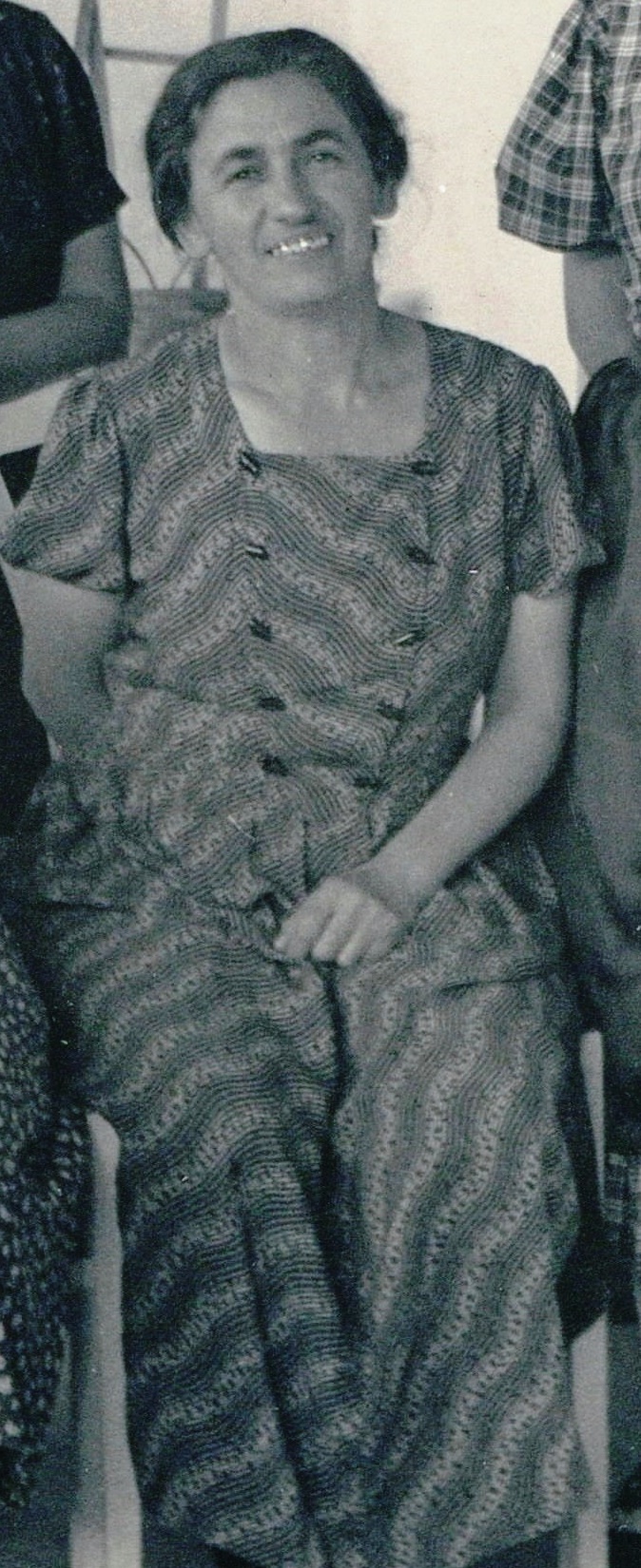
    We are pretty sure that the woman on the left is Gisela. Standing in the back is Helene (we knew her). But the woman sitting to the right and the one in the doorway–we are unsure of . They are most likely Rosa and Sommer (Hermine?), but which is which?

    I talked with my mother at length regarding September 3rd’s post (Why Grandma Cried). But memory is a fickle thing, coming and going without permission as we get older.  From my childhood I remember mom talking about Grandma’s four sisters; but as I started putting records together and gathering photos, I was only able to find evidence of three.  I told my mother this, and she began questioning her own memory.  Together, we decided that our memory had failed us. We labeled the photo of the four women according to this discussion, despite Mom’s insistence that her mother had four sisters.

    A few days after my post appeared I got a phone call. It was my dad. “Your Grandma Rothsprack had four sisters. The one that was missing was named Hermine.”  Okay, now the story is starting to make more sense.  I remember Mom saying that Grandma had four sisters. So I did a little more digging and sure enough, it came out of my own Grandmother’s mouth.  My father had tape-recorded my grandma’s life story when I was just a baby and had made type-written transcripts for each of his children.  This is what Grandma said:

    “I am one of five girls in the family–no boys. [She lists them] Gisela who lives in Austria. Rosa: killed in Auschwitz (sic). Not Married. Helen: Lives in Graten [California]. Sommer – lives in Austria.”

    Wait.

    Didn’t dad say the other sister’s name was Hermine?  This is confusing. Tante Leni didn’t have any children, I’ve never met my Austrian cousins, and Tante Leni and Grandma are not around to help us get it straightened out.

    Same eyes, same nose, same smile, same tilt of the head. Even the same eyebrows!
    Same eyes, same nose, same smile, same tilt of the head. Even the same eyebrows!

    As we were looking at the photograph I noticed something interesting.

    She is either Rosa or Sommer (or Hermine?)
    She is either Rosa or Sommer (or Hermine?)

    When I pointed it out to my husband he disagreed. I kept thinking about it, and I was pretty sure that he was wrong. Until last night.  I was at our local family history library because I was trying to solve the mystery of the missing sister. I showed the genealogist my information and the photograph from my blog; as she looked at the photo, her jaw dropped open, her eyes got big, and she pointed at the photograph. “Do you see this woman?” She asked. I laughed with relief. She saw it too.  We know it is my grandmother’s sister. Because Rosa and Giselle were the oldest, I think it is my Tante Rosa. And she looks like me!

    For me, this is the most awesome thing about genealogy.  I am living proof that I am related to this woman, and she is an integral part of my past. My dad tells me that he just uncovered several more photographs of Rosa.  I can’t wait to get the copies and make the comparisons.