Category: Mary Davis Skeen

  • Alotta changes goin’ on ’round here (a quick newsletter)

    Alotta changes goin’ on ’round here (a quick newsletter)

    I said I was back to Wednesday blog posts: and I meant it!

    –But something happened.

    There have been so many changes, that I couldn’t stay caught up. There was a big meeting that had to come first, and all the prep for that, kept me from focusing on this. I’ve many other excuses, some are good, but I’ve never liked excuses, so I’ll have to find another forum for them.

    As I began to make just one change in preparation for all of the rest of the changes, I realized that the changes had to come first! So, what you are getting is just the blog post and no changes . . . this week, anyway.

    This website is really old, and never has reached its full potential; it’s in desperate need of updating. So here’s what’s up:

    • New site theme
    • New organization
    • Logo, letterhead, and other visual updates
    • About us focusing less on beginnings and more on readers (If you’re reading this,
    • A new non-profit organization in the conceptual stages (Garden of Hope people needn’t worry, I’m not talking about Immanuel Inc.)
    • Cousin updates
    • New profiles for cousin connections, beginning with a man named Morris Coers.
    • Not really a change, but MANY new stories from the past.
    • A new page dedicated to stories from the Garden of Hope in Covington, KY
    • A greater diversity of stories
    • More chapters for the Second Wife’s Story
    • Research for Mary Damron’s story (untitled).
    • Austria report from 2019
    • Family History Conference review
    • Added post days

    You will see changes every week, and I’ll be sure to keep you updated. Reverend Coers and Garden of Hope Pages will come first, but regular STFP posts will not resume until January.

    See you next Wednesday!

  • 2019 Meeting of the Board

    2019 Meeting of the Board

    Looking back at Stories from the Past in 2018, I have learned that monthly newsletters are my greatest success. Although I am still writing them more for my own benefit than that of others, they truly are a guideline for what to expect for the month. More importantly, my newsletters give me the opportunity to identify what went well and illuminate my trouble areas. Making them public invites my readers to cheer me on and/or provide helpful suggestions and constructive criticisms.

    Photo by rawpixel.com on Pexels.com

    My newsletters have become my boardroom. Welcome to the board!

    The Race is not Necessarily Won by the Swiftest

    2019 certainly has not begun as I envisioned for Stories From the Past. I have encountered a few obstacles, and rather than let them keep me down, I am choosing to accept the stumble, and even the fall. As long as I am willing to pick myself up, dust myself off, and apply band-aids where necessary, I can make it to the finish line.

    The transition between 2018 and 2019 reminds me of Aesop’s fable, The Tortoise and the Hare. The tortoise won the race by continually moving forward while the hare napped. I moved much slower than I wanted to last year. Sometimes I was more like the hare, and I am not at all happy about that. What I am happy about is that I finally started moving again as the year came to its close and that I am still moving.

    Facing Obstacles

    An unexpected, but very welcome, obstacle means that I’ll be postponing my official launch for a few months. I am planning a trip to Austria where I can meet my story-telling face-to-face. I have been invited to the opening ceremony of a museum exhibit featuring the people that once thrived in the Bucklige Welt-Wechselland Region of Austria before Hitler’s reign of terror and the Shoah. Not only will I be able to learn more about my own family’s stories, but I will hopefully gather the stories of their friends and neighbors as well.

    I have a lot to do to prepare for the trip. This week alone, I’ll be applying for a new passport (I haven’t been out of the country for more than 17 years!), beginning a new course in German from Rosetta Stone, and creating a Go-Fund-Me account to help with basic expenses for the trip. Of course, I’ll also need to forward my acceptance to the invitation, arrange for lodging and travel while I am there, etc. The only other time I’ve been to Europe was when I was doing study abroad, and most of the arrangements were done for me. There’s much more to trip planning than I remembered.

    I also need to go back through my records in an attempt to trace the funds donated through Facebook last year. At this point, I am not recommending that anyone donate to Facebook’s charitable causes. I’ll be happy to let you know if my opinion changes.

    What Happened to the Second Wife’s Story?

    December was a huge struggle for me. With barely a nod to Hanukkah, I found myself mired in four stories originally intended to be just one. Although I am glad that I decided to tell the stories separately, the final story came after Christmas when I was supposed to be wrapping up the second Chapter of Mary Davis Skeen’s biography.

    As December drew to a close, I found myself mired in research for Mary Eynon Davies, mother of Mary Davis Skeen. I was supposed to have had Mary Eynon’s profile page up by the end of the month, along with a first and second chapter of the story. Instead, nothing was posted in regards to The Second Wife’s Story.

    I am behind on my writing, but that doesn’t mean I am behind on my goal to publish the Second Wife’s Story by the end of 2019. It just means that I need to find a better way to accomplish that goal. I CAN STILL do this.

    I need a better way to accomplish that goal. Like most of my profile pages, Mary Eynon’s will be incomplete when I post it tomorrow. A new post will appear when new profiles appear and when changes are made to existing profiles. I may also have to post chapters in parts (Why not? I did it with my Christmas Tree stories.), and they may even appear out of order, but at least my progress will be evident on Chapter One, and maybe even Chapter 2 by the end of January. Everything will be linked in order on The Second Wife Story’s book page.

    My new focus is to be on The Second Wife’s Story first, ancestral stories second, and stories found along the way third. Each month will have a social-historical focus, and for each monthly focus, I will provide a short summary or review along with link/s to the original story/ies.

    Since January’s focus is black history month, I’ll be looking at a story from North American Slave Narratives: a collection of books, articles, and journals telling the stories of Black America’s quest for freedom and equality, beginning with my home state: Kentucky.

    Reassessment

    Once again, I am reminded of James Clear’s prescription, “if you want to set your expectations appropriately, the truth is that it will probably take you anywhere from two months to eight months to build a new behavior into your life — not 21 days.”

    I have learned that the early morning writing routine does not work for me because I am usually picking my daughter up from work at midnight. By the time I wake up around eight or nine, everyone else is getting up too. My best time to focus without interruptions is during the middle of the day when my granddaughter is at school and my husband is at work. This is not my morning job; it is my day job.

     “It’s failure that gives you the proper perspective on success.”

    – Ellen DeGeneres

    I’ll be making a few minor changes as well:

    • Monthly Headers (a cosmetic change–you’ll know it when you see it)
    • Story Teasers (I’m already using these, but I need to update past posts)
    • Newsletters will be posted on the last Monday of the previous month when the first day of the month falls on a Tuesday or Wednesday.

    December Review

    Objectives met are crossed out.

    • Navajo Greetings and exploration of the name (Navajo vs. Diné)
    • Hanukkah for non-Jews (with a nod to rembembering the Shoah)
    • A Slovenian Christmas Eve (Recipe and Tradition)
    • (n)O Christimas Tree (Stories from Olean, New York, and Lark, Utah)
    • Mary Eynon ancestor profile page (not a post)
    • The Second Wife’s Story, Chapter 1, Wales
    • The Second Wife’s Story, Chapter 2, Aboard the Clara Wheeler: from Liverpool to New Orleans

    January Preview

    • Mary Eynon ancestor profile page (not a post)
    • The Second Wife’s Story, Chapter 1, Wales
    • The Second Wife’s Story, Chapter 2, Aboard the Clara Wheeler: from Liverpool to New Orleans
    • North American Slave Narrative: the story of Thomas W. Burton
    • Tante Rosa and Tante Rosa’s stories
    • February’s Newsletter

    Tentative stories for the upcoming months:

  • Let’s get this Story Started

    Let’s get this Story Started

    Can I ask for your help?

    I’ve been researching and gathering information about the life of Mary Davis Skeen off and on for several years. Thanks to great record-keeping by Davis and Skeen family genealogists and local historians, I have plenty of information to tell a complete story from beginning to end.

    But Mary Davis Skeen is not my family, and I want to honor her memory as best I can. I have been told by one of her great-grandchildren that Mary could not read or write, so she could not have written her own memoirs. Therefore, your knowledgeable input is the most valuable resource I have, especially if you are related to any of the players in Mary’s story.

    What you will see of Mary’s life is my rough draft of her complete biography. There will be gaps and inaccuracies that you can help me fix. I would love to hear from you especially if you belong to any one of the following categories:

    Descendant/s of

    • Thomas Davies (1816-1899  or Thomas Davis/Davies/David 1790-1865)
    • Mary Davis Skeen (The second wife)
    • Caroline Smart Smith Skeen (The first wife)
    • Abraham O Smoot

    Have family from

    • Carmarthen, Wales
    • Llanelly, Wales
    • Burry Port, Wales
    • Plain City, Utah

    Have family stories (especially written memoirs) of descendants regarding

    • Eisteddfod and the early Mormon Tabernacle Choir
    • Welsh customs, traditions, and recipes
    • LDS church history in Southern Wales
    • Welsh maritime history before 1860
    • 1855 Voyage from Liverpool to New Orleans on HMS Clara Wheeler
    • Mormon Grove, Kansas
    • Abraham O Smoot  missionary experiences in Wales 1850-1855
    • Abraham O Smoot 1856 pioneer company
    • Dry Creek, Deseret Territory (Lehi Utah)
    • Dry Creek water disputes
    • Plain City, Utah founders
    • Measles
    • Small Pox
    • Midwifery in Deseret Territory

    Please remember that I have access to libraries and online resources. What I don’t have is insider knowledge–something that may have come through your ancestors to you. I am especially looking for primary sources but secondary sources can be very helpful too.

    Finally, I want your corrections, suggestions, perspective, praise, and constructive criticism. You can comment below,  send me a private message, or join our Facebook group for extended conversation on the subject.

    Right now, I am putting together Mary’s family and early childhood in Wales for the first chapter to come in February 2020.  Next week I am posting an ancestor landing page for Thomas Davies (b. 1816 Llanelly, Carmarthenshire, Wales – d .1899 Plain City, Utah.)

    Thanks in advance for your interest and input! I hope we can make this a successful community effort.

  • In 1870, Something Happened Here

    In 1870, Something Happened Here

    Preface to The Second Wife’s Story (a biography)

    There is a sign hanging in my mother’s laundry room. It says, “On this site in 1897 nothing happened.” But who knows if that’s actually true? Who’s to say nothing happened on that site. Right there. You know, on that very spot right next to the washing machine? If there’s no evidence of schoolchildren following a path to an old schoolhouse just down the road, a young woman milking cows, an old farmer stooping to clear a clogged ditch, or a native woman searching for firewood to warm her hearth, who’s to say nothing actually happened right there, on that very spot?  If something did not happen on that very site next to my mother’s washer in 1897, I’m betting that there were a whole lot of somethings going on not too far away, and every time I see that silly sign in Mom’s laundry room, I wonder exactly what those somethings were.

    Of course, I might be exaggerating a little, but the first log cabin was built in the area in 1877, so something could have happened there. Mom’s bathroom memorial makes me think. We post memorials for all sorts of historical events–things like battles, negotiations, inventions, catastrophes, births of historical figures, and of course, deaths (to name a few). Those memorials can tell us a lot. And although I could probably visit the local museum to find out if anything happened in the general vicinity of my mother’s bathroom sink in 1897, I could also look for memorials in the cemetery.

    I love cemeteries. In fact, I still need to get myself that bumper sticker with the warning, “Caution, I brake for Cemeteries.” In 1997, when Utah was celebrating it’s sesquicentennial of the arrival of the Brigham Young and his followers, someone at the headquarters of The Church of Jesus Christ of Latter Day Saints came up with a reason to make me love cemeteries even more: A plaque to adorn every tombstone belonging to Utah pioneers who came before the arrival of the transcontinental railroad in 1869. I was raised in Utah as a member of that church. I wasn’t born there, and I had absolutely no pioneer ancestors, but I still remember the stories of courage, struggle, heartache and triumph that accompanied the many families who crossed the American plains mostly by foot. It was an unfathomable journey taking about three months. I tried it last summer by car with my daughter and granddaughter from Kentucky to Utah. It took us four days. Of course, it was a round-trip ride, which meant a total of eight days in an air conditioned car. By the time we arrived back home, we discovered that we’d picked up stowaways in the form of bed bugs along the way. I am in no hurry to try that trip again any time soon.

    But I digress.

    faith in every footstep. Sons of Utah Pioneers
    Utah pioneer grave marker image courtesy of Sons of Utah Pioneers

    The metal plaque, emblazoned with the phrase, “Faith in every footstep,” soon began appearing on tombstones throughout the state. By 2001, the pioneer plaques had been placed on nearly every known pioneer tombstone. By that time, my interest in graveyards had fully matured, and the histories known, and the mysteries unknown, called to me like ghosts in a romantic novel.  So when I stepped into the Cemetery in Plain City Utah, I was hoping those ghosts would lead me to a story.

    And they did.

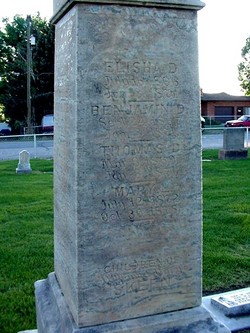
    Inscriptions on tombstones are not usually put there to make you laugh (even though some do); they are there to make you think. The family memorial I found that day left me thinking for years. Names and dates are inscribed on all four sides of the tombstone. I could tell just by looking at birth dates, that this was the grave site of pioneer settlers, but that’s not what got me thinking. It was the birth and death dates accompanying nine other names. All children. In the Fall of 1870, and into January of the next year, eight of those children died. Now I knew there had been an epidemic of some sort. I  could see that there was a mystery begging to be solved.

    I was in college on that initial visit, and a single mom at that. I didn’t have time to look for clues and answers, but that story stuck with me enough that I knew I had to write about it. I used an essay assignment from one of my English classes as an excuse to put my conjectures into writing. The essay won second place in a department contest at Weber State University, and I kept it over the years.

    When I finished school and became an empty-nester, I finally started digging for the tombstone’s story. My first foray came up with some answers–enough to help me see that I could easily build a history around that grave marker. I went back to Plain City and took pictures of all four sides of the tombstone. What I found, shocked me. On the backside of the tombstone are the names of three of the children who died during the epidemic, and one more who was born and died in the following years. It wasn’t those children that surprised me, though. It was the inscription I had missed in my first visit at the bottom of the back side of the tombstone, “Children of William and Mary Skeen.” I stepped back around to the front and looked at the bottom. It said, “Children of William and Caroline Skeen.” There were two different mothers and one father. This was a polygamous family.
     

    I grew up in Utah, and I am very familiar with polygamy, even though I have no Utah Pioneer roots. Many Utah pioneers practiced polygamy, and I had friends who were descendants of polygamous marriages. There was even a handful of families in my neighborhood who still practiced it, even though it was disavowed by The Church of Jesus Christ of Latter-Day Saints in the late 18th century and church members who currently enter into such unions are excommunicated. Today, they call themselves Fundamentalist Mormons. Knowing what I know about Utah and polygamy, I can’t pass judgment on the pioneer families who still practice it despite laws and church condemnation. I’ve seen happy children and wives who claim to share equally in marital bliss. Neither am I blind to the fact that some sects have taken the practice much too far by forcing children into unwanted marriages. It’s because of that second marriage that I decided to focus on Mary Davis, the second wife of William Dolby Skeen.

    I’ve lived outside of Utah for most of the time since I started my research, but that hasn’t stopped me.  Thanks to the internet, I have access to nearly everything I need to complete my research. Sometimes I think I have too much, and that I will need to pare down the story before it gets too unwieldy. It has become interesting to me that I could build a compelling biography of an utter stranger without ever having met her or having any access to written memoirs.

    I nearly missed Mary, tucked away as she was at the bottom of the backside of the monument. When I found her, I realized that her story is far more important than the location on the tombstone suggests. At a first glance, it’s easy to think nothing happened here. But from surrounding names, places, and dates, I could see that something had happened, and that little name tucked away in the corner had been there and played an integral role in the town’s history. It’s not her death that’s important, it’s her life. I don’t want Mary Davis Skeen to be forgotten, and I feel compelled to commit her to the memory of others who would never have known her otherwise.  We are surrounded on a daily basis by people living what they feel are ordinary and unremarkable lives, but if we make an effort to get to know them, we can learn valuable lessons and come to see them as crucial members of our community. Mary’s tale unfolds in bits and pieces. Like a patchwork quilt, it is colorful, warm and inviting. Her story includes heartache, tragedy and tribulation along with faith, perseverance and promise. While Mary’s story reminds us that happily ever after never happens, it also tells us that happy endings do.


    Please join me in my journey to tell Mary’s story. Your comments and helpful criticism are welcome and encouraged. Treat each post as rough drafts to Mary’s biography, as that is what they are intended to be. Mary’s story will be told one chapter at a time, and one month at a time, over the next year. My ultimate goal is to publish them together in a book. If you feel that you have information that may be helpful, or that will clarify ambiguities in Mary’s story, please leave a comment or contact me. And thank you in advance for your help!
  • . . . and I’m back.

    . . . and I’m back.

    Over the summer, Stories From the Past was never far from my mind. In fact, I felt a lot of anxiety over no posts, but between two grandkids and a broken PC (I have six grandkids but two were staying with me), my ability to blog was reduced to bits and snatches of time with a tablet or a phone. Have you ever tried to blog from your tablet or phone? Well, I’m a perfectionist, so I wasn’t even going to attempt it. In fact, I suffer from perfection paralysis. It’s a real thing, which means that if I can’t do something right, I’m not going to do it at all. Thankfully, knowing you have a problem is the first step in solving it, and I am now working hard to get over my fear of doing a less-than-perfect job. Now that both grandkids are back at home and in school, and I have a new PC,  Stories From the Past is ready to roll, and I’m gearing up to launch a professional, remodeled, website for 2019.

    back at work
    back at work  ( I hope it’s true that a messy desk is a sign of a genius mind.)

    Many of you are waiting for stories about your own ancestors, and if I told you I’d be writing about them, I WILL. In fact, I hope to be turning several of them into books. I’m getting started right away on at least one of them, but I consider this just the beginning, knowing it can only get better from here.

    I don’t have a set priority list, with the exception of the story that started it all, and that will be The Second Wife’s Story. Mary Davis Skeen is the subject of my first book, so all of you Davis/Davies/Skeen progeny can look forward to getting the first read. I plan to publish the unedited book one chapter at a time. I’ve been planning to author a book for more than three decades now, so all I can say about that is it’s ABOUT time!

    So here is my list of proposed subjects for the next few months and well into 2019:

    • Mary Davis Skeen (The Second Wife’s Story)
    • The Jews of Pitten, Austria (Specifically the ones who lived next door to my great-great-grandfather, Rudolf Abeles.)
    • Rosa Rebecca Abeles
    • Mary Rogers Damron
    • Sgt. Bernard Kwiatkowski and the WWII 5th Airforce 90th Bomb Group
    • new cemeteries
    • Kentucky slavery and the U.S. Civil War

    Blog posts are scheduled Wednesday at 10 AM of each week.

    Next Week: A special thanks to Ruth Contreras

    Ancestor Landing pages for specific blog subjects will appear on the first of each month. October’s Landing page is Thomas Davies (1816 Llannelly, Carmarthenshire, Wales – 1899 Plain City, Weber, Utah, USA)

  • Are You My Cousin?

    Are You My Cousin?

    Stories From the Past is proud to present The Cousin Connection Project.

    I grew up without cousins. Well, I did have cousins. I knew I had cousins. I had even met three of them. But I didn’t know them well, and I didn’t even live in the same state as any of them. I was well into my 40s by the time I started getting to know the rest of my cousins, and I still haven’t met most of them in person.

    I met my midwestern cousins on my mother’s side when I moved to Chicago for graduate school. As I sat at Thanksgiving dinner with all those first cousins trying to figure out how my children were related to them and how our children were related to each other, my cousin Allen patiently explained the differences between first, second, third cousins, etc., and the numbers of removal. It was a bit confusing, but I retained enough of the information that I felt comfortable in exploring cousin relationships to others.

    in search of myself

    Thanks to Facebook, I have been able to connect with even more cousins I have never met in person. With their cooperation, I am getting to know them better one blog post at a time. When my newly discovered cousin Bernie posted a family recipe on Facebook, I decided the recipe would make a great blog post. I felt that I should also identify just how we were related, so with Bernie’s cooperation, and using Allen’s “formula” I created a chart showing my newly discovered relationship. Bernie was great, and the post was so personally rewarding that I offered to do it for all of my cousins on Facebook.

    Between Bernie’s post and my next cousin post, I was contacted by a complete stranger named Diedre in Michigan. Diedre gave me some information indicating that we have common ancestors from early colonial America and the Netherlands (AKA Holland at the time). Much of Diedre’s information pointed to a probable family connection by removals with an old family friend in Utah. I could see that I could easily make cousin connections throughout the United States on a regular basis by connecting through common ancestors. I’ll go more into detail about those common ancestors in another cousin connection post, but suffice it to say I can see that I have plenty to keep busy.

    Thanks to my U.S. immigrant ancestors, and the cousins I’ve already connected with, I can connect with my past in a completely new and exciting way. Next week I’m connecting with another New York cousin, our family genealogy expert, John Woodgie. After that, Diedre, and I still have plenty of ideas to keep me going well into the new year. This is very rewarding for me, so I am creating a database for these cousin connections, and I am calling it The Cousin Connection Project.

    The Cousin Connection Project uses a surname and location database of most ancestors I have been able to identify.  The database is organized alphabetically by surname, and should be pretty easy to identify links to common ancestors. If you come across a name, location, and date range that matches names, locations, and date ranges in your own family tree, you can contact me for a free consultation and a possible cousin connection post showing your relationship to me.

    I am also including separate databases for Mary Davis Skeen and any other family lines for other historical biographies I decide to tackle in the future. The separate databases will make it easier to identify your own personal relation to other bygone figures. I have already checked Mary Davis and her husband William Skeen (who was from Pennsylvania), against my own family tree, and I have no reason at all to believe that there is a connection to myself (so far).

    As the connections grow, I plan to include links to stories, recipes, and family traditions. This is exciting for me, a person who grew up without knowing most of my extended family, including three of my grandparents and most of my first cousins. Where before I felt that I had almost no extended family, suddenly the world is becoming my family. I know that we have often been told that the family of humankind is all related. Some of those estimates claim that we are related by as little as sixth cousins. Other, more scientific endeavors claim that everyone on the earth is related by at least fiftieth cousins. I don’t know how much truth there is to that claim, but I am pretty sure that I am related to enough amateur genealogists to keep my Cousin Connection Project alive for as long as I want to pursue it. Here’s to getting to know you!

  • What Happened to the Skeen Family?

    What Happened to the Skeen Family?

    I wrote the original Untold Stories more than ten years ago.  At that time, there was little information to be found on the internet, and since I no longer lived in the area, I had to wait to get my questions about the Skeen family answered. I’ve been doing my research on my own free time, knowing that there was a story there. I haven’t been disappointed.  Thanks to a few phone calls, Family Search, Ancestry.comPlain City Utah.org, and one more trip to the Plain City Cemetery, I was able to find all the information that I needed to complete the Skeen’s story.  The story coincides with the history of  town itself, so it must be told as part of the town’s history.

    William Skeen
    William Skeen. Courtesy of Ancestry.com

    William Dolby Skeen was born in 1839 in Steelville Pennsylvania, son to Joseph Skeen, and brother to Lyman Skeen, all of whom were primary settlers in the Plain City , Utah area. The three men were among a larger group of Mormon pioneers who had originally settled in Lehi, but left to scout out an area in Weber County for a place with rich land for farming and a good water source.  The area now known as Plain City lies at the edge of a delta where the Weber River fans out upon entering the Great Salt Lake. These early pioneers found that they could use water from the river for irrigation, and culinary water could easily be found by sinking wells. It was a good spot with plenty of water for their small party of pioneers. This group of men staked claim to the land, and are therefore among the founders of Plain City. (more…)