Blog

  • Let’s get this Story Started

    Let’s get this Story Started

    Can I ask for your help?

    I’ve been researching and gathering information about the life of Mary Davis Skeen off and on for several years. Thanks to great record-keeping by Davis and Skeen family genealogists and local historians, I have plenty of information to tell a complete story from beginning to end.

    But Mary Davis Skeen is not my family, and I want to honor her memory as best I can. I have been told by one of her great-grandchildren that Mary could not read or write, so she could not have written her own memoirs. Therefore, your knowledgeable input is the most valuable resource I have, especially if you are related to any of the players in Mary’s story.

    What you will see of Mary’s life is my rough draft of her complete biography. There will be gaps and inaccuracies that you can help me fix. I would love to hear from you especially if you belong to any one of the following categories:

    Descendant/s of

    • Thomas Davies (1816-1899  or Thomas Davis/Davies/David 1790-1865)
    • Mary Davis Skeen (The second wife)
    • Caroline Smart Smith Skeen (The first wife)
    • Abraham O Smoot

    Have family from

    • Carmarthen, Wales
    • Llanelly, Wales
    • Burry Port, Wales
    • Plain City, Utah

    Have family stories (especially written memoirs) of descendants regarding

    • Eisteddfod and the early Mormon Tabernacle Choir
    • Welsh customs, traditions, and recipes
    • LDS church history in Southern Wales
    • Welsh maritime history before 1860
    • 1855 Voyage from Liverpool to New Orleans on HMS Clara Wheeler
    • Mormon Grove, Kansas
    • Abraham O Smoot  missionary experiences in Wales 1850-1855
    • Abraham O Smoot 1856 pioneer company
    • Dry Creek, Deseret Territory (Lehi Utah)
    • Dry Creek water disputes
    • Plain City, Utah founders
    • Measles
    • Small Pox
    • Midwifery in Deseret Territory

    Please remember that I have access to libraries and online resources. What I don’t have is insider knowledge–something that may have come through your ancestors to you. I am especially looking for primary sources but secondary sources can be very helpful too.

    Finally, I want your corrections, suggestions, perspective, praise, and constructive criticism. You can comment below,  send me a private message, or join our Facebook group for extended conversation on the subject.

    Right now, I am putting together Mary’s family and early childhood in Wales for the first chapter to come in February 2020.  Next week I am posting an ancestor landing page for Thomas Davies (b. 1816 Llanelly, Carmarthenshire, Wales – d .1899 Plain City, Utah.)

    Thanks in advance for your interest and input! I hope we can make this a successful community effort.

  • Tombstones Don’t Grow on Trees

    Tombstones Don’t Grow on Trees

    That’s because they grow in them.

    At least at the Lindon Grove Cemetery in Covington, Kentucky, that is. The cemetery is named after the grove of Lindon trees that once grew naturally in this part of town, so trees are important here. Lindon Grove is not just a Cemetery. It’s also a city park and certified arboretum. Many of the older and larger trees in the cemetery are marked with plaques designating both species and native origination.

    Of course tombstones aren’t intentionally planted in the trees, but as the trees grow they encroach upon  nearby tombstones, nearly swallowing them. The photograph below is probably the most picturesque I found, but there are a great many tombstones growing in the trees here. Some are still identifiable; others are more tree than stone.

    Tombstone in tree.jpg

    Of all the cemeteries I’ve ever visited, this one ranks among my favorites. It’s not a typical, run-down, Halloween-type graveyard, although it is one of the many I have seen that once suffered from neglect and vandalism. Despite the absence of play equipment, children feel welcome here. I brought my granddaughter with me, and she was just as entranced by the trees, tombstones, and gently rolling landscape as she would have been in a playground.

    curious little girl
    Fascinated by tombstones.

    This particular graveyard sits on the northern edge of the former Confederate States of America. Just two miles away, across the Ohio River, lays the land of freedom for African Americans still in the bonds of slavery. This is Underground Railroad country and a former hotbed of strife where brother fought against brother. Kentucky was the first southern state to fall back in to Union control.

    This particular cemetery does not hide its dark past; it embraces and rises above it. Set up as a public cemetery by a local Baptist Theological Institute, it began as a fully integrated cemetery including a pauper section where those who could not afford a proper burial were buried for free. A veteran’s section includes memorials for all United States’ wars since the cemetery’s establishment in 1843. Black and white, bond and free are all buried here.

    Civil War history is prominent in Lindon Grove. Because Kentucky did not last long as a Confederate State, both Union and Confederate memorials are laid row by row with Union stones facing off against Confederates. A wide pathway separates the two in semblance of the uneasy front line of a battlefield.  Interestingly, and certainly not intentionally, if one looks north towards Ohio, they can see the tips of Cincinnati’s towering skyline above the the war memorials as a reminder that freedom from the bonds of slavery was not far away.

    At Linden Grove, contemporary life is inspired to mingle with the past. Pebbled walkways meander through the park encouraging foot traffic. Historic walking tours through the cemetery are occasionally offered. The serenity of the area is perfect for yoga enthusiasts. There are also picnic tables for a relaxing repast with family and friends. In the warmer months, the cemetery turns into a theater where theatrical performances and movies are provided for family entertainment. And of course the tombstones make great conversation pieces.

    There is so much history here. The cemetery is actually included on the U.S. National Register of Historic Places. Among the prominent members of the cemetery, are the city’s founders, politicians, soldiers, and every day heroes including slaves, freed slaves, and their free progeny. One memorial marks the grave of B. F. Howard, a black railroad porter, and founder of the first African-American Elks Chapter in Cincinnati, Ohio. Another belongs to Dr. Louise Southgate, a female physician and early women’s rights activist.

    headless angelIt does not take much digging to find information on the many stories that are buried here. After just one visit and a quick Google search I had everything I needed for several blog posts. I could spend days digging through the mounds of historical information available at the Historic Linden Grove Cemetery & Arboretum website, and I could fill the rest of my lifetime telling stories from just this one cemetery. As Dave Schroeder, former director of Kenton County Public Library put it, “. . . If . . . you start writing down the names of some of the folks and look at the dates of birth and death and do a little research, you can learn so much about the community and what it was like at the time period just by taking your stroll through the cemetery.” My sentiments exactly.

    If you try it, let me know! I’d love to share the stories you find.


  • A Tale of Two Cemeteries

    A Tale of Two Cemeteries

    Too many years ago I wrote an essay. I wasn’t really doing it just for fun, but I can honestly say it was the most rewarding essay I’ve ever written (for school, that is). That essay, titled Untold Stories, won second place in a department contest and put me on a journey of discovery that led me to create this blog. Written for one of my many English classes (Do you think I majored in English?), it was a comparison of Cemeteries; one in Prague, the capitol city of the Czech Republic, and the other in Plain City, Utah. I was required to write eight to twelve pages. I can’t remember how many pages it actually ended up being, but I felt it was just too long for a blog post, so in the spirit of Cemetery Month and reviving this blog, I’ve decided to share a new abridged version:

    UNTOLD STORIES

    (revised, and abridged 2018)

    by Marianne Kwiatkowski

    I  begin with lines borrowed from Walt Whitman’s poem, Song of Myself. Although the title leads the reader to believe that Whitman is about to embark on a narcissistic journey of self-love (he begins with, “I celebrate myself, and sing myself”), one quickly discovers that we share qualities as members of the human race, making us more like him than not. It was the following lines, though, that got me thinking of the many stories that we bury with our dead:

    –I guess the grass is itself a child . . . the produced babe of the
    Vegetation–
    –now it seems to me the beautiful uncut hair of graves.
    Tenderly will I use you curling grass,
    It may be you transpire from the breasts of young men,
    It may be if I had known them I would have loved them;
    It may be you are from old people and from women and from
    offspring taken soon out of their mother’s laps,
    And here you are the mother’s laps.–
    –O I perceive after all so many uttering tongues!
    And I perceive they do not come from the roofs of mouths for
    nothing.
    I wish I could translate the hints about the dead young men and
    women,
    And the hints about old men and mothers, and the offspring
    taken soon out of their laps.
    What do you think has become of the young and old men?
    And what do you think has become of the women and children?

     As I stoop to read weather-beaten, time-worn headstones, I wonder as Whitman must have;  If I had known them, would I have loved them? I wonder about the loved ones that were left behind.  What kind of anguish was suffered at the untimely death of children?  What kind of heartbreak occurred at the death of a beloved spouse?  Was it a relief to know that long-term suffering had ended?  What about the families of strong young men who left brave-hearted and never returned from war?  What kind of reunion took place between the spirits of those who quietly slipped away to join their loved ones beyond the veil? These stories hang in the air at every grave site I visit.

    Seventeen years ago, I visited Europe.  While I was there, I explored the Jewish cemetery in Prague.  Located in the Jewish sector of the old town, the Prague cemetery is the second oldest Jewish cemetery to survive the Holocaust.  Back home in Utah, I explored another cemetery in the small town of Plain City.  It holds the remains of some of the original Mormon pioneers.

    I wanted to visit the old Jewish cemetery in Prague because my Americanized grandmother was raised Jewish in that part of the world.  Many of her family members disappeared during World War II.  Visiting the cemetery in Prague was a way to connect with my ancestral past. The stories of the Jews are just as intriguing, and far more lamentable than the Mormon pioneer stories.  It was so difficult for my grandmother to tell her own history that she refused to talk about it.  My mother tells me that she often heard my grandmother sobbing late in the night when she thought her family was sleeping. The Holocaust was so hard on her, but we’ll never know the details of her despair.  Like so many of the inhabitants of these cemeteries , Grandma’s story died with her.

    I went to Prague just once, but I took many pictures.  I used to live in Plain City, have visited the cemetery there many times and taken just a few pictures relevant to my story.  I liked to visit at dusk in the summertime, as the activities of the day were quieting down, and the people of the town began to prepare for a night’s rest.  One visit in particular occurred on a frosty November morning.  This time I went with the purpose of finding a story.  I was not disappointed.

    The graveyard in Plain City has many graves of Mormon pioneers who crossed the plains by wagon or handcart.  These are the stories that interest me.  Stories of faith and courage.  Stories that ended in triumph as families settled into their new homes after surviving the long arduous pilgrimage across the plains. Many of these stories have been told somewhere in the annals of the family histories in Utah.  I have no such pioneer heritage, so the stories and faith of those pioneer people are unknown and yet intriguing to me, just as the untold stories of family members who were separated by the Holocaust intrigue me.


    Memorials to so many children are located in the older end of the Plain City cemetery.  I spent nearly an hour hovering around one large needle shaped memorial.  At first I was intrigued about the family who had buried each of their children together.  As I walked around the four sides of the stone though, an intensely tragic story began to unfold, and I discovered the preface to an unwritten book, one that I desperately wanted to read.  Nine small stones lie neatly in two rows next to the memorial.  Each stone says simply, “Skeen.”  These little graves tell the beginning of a sorrowful journey for their saddened parents.
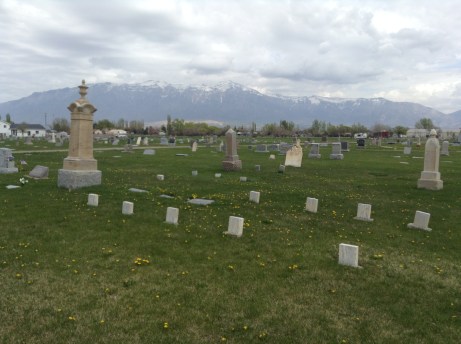
    Skeen Family

    Apparently the story began in the fall of 1870 when one by one, seven of the Skeen’s  children began to fall ill.  Whatever the epidemic was, the household must have been quarantined, because I was only able to find the grave of one other Plain City child who died during those three months.  It must have been six year-old Jane who brought the illness into the household.  On November twenty-third, the little girl succumbed to the illness and left this earthly life, leaving behind at least six siblings, a pregnant mother, and a worried father.

    Less than three weeks later, Caroline Skeen gave birth to a baby who died the same day it was born.  One more spirit to keep little Jane company.  Two days later, the ten year old namesake of Caroline died.  Maybe for a while it looked like the worst might be over, but after what must have been a very sad Christmas, two more children joined their siblings in death.  Four year-old Benjamin and five-year old Elisha died on January third of the new year.  By this time, the epidemic was raging throughout the Skeen household and nothing would stop it.  Five days later, two year-old Thomas died, followed by seven year-old Amanda on January tenth.

    I wondered about the oldest child, William, who was thirteen when he died on January fifteenth.  Was he hanging on in an attempt to care for his brothers and sisters?  How the parents must have mourned as each of their children went to the grave, one after another, in such a short time.

    The Skeen’s tragic story doesn’t end here, though. Several years after my discovery of the tragedy, I returned to take another look at the tombstone. On the opposite side of the tombstone where the names of Caroline and William were inscribed, are the names of a second wife, Mary Davis Skeen and some of her children.  Polygamy was not uncommon in Utah Territory in those days, specifically among devout Mormon families.  Two decades later, polygamy was officially denounced and the church abstained from further plural unions. I decided that I could not pronounce any condemnation upon the heads of William, Caroline, or Mary, though. For all I know, both marriages were solid, amicable, and willingly entered into by all parties.  In fact, I am well aware that many polygamous families have laid claim to happy unions and cordial friendships among wives and children.

    One more child was born to the Skeen family nineteen months after the tragedy.  Unfortunately, this little girl also joined her brothers and sisters in death just six years later.  This is just the beginning of the untold story of the Skeen family.  I wonder what their lives must have been like before and after the deaths of their children?  Which children belonged to which wife? Did they live together in the same house or even on the same street? Did they have any other children who survived?

    Less than a century after the Skeen tragedy occurred, a new devastation began to unfold in the Old World.  As the Holocaust swept over Europe, it wreaked larger destruction upon the inhabitants of the European continent than even the Skeen family could imagine.  After those black days, one Jewish cemetery in Prague stood as a testament against Nazi snipers.  The small plot in Prague escaped destruction, but as Longfellow penned in his poem, The Jewish Cemetery at NewportThe dead nations never rise again.”  Like the graves in Plain City, each cemetery has its own tale of sorrow.  Prague is no different.

    I couldn’t read the headstones at the cemetery in Prague.  Most of the markers were inscribed in “the mystic volume” of Hebrew, and other markers were in Slavic languages.  Even so, the majority of the headstones were weathered to the point that they would have been nearly impossible to read in any language.  I didn’t need to read them. The town’s history and the condition of the graveyard told its own intriguing story of heartache and struggle.  Longfellow thought the Jewish cemetery in Maine to be strange.  To me, it wasn’t strange or gratifying; it was sad and unjustified.  Then again, the very existence of the cemetery tells a tale of triumph over  bigotry and hatred.

    The casual observer in the old Jewish sector would find “narrow streets and lanes obscure” just as Longfellow described, but the cemetery is hidden from casual view. It is located on a small hill completely enclosed by a stone fence. I don’t think that the hill occurs naturally. After 700 years of burials on such a paltry lot of land, it became necessary for the Hebrew community to bring in more soil to bury their dead.
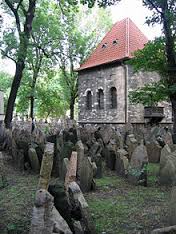
    Jewish cemetery PragueLess than an acre of land. Seven hundred years of death. Men, women, children. Old and young. All of their dead went there. As the years went on, bodies were uncovered, lifted up and reburied with new companions. People who were total strangers, never met, and lived hundreds of years apart became roommates in death. Strange bedfellows.

    Entering the cemetery from a busy street, one is met with an eerie silence. Brownish tombstones, large and small, rest grotesquely upon one another. Most of the stones are so old that the writing has been erased through years of wind and rain. The newer stones are written in Hebrew and couldn’t be read anyway (by me, at least). A pencil-thin pathway winds forlornly through the piles of hand-hewn rock. Above in the trees that serve to hide the sepulchral plot from mortal view, big black birds caw solitarily to one another, adding to the unearthly atmosphere. The calls reminded me of Edgar Allen Poe’s plea; “Is there–is there balm in Gilead? –tell me–tell me, I implore!” I almost expected to hear the raven’s plaintive cry of “Nevermore!”nhsd_raven

    Death is always sad for the living. Billions of tears were shed worldwide for the loss of over six million lives of the Holocaust. I am sure that the Plain City community mourned in a similar fashion for the loss of the Skeen children at what should have been a joyous time of the year. They were the tears of loss. Those who died may have been lucky, as Whitman put it, but those who were left behind lost a piece of their own lives as they put their loved ones into the ground. Often the only solace for the living is knowing that one day they will join their cherished families in death. If there is indeed life beyond the grave, then death cannot part loved ones, it only separates them for a while.

    As for the rest of this world, people come and go from this life daily. Some leave histories.  Most don’t.  Their voices are silent.  Their stories die with them.  My interest is to find tales worth telling and uncover their secrets.  There are some things that will never be known to the living, but the mysteries make great stories.


  • Dead Nations Rising One Citizen at a Time

    Dead Nations Rising One Citizen at a Time

    This year’s cemetery month begins with graveyard poetry. For today’s post, I begin with the end: the final stanza of The Jewish Cemetery at Newport by Henry Wadsworth Longfellow. The poem was first published 160 years ago, in 1858, and contemplated an abandoned Jewish graveyard established nearly 200 years previously in 1677. Among Longfellow’s contemplation, he wondered about the first major Jewish settlement in the American Colonies and their subsequent disappearance from the streets of Newport Rhode Island a century after their arrival. In similitude, people around the world have wondered about the Jews who lived actively within thriving European communities but disappeared by the millions in less than a decade during the Holocaust. Longfellow’s final stanza is this lament:

    But ah! what once has been shall be no more!
          The groaning earth in travail and in pain
    Brings forth its races, but does not restore,

          And the dead nations never rise again

    Perhaps Hitler and his Nazi sympathizers counted on the fact that the Jews lost in the Holocaust would remain lost and forgotten like the Jews of Newport. But thanks to the efforts of people like Ruth Contreras in Austria, the dead nations are rising again. Perhaps not literally, but they are being revived in the memories of towns across Europe like Pitten, Austria, and their names are being reconnected with family members who have lost contact. Those dead nations are indeed rising, one-by-one.

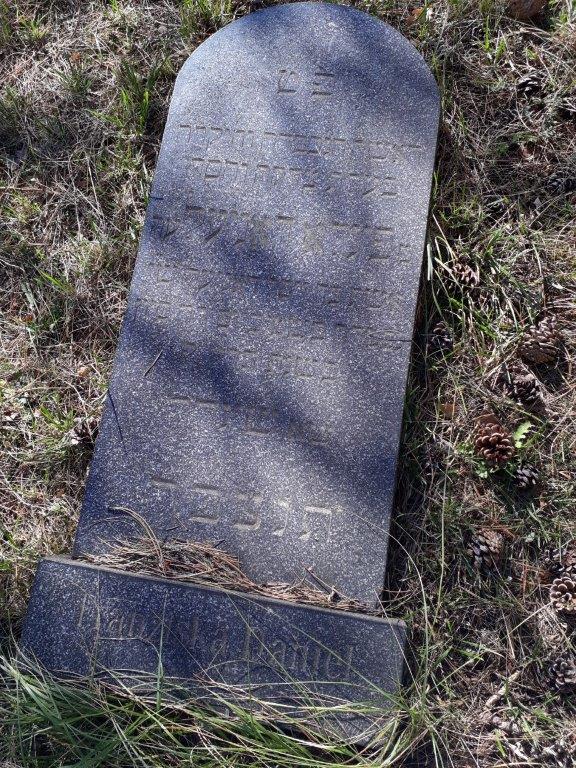
    Four years ago, I posted the photograph of a tombstone in Europe. Like the tombstones of Longfellow’s poem, it was spelled “. . . backward, like a Hebrew book, Till life became a Legend of the Dead.” That tombstone was indeed a mystery to me and my family. We had been unable to find anyone to help us connect that tombstone with or own family story.

    Until ten months ago, that is, when I received an email from Ruth Contreras referring to my blog, and asking about my post, How my Mormon Mom Learned She was a Jew. Attached to Ruth’s message was a photograph of a broken tombstone written in Hebrew and lying in the grass. The bottom of the tombstone bore my great-grandmother’s name in Roman lettering.  I’d seen that tombstone before, but I didn’t recognize it in its dilapidated condition.

    Ruth wanted to know if my grandmother was the same Josephine Daniel who was the daughter of Franziska Abeles Daniel from the tombstone and had lived in Pitten a century ago. If so, could I possibly help her get in touch with any of Josephine’s living relatives? As I read through the letter, I realized that this was a person who had done some in-depth research into my grandmother’s family. She mentioned dates, names, and places particular to my family, and in my intense overload of excitement, I missed the fact that she was even solving the mystery of the tombstone, like Longfellow’s “mystic volume of the dead.”


    I felt like an overexcited puppy being let out to play after a long day home alone. I was positively bouncing; and if I had a tail, I’m sure my whole back end would have been wagging.  The first thing I did was call my parents in Utah to share the message. My mom was just as elated as I was. After all, she had spent years searching for information regarding my third great grandfather who had lived in Pitten all those years ago. This was a break-through for my family. My reply to Ruth’s first inquiry included a photograph of the woman belonging with the tombstone.

    Over the next few weeks a flurry of emails went back and forth between Kentucky, Utah, and Austria. Each new message from Austria was followed up by a phone conversation with Mom and Dad. During that first flurry of messages I learned that Ruth was the granddaughter of the family that lived next door to my grandmother and third great-grandfather in Pitten in the years between the first world war and the Holocaust.

    FT_15.02.04_JewsEurope200pxMy first and most empowering understanding of the Holocaust was my study of The Diary of Anne Frank in eighth grade. To my young mind, Anne’s story explained so much of a grandmother I barely remember. My mother heard grandma speak of her Jewish past only once, and never again. I was able to learn of my own relationship to that Jewish past through a reel-to-reel tape recording of that same conversation. The recording, and my study of Anne Frank raised difficult questions: Who were my relatives in Austria? How many of Grandma’s close friends and cousins died among the six million in the Holocaust? How many others survived? Who were they? Where are they now?
    Ruth’s mission, she explained, was to answer some of those questions. She was looking for the members of the former Jewish community in Pitten, Austria, in order to explain what had happened to them after the annexation of Austria to Nazi Germany in 1938. The Jewish community in Pitten was small, but given that out of the 9.5 million Jews living in Europe before 1938, only 1.4 remain, finding the descendants of those missing Jews is like finding a needle in a haystack . Six million died in the Holocaust, and the remaining 2.1 European Jews are scattered across the globe.

    In the past ten months, Ruth has been collecting and organizing information, and I have not been telling my stories. I’ve been dealing with life, putting the “grand” into grandmothering, fighting bed bugs (The reason for no posts in September. WHY did we move here?), and feeling guilty for not telling stories. But I have not forgotten that one of the reasons I established this blog was to attract previously unknown family members looking to connect with their ancestors and their untold stories.

    My family’s stories are largely unknown, but thanks to Ruth Contreras, I can begin by telling previously unknown stories from my own Jewish ancestors, aunts, uncles and cousins. I hope that Ruth will let me tell her family’s story as well. I’ll never be able to tell even close to six hundred stories of the Jews lost in the Holocaust (let alone six million), but as Ruth reminded me, “The generation of survivors of the Shoah [Holocaust] very often hesitates to speak about what happened, but I think it is the obligation of the second and third generation  to find out as much as possible to ensure that this does not happen again.” Ruth is of the second generation. I am of the third. I take this obligation seriously.

    Ruth was also able to tell me of some neighbors to my ancestors in Pitten, Austria:

    • Ruth’s mother and grandparents lived next door to my family before the Anschluss. They relocated to Columbia, and their property was Aryanized. The family returned to reclaim their property in 1948, and Ruth lives there now.
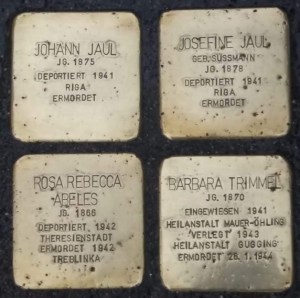
    • Johann Jaul and his wife Josephine, also victims of the Holocaust, owned the property my family lived in, and lived about ten minutes away by foot. The Jauls’ daughter and her husband escaped to Argentina, but their former properties no longer exist.
    • A fourth Pitten resident, Barbara Trimmel, was a victim of Nazi Eugenics (biological purification of the Aryan race). She was not Jewish, but fit into another category targeted by the Nazis.

    Related results of Ruth’s efforts include:

    • Pitten Stumbling Blocks
      Photo contributed by Ruth Contreras

      A photo of my great-grandmother will be included in an exhibit of Jewish life in the Museum of Contemporary History in Bad Erlach.

    • Four bronze “Stumbling Blocks” laid next to the secondary school in Pitten, including one for my third great-aunt, Rosa Rebecca Abeles who died in Treblinka.
    • A commemorative event for the alumni of the secondary school in Pitten.  Ruth reports that the event was quite successful. In her words, “I think the kids learned a lot about prejudices, marginalization of minorities and they will have to discuss a lot at home with their parents. Never again!”
    • An article published in Messenger from the Bucklige Welt telling of Ruth’s quest to identify Holocaust victims and their families, including the story of how she found my family through a web search leading her to Stories From the Past.

    So the dead nations are rising one by one through the  commemoration of their lives in museums, on the streets of their hometowns, magazine articles, and stories told on the internet.

    May we never forget.


    A special thanks to Pitten Mayor Helmut Berger, Stumbling Block artist Gunter Deming, project initiator Ruth Contreras, and research director Werner Sulzgruber.


    How strange it seems! These Hebrews in their graves,
          Close by the street of this fair seaport town,
    Silent beside the never-silent waves,

          At rest in all this moving up and down!

    The trees are white with dust, that o’er their sleep

          Wave their broad curtains in the south-wind’s breath,
    While underneath these leafy tents they keep

          The long, mysterious Exodus of Death.

    And these sepulchral stones, so old and brown,

          That pave with level flags their burial-place,
    Seem like the tablets of the Law, thrown down

          And broken by Moses at the mountain’s base.

    The very names recorded here are strange,

          Of foreign accent, and of different climes;
    Alvares and Rivera interchange

          With Abraham and Jacob of old times.

    “Blessed be God! for he created Death!”

          The mourners said, “and Death is rest and peace;”
    Then added, in the certainty of faith,

          “And giveth Life that nevermore shall cease.”

    Closed are the portals of their Synagogue,

          No Psalms of David now the silence break,
    No Rabbi reads the ancient Decalogue

          In the grand dialect the Prophets spake.

          And not neglected; for a hand unseen,
    Scattering its bounty, like a summer rain,

          Still keeps their graves and their remembrance green.

    How came they here? What burst of Christian hate,

          What persecution, merciless and blind,
    Drove o’er the sea — that desert desolate —

          These Ishmaels and Hagars of mankind?

    They lived in narrow streets and lanes obscure,

          Ghetto and Judenstrass, in mirk and mire;
    Taught in the school of patience to endure

          The life of anguish and the death of fire.

    All their lives long, with the unleavened bread
          And bitter herbs of exile and its fears,

    div>The wasting famine of the heart they fed,

          And slaked its thirst with marah of their tears.

    Anathema maranatha! was the cry

          That rang from town to town, from street to street;
    At every gate the accursed Mordecai

          Was mocked and jeered, and spurned by Christian feet.

    Pride and humiliation hand in hand

          Walked with them through the world where’er they went;
    Trampled and beaten were they as the sand,

          And yet unshaken as the continent.

    For in the background figures vague and vast

          Of patriarchs and of prophets rose sublime,
    And all the great traditions of the Past

          They saw reflected in the coming time.

    And thus forever with reverted look

          The mystic volume of the world they read,
    Spelling it backward, like a Hebrew book,

          Till life became a Legend of the Dead.

    But ah! what once has been shall be no more!

          The groaning earth in travail and in pain
    Brings forth its races, but does not restore,

          And the dead nations never rise again.


  • . . . and I’m back.

    . . . and I’m back.

    Over the summer, Stories From the Past was never far from my mind. In fact, I felt a lot of anxiety over no posts, but between two grandkids and a broken PC (I have six grandkids but two were staying with me), my ability to blog was reduced to bits and snatches of time with a tablet or a phone. Have you ever tried to blog from your tablet or phone? Well, I’m a perfectionist, so I wasn’t even going to attempt it. In fact, I suffer from perfection paralysis. It’s a real thing, which means that if I can’t do something right, I’m not going to do it at all. Thankfully, knowing you have a problem is the first step in solving it, and I am now working hard to get over my fear of doing a less-than-perfect job. Now that both grandkids are back at home and in school, and I have a new PC,  Stories From the Past is ready to roll, and I’m gearing up to launch a professional, remodeled, website for 2019.

    back at work
    back at work  ( I hope it’s true that a messy desk is a sign of a genius mind.)

    Many of you are waiting for stories about your own ancestors, and if I told you I’d be writing about them, I WILL. In fact, I hope to be turning several of them into books. I’m getting started right away on at least one of them, but I consider this just the beginning, knowing it can only get better from here.

    I don’t have a set priority list, with the exception of the story that started it all, and that will be The Second Wife’s Story. Mary Davis Skeen is the subject of my first book, so all of you Davis/Davies/Skeen progeny can look forward to getting the first read. I plan to publish the unedited book one chapter at a time. I’ve been planning to author a book for more than three decades now, so all I can say about that is it’s ABOUT time!

    So here is my list of proposed subjects for the next few months and well into 2019:

    • Mary Davis Skeen (The Second Wife’s Story)
    • The Jews of Pitten, Austria (Specifically the ones who lived next door to my great-great-grandfather, Rudolf Abeles.)
    • Rosa Rebecca Abeles
    • Mary Rogers Damron
    • Sgt. Bernard Kwiatkowski and the WWII 5th Airforce 90th Bomb Group
    • new cemeteries
    • Kentucky slavery and the U.S. Civil War

    Blog posts are scheduled Wednesday at 10 AM of each week.

    Next Week: A special thanks to Ruth Contreras

    Ancestor Landing pages for specific blog subjects will appear on the first of each month. October’s Landing page is Thomas Davies (1816 Llannelly, Carmarthenshire, Wales – 1899 Plain City, Weber, Utah, USA)

  • Light Housekeeping Before Major Renovation

    Light Housekeeping Before Major Renovation

    January is the season for it.

    I made some cosmetic changes to StoriesFromThePast last year. I changed my background, and experimented with new designs, but as readership increased and I began making new connections, the potential of this project became clear. I was connected with readers in unexpected ways, and by the end of the year, StoriesFromthePast had taken on a life of its own. This is exactly what I had hoped would happen, but it’s too much and too little all at the same time.

    As StoriesFromThePast moved  full-steam ahead, life applied the brakes. I can see that I curses, foiled again.jpgneed more time to apply to this project, but instead of having more time as an empty-nester, I now have a little grandchild to take care of on a nearly-full-time basis. Not a problem, I thought, I’m a morning person anyway, so I could research, write stories, and revamp the blog while my granddaughter sleeps. Nope. The website isn’t making money yet, and our family can’t afford to wait, so I’ve had to take on a morning job teaching ESL online. Curses. Foiled again.
    I’m not giving up though. StoriesFromthePast has become the avenue for realizing my lifelong dream of becoming a published author. Well, technically that’s already happened, but I’m talking full-length biographies. Getting that first biography out takes time, and day-to-day living takes money. Not only that, but I have decided to get some professional consultation to make this work well into retirement. It looks like 2018 is the year for some major changes.

    While I’m preparing for this major overhaul, I am applying a few immediate changes.  I’m planning some new additions and streamlining to make it easier for both me and my readers while I am learning and implementing some new tricks of the trade.

    Since there are, on average, four weeks to each month (and occasionally five), I have decided to organize information I present by weeks. My current goal to publish one new article each week. It should look something like this:

    • Week 1: Stories and/or chapters from the lives of people who are no longer alive to speak for themselves.
    • Week 2: Cousin Connections
    • Week 3: Cousin landing pages
    • Week 4: A chapter from my own life: This is the part of genealogy I dread the most. You would think a writer would love writing about herself. For me, his is true only to the extent that I like sharing my thoughts and feelings about things I find interesting. However, I think we all share the responsibility for preserving our own past for the sake of our progeny, so I’m beginning this task publicly.
    • Week 5: Genealogy tips and tricks

    I don’t know if anyone else will be interested, but it is helpful for me to get my plans out in a visible way. I have not received a paycheck from my new job (I’m in training and  haven’t officially started yet), so it will be at least two months before I begin workshops to learn the business end of blogging. You’ll be seeing changes beginning next week, but I don’t expect the biggest changes to come for a few months at least. In the meantime, thanks so much for following and reading, and please don’t give up! You never know whose ancestor’s name is going to pop up next!


  • Family Xenophobia

    Family Xenophobia

    Today marks the 32nd anniversary of the first official observance of Martin Luther King, Jr., Day as a national holiday in the United States, and on this day I felt it important to tell the stories of “othering” in our own personal family trees.

    Before I get started, let me make a disclaimer. In no way do I intend to downplay the significance of discrimination experienced by Americans of  African descent. There can be no excuse made for the maltreatment of Black Americans today and in the history of the United States. It’s just that today seems like the best time to focus on xenophobia in my own family history. Not that it matters to me, but there is no evidence of African blood in my DNA, and I have simply not found any such stories to tell.  Not yet anyway.

    I was raised in a community where the “others” were often those of different religions. I grew up in Utah as a member of the Church of Jesus Christ of Latter-day Saints (LDS or “Mormons”). I wasn’t necessarily taught this othering at home, but I saw it and learned it from the discourse around me: at school, in social gatherings, in the workplace, and at church. Many Utah LDS families inherited a deep distrust of outsiders from their ancestors who experienced persecution and intense harassment leading to an official extermination order from the state of Missouri and their eventual exodus from Illinois to what was then Mexican Territory.  Terms like prejudice and racism never entered the conversation, and I was well into adulthood before I learned to put a name to the fear that governed that public discourse. The name is xenophobia, an intense and irrational fear of aliens. I’m not talking about little green guys with antennae growing out of their heads coming from distant planets; I am talking about human beings coming into our communities from different places, cultures, and religions.  Here in the United States, that can be anyone.

    Dad’s Story

    So I begin with a simple story from my father’s childhood. Dad was born in Olean, New York and lived there until he was thirteen. During the 1940s, he attended Olean Public School no. 7. As Dad tells it, there were two doors serving students in the school, the main door on the East, and a side door on the South. The side door had been claimed by a large group of Italian students at “the Italian door,” and when teachers weren’t looking, they patrolled the door for encroachments upon their self-proclaimed territory. The “Italian” door was closer to Dad’s route home, so one day he decided to leave through it. As he heard the door latch behind him, he knew he was in trouble; there was a group of kids waiting at the bottom of the steps. Dad took off at a run and managed to escape, but looking back at that day, Dad said, “I learned to run real fast.”

    Even though many Italian Americans share similar physical features, their mostly fair skin and European facial features keep them firmly entrenched in white-American society. The only way those schoolchildren truly knew whether one came from one European background or another, was to be well aware of families in the neighborhood and the other students attending their school. So when the Hawaiian Kwiatkowskis came to stay with family following their mother’s death in 1952, their unfamiliar faces and tanned complexions immediately identified them as alien.

    Tod and Ski’s Story

    Being the youngest of the Hawaiian clan, Ski doesn’t remember much about his trip to New York in 1952, and he does acknowledge that there are many reasons why resettling in New York didn’t work for Leo Kwiatkowski and his five children. However, the one obstacle to the widowed father and his family that Ski remembers well is the othering of himself and his siblings by New Yorkers who could not accept mixed marriages. As Ski put it,

    It was almost scandalous that a white man from New York was marrying a dark skinned Hawaiian woman.  But it was not at all as scandalous as some might have thought as a lot of us newer generation Hawaiians are mostly of mixed blood, so inter racial marriages started way back in Hawaii, where there really is no racial bias or prejudice. [sic.]  The only bias, if one could call it that, was a form of reverse discrimination where the Hawaiians were very wary of any white man and how he would fit into “our” society.  Our society is very, very different from that of the mainland U.S.  The most glaring difference is the mixture of races and the harmony in which we all live.  Japanese, Caucasian, Negro, Hawaiian, Filipino, Chinese, Korean, Puerto Rican, Portuguese, and the list goes on with as many ethnic groupings as the earth holds.

    Tod remembers that time as “a tragic and confusing time for five children, ages 14 to 5, and a single Father with no job, and no income.” Although both brothers admit that racism was just a part of the issues facing the young Hawaiians in New York, xenophobia often has the effect of further alienating families from the very places where they go to seek refuge, just as it did for this family.

    Mom’s Story

    The Jews of Europe know that story well. Those who survived the Holocaust and chose to return to their European homes faced an uphill battle to reclaim their ravaged property and maintain an uneasy peace among many of their neighbors. Their numbers are significantly reduced from pre-Holocaust days. Those who chose to seek asylum in the reformed nation of Israel have yet to find peace. Still others who scattered to the Americas denied their identity as a form of protection to their progeny. Such was my mother’s case, as she was in her early twenties when her mother finally revealed her Jewish identity.

    I grew up believing that racism and cultural bias did not exist in my Utah home. It wasn’t until I returned to Utah after living in California for two years that I could truly see the extent of xenophobia in my beloved mountain home. Although that’s another story for another time (and maybe a different blog), the most profound example came when my empty-nester parents moved into a typical Utah suburban home. One neighbor who came to welcome them into the neighborhood, exclaimed to my mother, “Thank goodness you are not blacks or Jews!” I’m sure she explained her reasoning that neither group could be trusted to my mother, but by that time, Mom was no longer listening and had firmly decided to look elsewhere for new friends.

    Tony’s story

    mixed race marriage
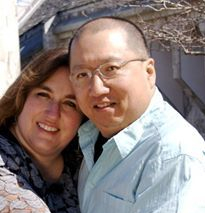
    Our engagement photo taken by Denise de la Foye, 2009.

    Now I have a confession to make. I am in a bi-racial marriage. Mine is not the first. It won’t be the last, but when we find such a thing among our ancestors it is not only a talking point, but often a source of contention. My husband was born in Hong Kong, China and came to the United States when he was just three months old. He grew up in the near suburbs of Chicago, and when people ask him what country he comes from, his answer is always the same, “The United States.” He grew up here. He knows nothing else, but unlike European Americans, his skin color and distinct facial features belie the fact that he was not born here. He goes by the distinctly Western name of Anthony, so when I tell people who have never met him that my husband is an immigrant and his name is Anthony (“Tony”), they nearly always say, “Oh, he’s Italian, right?” No.

    It seems pretty common for Chinese immigrants to take on an “American” identity when they come here. Most I have met go by names like David, Catherine, Alexander, and Marie. On his birth certificate, his name is Sai Fung, but on his naturalization papers, social security card, and other official documents, he has always been Anthony. We didn’t think anything of it until he brought his Illinois driver’s license into a Utah DMV to exchange for a new one. I was able to exchange mine within a matter of minutes. For Tony, it was a matter of months. Six years  and a move to Kentucky later, all of his legal documents identify him by a name no one but his siblings recognize. I blame xenophobia cloaked in our Patriot Act signed into law on my 36th birthday.

    As Tony was nearing the end of his legal paperwork nightmare, a casual encounter with a drunk man at a bus station revealed a side to Tony’s life that I had not yet seen or understood. The drunk man approached my husband, and said, “Fried rice on the side?” Giggling to himself, the man staggered off. It was not the first time my husband had encountered such ignorance, but it sure helped me understand Tony’s lament, “Sometimes I wish I was white.”

    We can’t deny that xenophobia exists all around us, and it would take willful blindness to claim that there is no racism in the midst of our families and ancestors. But we have to face it as it happens, and learn to acknowledge it. It is so easy to claim superiority based on the color of our skin and country of origin, but we must be wary as it happens to us. To be clear, my surname is Kwiatkowski, an obviously Polish name. As happened with the Italians in my father’s grade school, it would be just as easy to group together and claim racial superiority based on pure Polish blood. That is, until one encounters another who has had different experiences and sees life from a different narrowly appointed point of view.

    Yesterday, my dear cousin Bernie illustrated this point in a Facebook post quoting Thomas E. Watson, an American politician from Georgia. As Bernie pointed out, Watson is “Talking about [our mutual] ancestors from some hole* in Eastern Europe.
    *That would be Poland.”

    So here it is:

    “The scum of creation has been dumped on us. Some of our principal cities are more foreign than American. The most dangerous and corrupting horde of the Old World have invaded us. The vice and crime they planted in our midst are sickening and terrifying.” Thomas E. Watson, 1912

    It has not been my intent to preach or to politicize my family history. I simply want to create awareness. After events such as those in Charlottesville, West Virginia, last summer, I have become hyper-aware that xenophobia in the United States seethes barely beneath our surface.  We need a new way of looking at things, and I believe the best way to start is by acknowledging our mistakes of the past. We could also look to places, like Hawaii, that have managed to become true melting pots. As my cousin Ski explains, “Hang loose is an expression we use to say “Just chill, take it easy, there’s no need to rush” and it befits the island lifestyle.” We could learn a few things from the Hawaiians.

  • Life Gets in the Way

    Life Gets in the Way

    The hardest part of telling the stories of dead people is that it requires a living person to do it.  But sometimes life gets in the way, and that is what is going on with me right now. In fact, I had a plan way back in November, and I was well on the way to have it in place and moving smoothly by 2018. Then life happened.

    I have a lot to tell you, and it won’t take much time to tell that part of my story, but I just can’t fit it into my schedule for a few days. Please bear with me until I can get everything compartmentalized and reorganized.

    notfoundWhile some of this might have to do with procrastination (i’m good at that), most of it has to do with unexpected communication from my readers and just life in general. I’ll tell all; don’t worry. But before I go today, I really want to give a shout out to my three groups of readers, plus two individuals, that are helping pave the way for new and exciting changes for the new year:

    • Descendants of William Dolby Skeen and his two wives: Carolyn Smart Smith and Mary Davis. Theirs is the story that started it all, and I have not forgotten them by any means.
    • Descendants of Johannes (John) Kwiatkowski from Olean New York. Without your support and encouragement, I would not be contemplating a big step. An extra special thanks goes to my new-found cousin, Chuck, who’s caught the passion for telling the story that deserves to be told.
    • Ruth Contreras and the people of Bucklige Welt. I haven’t forgotten you, and I have no intention of doing so. I consider it my responsibility to play a part in making sure that the Jews of Bucklige Welt are not forgotten. I am still looking for those lost family members, and will let you know every time I find another one. And Ruth, I haven’t forgotten that I still owe you an email response.
    •  Diedre McLean, who alerted me to the many family stories that could be told for our ancestors right here in the United States.
    • And Dad. His dedication and passion for genealogy have led directly to an extension of my Cousin Connection project that I never thought possible. I can’t wait to tell you about it!

    I have a post planned for Martin Luther King jr. Day, so that comes first. After that, I’m pretty sure I’ll be more than ready to get caught up. See you in a few days!


  • Cousin Connection #6: Hauʻoli Makahiki Hou (Happy New Year!)

    Cousin Connection #6: Hauʻoli Makahiki Hou (Happy New Year!)

    Aloha, Olean Kwiatkowskis! This marks the last of the Kwiatkowski Cousin Connections for a while. Time to focus on other branches of the family tree, especially Rothsprack; I’m completely stumped on that one. But first, let me introduce you to my Hawaiian cousins. I’ve got plenty of them, thanks to a cousin named Leo (or Leon, as he told it).

    While Cousins in New York experienced a typically white Christmas snuggled warmly at home away from outside temperatures well below freezing, cousins in Hawaii had temperatures right around 80 degrees fahrenheit.  A great day for some Christmas hula. And since the temperature won’t be changing much this weekend, I’m betting plenty more hula is planned for the New Year as well, even if the Hawaii Kwiatkowskis don’t plan to attend.

    Michael Thaddeus “Tod” Kwiatkowski, and Philibert Francis “Ski” Kwiatkowski are respectively the oldest and youngest of five children born to Leo Michael Kwiatkowski and his wife Catherine Ku’uleilani Guerreiro in Honolulu. Although they are in my father’s social generation, the three men have never met in person. All five of  Catherine and Leo’s children were born in Hawaii, and Dad had moved from Olean before the cousins from HI visited in 1952.

    My first question to both Tod and Ski, was “How did this group of Kwiatkowskis end up in Hawaii?” The answer is pretty simple, really: the U.S. Army. As Tod tells it,

    My father joined the Army and was shipped to Honolulu, sometime in 1935, or so. There, he met my mother, Catherine Ku’uleilani Guerreiro of Waialua, Territory of Hawaii. They were married in 1937, I think, and he mustered out of the Army in Honolulu, rather than mustering out in New York.”

    Catherine Ku’uleilani Guerreiro and Leo Michael Kwiatkowski.jpg
    Catherine Ku’uleilani Guerreiro and Leon Kwiatkowski as they must have looked when they first met.

    All five of Leo and Catherine’s children were born on the “Big Island” (Honolulu), except for a very short stint in 1952 after Catherine died. She was just 43 years old. It was a very rough time for the family. Tod explains,

    Hawaii Kwiatkowskis c1952
    Circa 1950 or 1951. L-R: Bernadette, Phil (“Ski”), Tod, Noel, and Larry.

    We saw our first snowfall in Olean, on October 12, 1952. Because of the burden five children placed on my grandmother and my Aunt Jenny, we all returned to Hawaii sometime in October or November of 1952. That was a tragic and confusing time for five children, ages 14 to 5, and a single Father with no job, and no income. That episode will fill a book.

    Because he was so young at the time. Ski has a more colorful memory of his short time in New York:

    Family connections to the mainland U.S. Kwiatkowskis that lived in Olean, N.Y. are very sketchy for me. . .  I was 5 at the time and remember meeting many cousins, uncles and aunts, but most of them faded from memory aside from photographs that we would get from time to time.  I remember “Bu” quite well and my dad’s sister, Aunt Jenny.  My dad’s brother, John and his other sister Helen I also remember.  I remember Olean as a very typical foothill town of East New York state, not a large town, but a quaint one  with all the trappings of a 1950’s town.  I remember going down to the “crick” near the railroad trestle to skip stones in the water and things like that, but for the most part, faded memories.

    We stayed about 3 months on that trip as we were planning to live in Olean.  Many obstacles came up, one of which was racial and the others I was too young to remember.  My experiences in St. Augustine Elementary were different than Michael as I was sent home for punching a ninny of a nun because she wanted to whack my hands.  I was having none of that, so I punched her in the stomach.  That was the beginning of a few lickings.

    I got a kick out of that last part. My father’s stories of his childhood in Olean are very similar. The family was staunchly Catholic, but that didn’t stop kids from being kids and nuns from doing what nuns did at the time. I went to public school myself, but my father and husband were both raised Catholic, along with several of my friends. All of their stories have a very similar ring to them. One of these days I’ll have to tell the story of the time my husband and his schoolmates spiked the holy water with red Kool-Aid.

    Ukulele by Ski
    A ukulele in the making. By Ski Kwiatkowski

    Now that I know the reasons for the Hawaii cousins remaining in Hawaii, it makes sense. By their Hawaiian heritage bestowed by their mother, these Kwiatkowskis are firmly Hawaiian. Hawaii was the last state to join the Union in 1959, long after the children’s return from their last family trip to the mainland. Ski, who is the youngest, has been making traditional Hawaiian woodwork for many years. He even makes ukuleles.

    As a mainlander who’s never been to Hawaii, I can only base my knowledge of Hawaiians on what I’ve learned through school and the media. Which isn’t much. Aside from my new-found cousins, Pearl Harbor is always the first thing that comes to mind when thinking of Hawaii, and since their father came to the islands with the U.S. Army, I had to ask.

    Ski was very obliging with details.

    My dad told it to me that he was home when the attack on Pearl Harbor began.  He was a policeman and we did not have a phone yet so the police department called the neighbor (the contact number) neighbor told him about the attack and to go immediately to the police headquarters.  When he got there, he and one other officer were given a shotgun each and a box of shells and told to report to the area somewhere near an area called Iwilei.  Up the street from them was the OR & L train depot and roundhouse, but they were told to go to the pier and supposedly hold off any Japanese invasion of the harbor with a shotgun apiece, a box of shells and their .38 caliber service revolvers.  Once at the pier my dad recalled a Zero coming in on them and strafing the pier with bullets.  He said that it was close enough that splinters from the wood were hitting them.  It was at that time that he and his partner decided they would be better protected by staging at the OR&L depot, which they did.  There were several more strafing runs in that area and my dad said that he emptied his revolver on one Zero, but knew that it was like shooting spitballs at a tank.

    At least he got to shoot at them, which is more than others did.

    Tod provided another interesting Hawaiian link to the Olean Kwiatkowskis. It turns out that my cousin Bernie’s uncle, Bernie, was brother not only to Bernie’s mother, but Leo as well, which makes their Cousin Connection chart nearly identical to Bernie’s. Not only that, but it seems that Leo’s brother spent some time in the island as a sergeant in the Army Air Corps while Leo was on the Honolulu police force.


    So now I have even more questions for Bernie, Tod, and Ski. I definitely want to ask about “Uncle Bernie’s” Pearl Harbor experience, so I’ll have to plan a new post for next Dec. 7.

    Even more curious for me, though, is that all three cousins claim that their grandmother’s maiden name (“Babci Mary“), Conkle, actually derives from the surname Krysztofiak.  Conkle is a Germanic surname, but Krysztofiak is definitely Slavic. So which is it, Conkle or Krystofiak? The geographical boundaries are blurred in Poland and Germany by the rise and fall of the Prussian empire, and I think there may be some answers in the geography. This is going to take a bit of digging, but I’ve got eleven months to do it. It will be fun to see what I come up with.

    In the meantime, Happy New Year, and STAY WARM! (Hawaii Cousins can ignore that last part.)