Last month, one of my readers commented on my newsletter that readers are an audience, and that I can do what I want without consulting them. Please don’t get me wrong, it is valuable advice for many blogs, but when I started Stories From the Past, I meant for it to be something bigger than that. I wanted this to be a place to revive the stories of “average” people who slipped out of this life and into obscurity. While their lives may have seemed unimportant and mundane to them, following generations don’t necessarily agree. There are stories of heroism left unwritten, lessons to be learned, entertaining insights, and great ideas that are otherwise lost to the world if they are not put into words and made accessible, so input from my readers is extremely valuable to me.
For history nuts like myself, reading and telling stories of bygone days is fun, but I am repeatedly told that telling the true stories of past generations is a valuable service. There are plenty of biographical tidbits all over the internet, in books and other published media, but I wanted this to be a place where otherwise untold stories could find a home.
What I really want is for this to be an interactive site where I am not only telling stories from my own family’s past, but incorporating stories from readers, collecting stories from friends, inviting others to submit their own stories, and reaching out in search of lost stories. It’s done well by me so far, and I want to do well by my contributors, so the monthly newsletter will continue to act as a way to reach out to family, old friends, new friends, and new-found cousins for feedback and more stories. And, of course, it will always continue to function as foundation for accountability on my part.
What am I Doing Wrong?
Last month I set up a Go-Fund-Me fundraiser to help me get to Austria. I was so excited when less than five minutes after publication I had a $100 donation. Great! I thought, I’m on my way. Then nothing. I posted to Facebook, LinkedIn, made an individual Facebook message for many of my friends, and still got nothing other than that one original donation. I would really love for someone with Go-Fund-Me experience to give me some advice. I must be doing something wrong . . .
In the meantime, my Fundraiser will stay open until I have received enough donations and/or saved enough to go to Austria. Even if I have to go later. I may miss the museum inauguration, but I can still go when I can afford it.
Still in the Race
I didn’t get a whole lot done last month, but I am still plugging along on two or three hours a day, five days a week. I’m definitely not moving at Stephen King pace, but I am happy that I’m still going.
February 5 is Chinese New Year. I don’t want it to be forgotten. In fact, I intend to include a series of stories for my husband’s Chinese family. However, I have rarely mentioned my husband. This is mostly due to the fact that my husband is a high-functioning adult with autism. Anyone with autistic family members may be quite aware that people with autism have little to no interest in thoughts, ideas, activities, or events that do not directly affect them, so when I brought up the idea of researching his ancestors, he told me, “Why don’t you just leave them alone? They’re dead. They don’t care.” LOL. I ignored him and kept on researching and writing.
So in honor of my husband, I intend to make this month’s Raising Voices about something that directly affects him: disability, and the misuse of terms like idiot, retard, and even disability. In the future, I’ll be focusing more on stories from his Chinese background.
So here’s what’s going on this month:
January Review:
Mary Eynon ancestor profile page (not a post) -incomplete
Looking back at Stories from the Past in 2018, I have learned that monthly newsletters are my greatest success. Although I am still writing them more for my own benefit than that of others, they truly are a guideline for what to expect for the month. More importantly, my newsletters give me the opportunity to identify what went well and illuminate my trouble areas. Making them public invites my readers to cheer me on and/or provide helpful suggestions and constructive criticisms.
My newsletters have become my boardroom. Welcome to the board!
The Race is not Necessarily Won by the Swiftest
2019 certainly has not begun as I envisioned for Stories From the Past. I have encountered a few obstacles, and rather than let them keep me down, I am choosing to accept the stumble, and even the fall. As long as I am willing to pick myself up, dust myself off, and apply band-aids where necessary, I can make it to the finish line.
The transition between 2018 and 2019 reminds me of Aesop’s fable, The Tortoise and the Hare. The tortoise won the race by continually moving forward while the hare napped. I moved much slower than I wanted to last year. Sometimes I was more like the hare, and I am not at all happy about that. What I am happy about is that I finally started moving again as the year came to its close and that I am still moving.
Facing Obstacles
An unexpected, but very welcome, obstacle means that I’ll be postponing my official launch for a few months. I am planning a trip to Austria where I can meet my story-telling face-to-face. I have been invited to the opening ceremony of a museum exhibit featuring the people that once thrived in the Bucklige Welt-Wechselland Region of Austria before Hitler’s reign of terror and the Shoah. Not only will I be able to learn more about my own family’s stories, but I will hopefully gather the stories of their friends and neighbors as well.
I have a lot to do to prepare for the trip. This week alone, I’ll be applying for a new passport (I haven’t been out of the country for more than 17 years!), beginning a new course in German from Rosetta Stone, and creating a Go-Fund-Me account to help with basic expenses for the trip. Of course, I’ll also need to forward my acceptance to the invitation, arrange for lodging and travel while I am there, etc. The only other time I’ve been to Europe was when I was doing study abroad, and most of the arrangements were done for me. There’s much more to trip planning than I remembered.
I also need to go back through my records in an attempt to trace the funds donated through Facebook last year. At this point, I am not recommending that anyone donate to Facebook’s charitable causes. I’ll be happy to let you know if my opinion changes.
What Happened to the Second Wife’s Story?
December was a huge struggle for me. With barely a nod to Hanukkah, I found myself mired in four stories originally intended to be just one. Although I am glad that I decided to tell the stories separately, the final story came after Christmas when I was supposed to be wrapping up the second Chapter of Mary Davis Skeen’s biography.
As December drew to a close, I found myself mired in research for Mary Eynon Davies, mother of Mary Davis Skeen. I was supposed to have had Mary Eynon’s profile page up by the end of the month, along with a first and second chapter of the story. Instead, nothing was posted in regards to The Second Wife’s Story.
I am behind on my writing, but that doesn’t mean I am behind on my goal to publish the Second Wife’s Story by the end of 2019. It just means that I need to find a better way to accomplish that goal. I CAN STILL do this.
I need a better way to accomplish that goal. Like most of my profile pages, Mary Eynon’s will be incomplete when I post it tomorrow. A new post will appear when new profiles appear and when changes are made to existing profiles. I may also have to post chapters in parts (Why not? I did it with my Christmas Tree stories.), and they may even appear out of order, but at least my progress will be evident on Chapter One, and maybe even Chapter 2 by the end of January. Everything will be linked in order on The Second Wife Story’s book page.
My new focus is to be on The Second Wife’s Story first, ancestral stories second, and stories found along the way third. Each month will have a social-historical focus, and for each monthly focus, I will provide a short summary or review along with link/s to the original story/ies.
Since January’s focus is black history month, I’ll be looking at a story from North American Slave Narratives: a collection of books, articles, and journals telling the stories of Black America’s quest for freedom and equality, beginning with my home state: Kentucky.
Reassessment
Once again, I am reminded of James Clear’s prescription, “if you want to set your expectations appropriately, the truth is that it will probably take you anywhere from two months to eight months to build a new behavior into your life — not 21 days.”
I have learned that the early morning writing routine does not work for me because I am usually picking my daughter up from work at midnight. By the time I wake up around eight or nine, everyone else is getting up too. My best time to focus without interruptions is during the middle of the day when my granddaughter is at school and my husband is at work. This is not my morning job; it is my day job.
“It’s failure that gives you the proper perspective on success.”
– Ellen DeGeneres
I’ll be making a few minor changes as well:
Monthly Headers (a cosmetic change–you’ll know it when you see it)
Story Teasers (I’m already using these, but I need to update past posts)
Newsletters will be posted on the last Monday of the previous month when the first day of the month falls on a Tuesday or Wednesday.
December Review
Objectives met are crossed out.
Navajo Greetings and exploration of the name (Navajo vs. Diné)
Hanukkah for non-Jews (with a nod to rembembering the Shoah)
A Slovenian Christmas Eve (Recipe and Tradition)
(n)O Christimas Tree (Stories from Olean, New York, and Lark, Utah)
Like my previous newsletter, this is more for my benefit than anyone else (I’m still practicing).
Before I get this party started, I need to point out that today is the second day of Hanukkah! For Jews, this party is already well underway. Happy Hanukkah everyone!
November did not go as I planned. I started off gung-ho, but by the end of the month I was off track, and missed my most important post: Chapter One of The Second Wife’s Story. All I can say is hooray for a new month!
Maybe the holiday season was not the best time to be reviving and preparing for a relaunch of Stories From the Past. Maybe I should have started off slower. I could probably blame my missing first chapter of The Second Wife’s Story on the flu that I caught immediately after Thanksgiving. Or just maybe I could say, Well, I’m not quite there yet; take a closer look at where I went wrong, and start fresh.
So without any more excuses, and remembering that every day is a clean slate, I can take a look at the past, see where I went wrong, and try again.
Habit Building
As I think about the month of December, and my plans for the New Year, I am reminded that I am building new habits for the rest of my life. Habits don’t change overnight, and I have to be patient and not take on more than I can handle. I am building a blog, writing a book, and building a habit, so I need to take on one task a time.
In his article, How Long Does it Actually Take to Form a New Habit? (Backed by Science), James Clear debunks the 21-day habit myth and explains, “if you want to set your expectations appropriately, the truth is that it will probably take you anywhere from two months to eight months to build a new behavior into your life — not 21 days.” This is encouraging, and a bit daunting, as I was hoping to have my new daily routine set before the New Year begins.
There I go again, expecting perfection overnight. Well, that ain’t happening.
But eight months? I’m not expecting it to take that long, but at least I can be assured that with dedication and determination, my goals of regular, on-time posting and having Mary Davis Skeen’s biography, The Second Wife’s Story, ready for publishing will be accomplished within the new year. I CAN do this.
Re-launch
I have to remember that December is the busiest month of the year in the United States, and that my readers are probably just as overwhelmed with holiday preparations as I am. I still have a lot of planning and organizing to do in order to prepare for a professional New Year launch.
I intend to follow my own inner clock which tells me that December is a time for reflection while January is a time for renewal. This month I’ll be looking over what I have completed so far, and tweaking and preparing for a clean new start in January.
My posts will be simple, as my focus will be on completing two chapters of The Second Wife’s Story (appearing after Christmas), and cleaning up and preparing Stories From the Past for its new start in January.
To accommodate for the holidays, posts will not necessarily appear on their regularly scheduled days and times.
Fundraising for Austria:
New generations are already forgetting, and denying,
I’ve been invited to Austria for the inauguration of a museum housing exhibitions on the Jews in Bucklige Welt and Wechselland regions titled “With – Without Jews.” The museum will tell the stories of the many families who disappeared during the Holocaust–including mine.
I will be able to gather so many more stories of people who can’t tell them.
This year’s cemetery month begins with graveyard poetry. For today’s post, I begin with the end: the final stanza of The Jewish Cemetery at Newport by Henry Wadsworth Longfellow. The poem was first published 160 years ago, in 1858, and contemplated an abandoned Jewish graveyard established nearly 200 years previously in 1677. Among Longfellow’s contemplation, he wondered about the first major Jewish settlement in the American Colonies and their subsequent disappearance from the streets of Newport Rhode Island a century after their arrival. In similitude, people around the world have wondered about the Jews who lived actively within thriving European communities but disappeared by the millions in less than a decade during the Holocaust. Longfellow’s final stanza is this lament:
But ah! what once has been shall be no more!
The groaning earth in travail and in pain
Brings forth its races, but does not restore,
And the dead nations never rise again
Perhaps Hitler and his Nazi sympathizers counted on the fact that the Jews lost in the Holocaust would remain lost and forgotten like the Jews of Newport. But thanks to the efforts of people like Ruth Contreras in Austria, the dead nations are rising again. Perhaps not literally, but they are being revived in the memories of towns across Europe like Pitten, Austria, and their names are being reconnected with family members who have lost contact. Those dead nations are indeed rising, one-by-one.
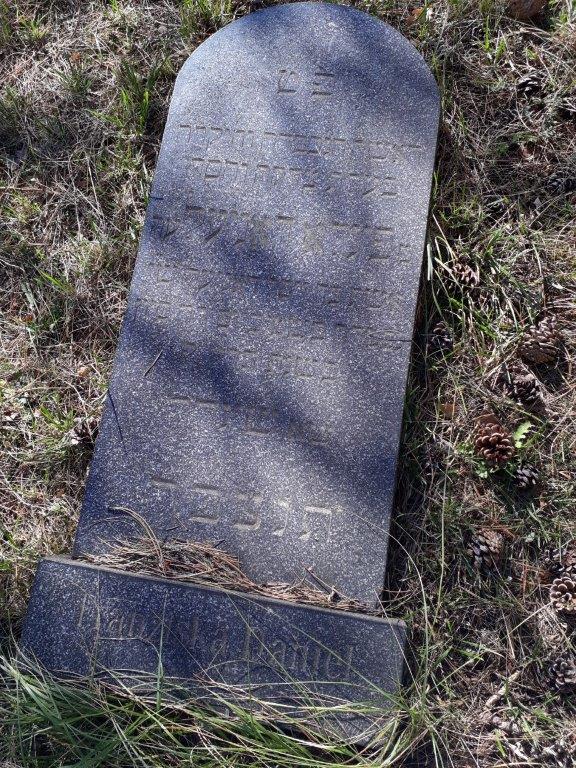
Four years ago, I posted the photograph of a tombstone in Europe. Like the tombstones of Longfellow’s poem, it was spelled “. . . backward, like a Hebrew book, Till life became a Legend of the Dead.” That tombstone was indeed a mystery to me and my family. We had been unable to find anyone to help us connect that tombstone with or own family story.
Until ten months ago, that is, when I received an email from Ruth Contreras referring to my blog, and asking about my post, How my Mormon Mom Learned She was a Jew. Attached to Ruth’s message was a photograph of a broken tombstone written in Hebrew and lying in the grass. The bottom of the tombstone bore my great-grandmother’s name in Roman lettering. I’d seen that tombstone before, but I didn’t recognize it in its dilapidated condition.
Ruth wanted to know if my grandmother was the same Josephine Daniel who was the daughter of Franziska Abeles Daniel from the tombstone and had lived in Pitten a century ago. If so, could I possibly help her get in touch with any of Josephine’s living relatives? As I read through the letter, I realized that this was a person who had done some in-depth research into my grandmother’s family. She mentioned dates, names, and places particular to my family, and in my intense overload of excitement, I missed the fact that she was even solving the mystery of the tombstone, like Longfellow’s “mystic volume of the dead.”
The tombstone, finally identified.
My great-grandmother, Franziska “Fanny” Abeles Daniel
My grandmother, Josephine Daniel, and her sister Sommer, at their mother’s tombstone.
I felt like an overexcited puppy being let out to play after a long day home alone. I was positively bouncing; and if I had a tail, I’m sure my whole back end would have been wagging. The first thing I did was call my parents in Utah to share the message. My mom was just as elated as I was. After all, she had spent years searching for information regarding my third great grandfather who had lived in Pitten all those years ago. This was a break-through for my family. My reply to Ruth’s first inquiry included a photograph of the woman belonging with the tombstone.
Over the next few weeks a flurry of emails went back and forth between Kentucky, Utah, and Austria. Each new message from Austria was followed up by a phone conversation with Mom and Dad. During that first flurry of messages I learned that Ruth was the granddaughter of the family that lived next door to my grandmother and third great-grandfather in Pitten in the years between the first world war and the Holocaust.
My first and most empowering understanding of the Holocaust was my study of The Diary of Anne Frank in eighth grade. To my young mind, Anne’s story explained so much of a grandmother I barely remember. My mother heard grandma speak of her Jewish past only once, and never again. I was able to learn of my own relationship to that Jewish past through a reel-to-reel tape recording of that same conversation. The recording, and my study of Anne Frank raised difficult questions: Who were my relatives in Austria? How many of Grandma’s close friends and cousins died among the six million in the Holocaust? How many others survived? Who were they? Where are they now?
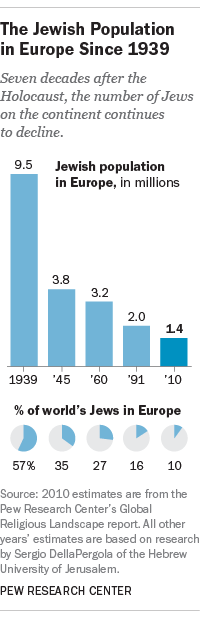
Ruth’s mission, she explained, was to answer some of those questions. She was looking for the members of the former Jewish community in Pitten, Austria, in order to explain what had happened to them after the annexation of Austria to Nazi Germany in 1938. The Jewish community in Pitten was small, but given that out of the 9.5 million Jews living in Europe before 1938, only 1.4 remain, finding the descendants of those missing Jews is like finding a needle in a haystack . Six million died in the Holocaust, and the remaining 2.1 European Jews are scattered across the globe.
In the past ten months, Ruth has been collecting and organizing information, and I have not been telling my stories. I’ve been dealing with life, putting the “grand” into grandmothering, fighting bed bugs (The reason for no posts in September. WHY did we move here?), and feeling guilty for not telling stories. But I have not forgotten that one of the reasons I established this blog was to attract previously unknown family members looking to connect with their ancestors and their untold stories.
My family’s stories are largely unknown, but thanks to Ruth Contreras, I can begin by telling previously unknown stories from my own Jewish ancestors, aunts, uncles and cousins. I hope that Ruth will let me tell her family’s story as well. I’ll never be able to tell even close to six hundred stories of the Jews lost in the Holocaust (let alone six million), but as Ruth reminded me, “The generation of survivors of the Shoah [Holocaust] very often hesitates to speak about what happened, but I think it is the obligation of the second and third generation to find out as much as possible to ensure that this does not happen again.” Ruth is of the second generation. I am of the third. I take this obligation seriously.
Ruth was also able to tell me of some neighbors to my ancestors in Pitten, Austria:
Ruth’s mother and grandparents lived next door to my family before the Anschluss. They relocated to Columbia, and their property was Aryanized. The family returned to reclaim their property in 1948, and Ruth lives there now.
Johann Jaul and his wife Josephine, also victims of the Holocaust, owned the property my family lived in, and lived about ten minutes away by foot. The Jauls’ daughter and her husband escaped to Argentina, but their former properties no longer exist.
A fourth Pitten resident, Barbara Trimmel, was a victim of Nazi Eugenics (biological purification of the Aryan race). She was not Jewish, but fit into another category targeted by the Nazis.
Related results of Ruth’s efforts include:
Photo contributed by Ruth Contreras
A photo of my great-grandmother will be included in an exhibit of Jewish life in the Museum of Contemporary History in Bad Erlach.
Four bronze “Stumbling Blocks” laid next to the secondary school in Pitten, including one for my third great-aunt, Rosa Rebecca Abeles who died in Treblinka.
A commemorative event for the alumni of the secondary school in Pitten. Ruth reports that the event was quite successful. In her words, “I think the kids learned a lot about prejudices, marginalization of minorities and they will have to discuss a lot at home with their parents. Never again!”
An article published in Messenger from the Bucklige Welttelling of Ruth’s quest to identify Holocaust victims and their families, including the story of how she found my family through a web search leading her to Stories From the Past.
So the dead nations are rising one by one through the commemoration of their lives in museums, on the streets of their hometowns, magazine articles, and stories told on the internet.
May we never forget.
A special thanks to Pitten Mayor Helmut Berger, Stumbling Block artist Gunter Deming, project initiator Ruth Contreras, and research director Werner Sulzgruber.
Over the summer, Stories From the Past was never far from my mind. In fact, I felt a lot of anxiety over no posts, but between two grandkids and a broken PC (I have six grandkids but two were staying with me), my ability to blog was reduced to bits and snatches of time with a tablet or a phone. Have you ever tried to blog from your tablet or phone? Well, I’m a perfectionist, so I wasn’t even going to attempt it. In fact, I suffer from perfection paralysis. It’s a real thing, which means that if I can’t do something right, I’m not going to do it at all. Thankfully, knowing you have a problem is the first step in solving it, and I am now working hard to get over my fear of doing a less-than-perfect job. Now that both grandkids are back at home and in school, and I have a new PC, Stories From the Past is ready to roll, and I’m gearing up to launch a professional, remodeled, website for 2019.
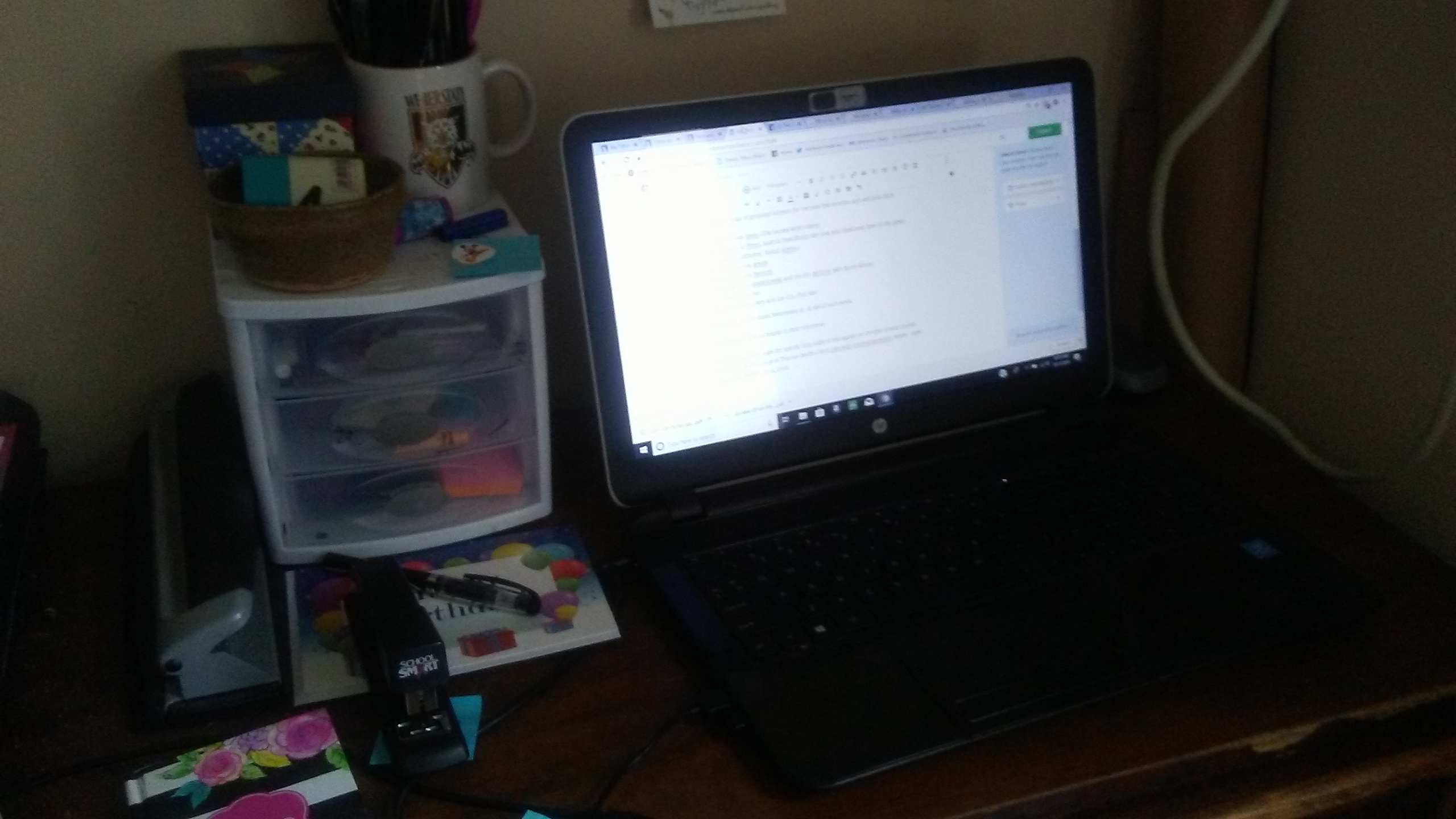
back at work ( I hope it’s true that a messy desk is a sign of a genius mind.)
Many of you are waiting for stories about your own ancestors, and if I told you I’d be writing about them, I WILL. In fact, I hope to be turning several of them into books. I’m getting started right away on at least one of them, but I consider this just the beginning, knowing it can only get better from here.
I don’t have a set priority list, with the exception of the story that started it all, and that will be The Second Wife’s Story. Mary Davis Skeen is the subject of my first book, so all of you Davis/Davies/Skeen progeny can look forward to getting the first read. I plan to publish the unedited book one chapter at a time. I’ve been planning to author a book for more than three decades now, so all I can say about that is it’s ABOUT time!
So here is my list of proposed subjects for the next few months and well into 2019:
Mary Davis Skeen (The Second Wife’s Story)
The Jews of Pitten, Austria (Specifically the ones who lived next door to my great-great-grandfather, Rudolf Abeles.)
Rosa Rebecca Abeles
Mary Rogers Damron
Sgt. Bernard Kwiatkowski and the WWII 5th Airforce 90th Bomb Group
new cemeteries
Kentucky slavery and the U.S. Civil War
Blog posts are scheduled Wednesday at 10 AM of each week.
Next Week: A special thanks to Ruth Contreras
Ancestor Landing pages for specific blog subjects will appear on the first of each month. October’s Landing page is Thomas Davies (1816 Llannelly, Carmarthenshire, Wales – 1899 Plain City, Weber, Utah, USA)
The hardest part of telling the stories of dead people is that it requires a living person to do it. But sometimes life gets in the way, and that is what is going on with me right now. In fact, I had a plan way back in November, and I was well on the way to have it in place and moving smoothly by 2018. Then life happened.
I have a lot to tell you, and it won’t take much time to tell that part of my story, but I just can’t fit it into my schedule for a few days. Please bear with me until I can get everything compartmentalized and reorganized.
While some of this might have to do with procrastination (i’m good at that), most of it has to do with unexpected communication from my readers and just life in general. I’ll tell all; don’t worry. But before I go today, I really want to give a shout out to my three groups of readers, plus two individuals, that are helping pave the way for new and exciting changes for the new year:
Descendants of Johannes (John) Kwiatkowski from Olean New York. Without your support and encouragement, I would not be contemplating a big step. An extra special thanks goes to my new-found cousin, Chuck, who’s caught the passion for telling the story that deserves to be told.
Ruth Contreras and the people of Bucklige Welt. I haven’t forgotten you, and I have no intention of doing so. I consider it my responsibility to play a part in making sure that the Jews of Bucklige Welt are not forgotten. I am still looking for those lost family members, and will let you know every time I find another one. And Ruth, I haven’t forgotten that I still owe you an email response.
Diedre McLean, who alerted me to the many family stories that could be told for our ancestors right here in the United States.
And Dad. His dedication and passion for genealogy have led directly to an extension of my Cousin Connection project that I never thought possible. I can’t wait to tell you about it!
I have a post planned for Martin Luther King jr. Day, so that comes first. After that, I’m pretty sure I’ll be more than ready to get caught up. See you in a few days!
Shalom and Hanukkah Sameach! Hanukkah 2017 begins this evening. And because I do identify as Jewish by virtue of my ancestral birthright, we find no problem with fitting it in among our celebrations of the season.
Being Jewish has everything to do with my passion for Family History. I grew up knowing that my grandmother was a Jew, but I did not feel its impact until I was required to read The Diary of Anne Frank in junior high school. The connections I made between my grandmother, Anne, and the Holocaust suddenly became very real to me, and I longed to know more about my own family’s experiences during those dark days, but it would be several decades before the truths of those times would come to light.
I know that my personal commitment to religious, cultural, and racial tolerance had its beginnings in those early literature and history lessons. I was solidly struck by the fact that I would have been targeted for death camps had I lived in Europe during those rough times, simply because my grandmother was born into Judaism. I could not wrap my mind around the fact that my whole family could have been slaughtered based on the identity of one grandparent. I still can’t.
Those early lessons in prejudice and religious/racial tension led me to want to know more. As I learned, the desire to understand that extreme commitment to birthright and religious heritage led me to make connections between my parents’ chosen religion and the tenets of faith espoused by my third great grandfather, Rabbi Heinrich Abeles.
For the longest time, the only things I knew about my Jewish predecessors were related to what I could learn through my history classes at school and church. Unfortunately, those lessons were limited to the Spanish Inquisition, the Holocaust, and the older-than-dirt-and-twice-as-dusty Old Testament, the latter of which I found beyond boring. In the intervening years between high school and the advent of the internet, I was able to glean a few more insights into Judaism, but really only enough to help me to understand the basic differences between Christmas and Hanukkah, along with the fact that all of those “potato pancakes” I’d been eating over the years as a side dish to Mom’s Christmas Saurbraten, were really Latkes, the traditional food of Hanukkah.
This photo was taken from our 2016 celebration. Tonight, Jews all over the world will light the first candle to begin their festivities.
Thanks to the internet though, I have been able to bring to life the Jewish commitment to God and tradition, and to intertwine them with my past and present. It was during those early days of inquiry that led me to understand myself as a Messianic Jew. I think there is an actual established religion out there that identifies as such, but for me, Messianic Jew is simply a way to identify my personal faith in Jesus Christ as the god of the Old Testament (“Yahweh”—whose name is too sacred to be spoken aloud). Since then, I have not only learned how to make Hanukkah an annual tradition in my home, but I have learned how music, prayer, and practice come together to make religion an integral part of daily life as a Jew. I have even been able to participate in, and appreciate, the deeply spiritual Passover Seder. Those early days of inquiry and discovery brought that dusty Old Testament back to life for me.
But doing Jewish genealogy has not been so easy. This has a lot to do with the Holocaust and the intersection of German, Hebrew, and Yiddish languages, upon none of which anyone in my family has much of a grasp. We have struggled to make connections between my grandmother’s verbal history and the truth of her past as a European Jew with not much to go on. Were it not for a handful of trinkets, photographs, and letters in a handwritten language we have yet to decipher, that past would have been nothing more than rumor.
All of that changed exactly one month ago when I received an email from a woman I’ve never met by the name of Ruth Contreras. Ruth’s letter asked about the family of Rudolf and Charlotte Abeles. She implored, “If there is the possibility to get into contact with someone of the descendants of the Abeles Family you may give them my e-mail address . . . so they can decide if they want to contact me.” Ruth not only provided the names of my great-great grandparents, but the name of my great grandmother along with the name and birthdate of my grandmother, all of whom had lived in Pitten, Austria at one point or another. This was information we already had on record, but her letter indicated that she could provide even more that we did not have. I was so overcome with excitement I had to read the email three times before I could actually believe what I was reading. The first thing I did was call my mother, after which I swiftly replied, “We are very pleased to report that you have made direct contact with descendants of the Abeles family in the United States.”
Ruth Contreras, the lovely woman who would not give up her search until we were found. (Photo Courtesy of Ruth Contreras).
After a series of back and forth emails in which we both asked and answered questions, I asked Ruth for a candid interview regarding her background and interest in finding my family. To my delight she was completely forthcoming in her answers. Ruth’s family had been next door neighbors to my family before all of the residents in the Jewish sector of Pitten were displaced or murdered in the dark days of the Holocaust. As I told her, “We must not let the world forget.” Ruth agreed, and the interview proceeded as follows:
Q: Would you prefer to be called just Ruth, or may I also share your surname?
A: You may do as you like and feel better.
Q: I have noticed that your official title is “Mag. Dr.” Does the Mag. stand for magistrate? Is the Dr. a Doctrate of Philosophy or some other kind of doctor? If magistrate, are you a magistrate for the town of Pitten?
A: My titles are „Master of science“ (I studied biology and have been teaching for some year in Vienna at a highschool.) and Dr. phil. Yes, indeed when I studied in spite of studying a branch of natural sciences the degree was Dr. phil. I have been working as an entomologist at the Natural History Museum in Vienna since 1972. From 1995 to 2003 (my retirement) I was the Head of the Department of Entomology at the Natural History Museum. After my retirement I did some terms of Jewish Studies at the University in Vienna.
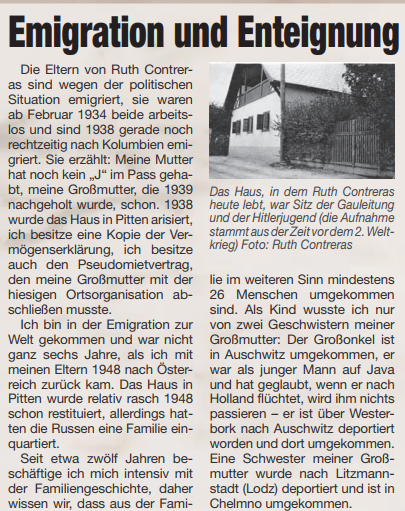
A more detailed biography of Ruth Contreras along with a photograph of her family’s home in Pitten.
Q: I can see that you have a personal vestment in this project, but do you also have a more official role in the Jews of Bucklige Welt project? What is your role?
A: One of my interests is the history of Jews in Austria before the Shoah. I am working since several years on a project about the Jews that lived in the 10th district of Vienna and so I learned first about Rosa Rebecca Abeles who was deported from Alxingergasse 97 to Theresienstadt.
Some years ago I was interviewed for a book on the history of our family and the house where we are living: Johann Hagenhofer, Gert Dressel (editors) (2014) „Eine Bucklige Welt – Krieg und Verfolgung im Land der Tausend Hügel.“ ISBN: 978-3200037342 . Publisher:Alois Mayrhofer.
Q: What is the official name of the project, and how did it come about?
A: Last year I was invited by Dr. Hagenhofer to participate in the team that is doing research for a project „Die jüdische Bevölkerung der Region Bucklige Welt – Wechselland“
(English translation:The Jewish Population of the Bucklige Welt Region – Wechselland. Bucklige Welt covers more than 23 villages with approximately 39,000 inhabitants. Wechselland is a region of mountains and valleys in Lower Austria, South of Vienna. )
Q: Will there be a museum? A book? A website?
A: This project is part of the preparation for a regional Jewish Museum in Bad Erlach, which will be inaugurated in on occasion of the Lower Austrian Provincial Exhibition 2019 and yes, there are also plans for a book.
Q: How many towns in the region does the project cover?
A: We are 17 working on this project on about 25 villages and their former Jewish fellow citizens.As I am living in Pitten and had already some information, I was invited to participate in this project.
Q: How did you know to look for the Abeles family, and what was important about Rudolf, Lotti, and their children?
A: The history of the Jaul- Family in Pitten was known as well as the history of our house. In order to get more information I started with the permission of the Mayor of Pitten to check old registries at the school in Pitten where I found the information on Josefine Daniel and Heinrich Abeles. The other children of Rudolf have been added with the help of the archive of the Jewish Community in Vienna and by using the Austrian genealogical website https://www.genteam.at/.
The other important source where the registration forms where I found Rosa Rebecca repeatedly also hosting people at her home and this last document when she had to leave Pitten..
From the registration forms at the municipal archive in Wr. Neustadt I learned that Jakob Abeles had changed his name into Aldor.
The next step was to go to the Jewish Cemetery in Neunkirchen where I found the gravestone of Franziska Daniel. There is also a grave stone of a Ruben Abeles. The letters are in Hebrew, do you know the Hebrew name of your great great grandfather?
(The only name we have for my great-great grandfather is Rudolph)
Q: What was the surname of your family living next door to the Abeles family?
A: My grandparents who bought the house in 1917 were Rosa and Fritz Weiss. My parents were Elfi Lichtenberg (maiden name Weiss) and Franz Lichtenberg.
Q: Do you have any details of comradery or community between the families that can be shared?
A. I have no information if there was any contact between the families. As I told you, my mother did not talk much about this. My grandmother was born in 1880 (she was two years younger than the youngest son of Rudolf Abeles who was born in 1878) Maybe he did not even live there anymore. My mother was born in 1904 and my dad was born in 1907 so I think there was too much difference in the ages of them.
Q: How difficult was it to find us, and what led you to my website?
A: As Rosa Rebecca was the third person directly deported from Pitten I considered it important to find more information about this family. And yes, it was not easy at all to find your blog. After having contacted several groups of 2nd generation of survivors of the Shoah without success it was really by incident that I tried by using Google to look if I could find something about Josephine Daniel Wimpassing and came to your article A Renewed Tribute to Tante Rosa – Stories From the Past .
(Rosa Rebecca was a previously unidentified daughter of Rudolph Abeles. She was my great-great aunt)
One of the most fun parts of the Hanukkah celebration is the dreidel game. The dreidel is a four-sided spinner with the Hebrew letters nun, gimmel, hey, shin; one letter appears on each side. My children have very fond memories of that game which we played as a family. The letters stand for the Hebrew words, nes gadol haya sham, meaning “a great miracle happenedthere.” For my family,connecting with Ruth is a great miracle, and we are so very thankful to welcome her as a new part of our continued quest to discover the truth of our Judaistic past.











 My first and most empowering understanding of the Holocaust was my study of The Diary of Anne Frank in eighth grade. To my young mind, Anne’s story explained so much of a grandmother I barely remember. My mother heard grandma speak of her Jewish past only once, and never again. I was able to learn of my own relationship to that Jewish past through a reel-to-reel tape recording of that same conversation. The recording, and my study of Anne Frank raised difficult questions: Who were my relatives in Austria? How many of Grandma’s close friends and cousins died among the six million in the Holocaust? How many others survived? Who were they? Where are they now?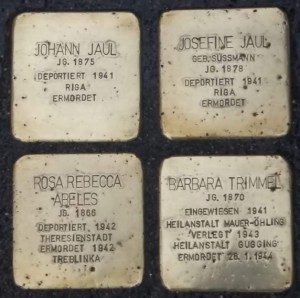

 While some of this might have to do with procrastination (i’m good at that), most of it has to do with unexpected communication from my readers and just life in general. I’ll tell all; don’t worry. But before I go today, I really want to give a shout out to my three groups of readers, plus two individuals, that are helping pave the way for new and exciting changes for the new year:


 StoriesFromthePast.com