The Second Wife’s Story is coming together, but I had to quit working on it for a couple of months. I’m now two months now, but I’m back on track and working on a second biography as well. There’s so much to tell, and I’m so excited to share my progress with you!
Many of you know me personally and many others have known me by my birthname on Facebook and other social media sites. Here on WordPress, I have gone by Too Many Hats for too many years. Some of those hats have come off so it’s now time to change, not just my profile name, but my pen-name as well.
I chose my pen-name many, many years ago, when I decided that someday I would become a writer of books. That someday has been a long time in coming, so the name change is finally underway.
I began looking into that name on Facebook about a month ago–just to see how many individuals might be affected by my choice and just a couple of weeks later a profile with that very name showed up as a friend request. This was very suspicious to me at the moment, so I immediately blocked the request. I was concerned that someone, or some-thing, was trying to take over my professional identity. Since then, I have realized that it was most likely a Facebook generated suggestion and not an attempt to steal anything. I’ve since tried to figure out how to unblock the suggestion so I can send an apologetic friend request, but to no avail.
I thought I’d better go public soon, anyway, so at least my readers won’t get as confused as I am. I hope this helps. You may see me here on WordPress and on other social media by both my given name and Mari K. Flowers, an English variation on my given name. Either way it’s still me, and you will be seeing much more of both of me in the near future!
I’m back to Wednesday blog posts: and I mean it! No excuses.
This website is really old, and never has reached its full potential. It’s in desperate need of updating; so here’s what’s up:
January 2026: Thanks to Super-flu 2025, this newsletter, which should have posted the last year, didn’t make it out on time. So STORIES FROM THE PAST is already two weeks behind and I already have some catching up to do.
Here’s what you can expect this year:
New Theme, Logo, letterhead, and other organizational updates. (You should already see some of them.)
About Us focusing less on beginnings and more on readers. (This keeps you involved.)
Research for Mary Damron’s story (untitled) and at least one more story I can’t wait to get started on.
Austria report from 2019
Family History Conference reviews
Added post days
New Social media connections
February 2026: New research on a new biography. This is near and dear to my heart. but I am quite sure that many of my existing readers and even more of my new readers will be able to find a personal connection or two along the way.
I can’t wait to tell you about it! Stay tuned; preliminary details will be released on January 28.
You will see changes every week, and I’ll be sure to keep you updated.
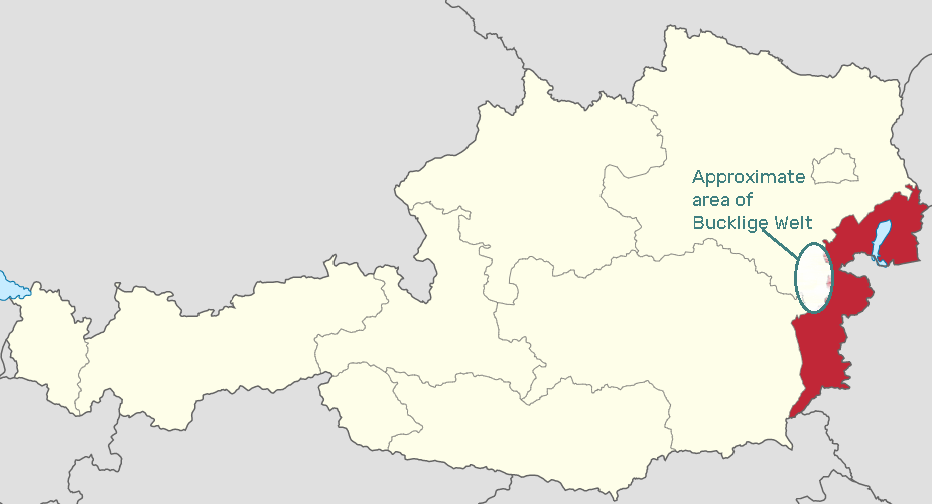
Burgenland is a state of Austria encompassing the entire eastern border adjacent to Hungary. The Bucklige Welt, or Hunchback World, is a region of foothills situated in the southeastern corner of Lower Austria particularly suited to hiking and biking. Also called “The Land of a Thousand Hills,” Bucklige Welt shares the northern corner of Burgenland. As an American “tourist,” I’d describe the area as Austria’s best-kept secret.
The secrets to my Semitic past have been left behind in the remaining homes, synagogues, and cemeteries of the Austrian Jews from the former Austro-Hungarian Empire. The unfortunate tides of history have forever altered access to those secrets. Homes and synagogues were torn down and aryanized while cemeteries were desecrated and/or destroyed. Larger cemeteries in key cities were often lost to the ravages of war. Many of those cities, such as Wiener Neustadt, have made quite successful attempts at restoring their historical town centers to their former glory, despite the loss of vibrant and thriving Jewish sectors. (more…)
Last month, one of my readers commented on my newsletter that readers are an audience, and that I can do what I want without consulting them. Please don’t get me wrong, it is valuable advice for many blogs, but when I started Stories From the Past, I meant for it to be something bigger than that. I wanted this to be a place to revive the stories of “average” people who slipped out of this life and into obscurity. While their lives may have seemed unimportant and mundane to them, following generations don’t necessarily agree. There are stories of heroism left unwritten, lessons to be learned, entertaining insights, and great ideas that are otherwise lost to the world if they are not put into words and made accessible, so input from my readers is extremely valuable to me.
For history nuts like myself, reading and telling stories of bygone days is fun, but I am repeatedly told that telling the true stories of past generations is a valuable service. There are plenty of biographical tidbits all over the internet, in books and other published media, but I wanted this to be a place where otherwise untold stories could find a home.
What I really want is for this to be an interactive site where I am not only telling stories from my own family’s past, but incorporating stories from readers, collecting stories from friends, inviting others to submit their own stories, and reaching out in search of lost stories. It’s done well by me so far, and I want to do well by my contributors, so the monthly newsletter will continue to act as a way to reach out to family, old friends, new friends, and new-found cousins for feedback and more stories. And, of course, it will always continue to function as foundation for accountability on my part.
What am I Doing Wrong?
Last month I set up a Go-Fund-Me fundraiser to help me get to Austria. I was so excited when less than five minutes after publication I had a $100 donation. Great! I thought, I’m on my way. Then nothing. I posted to Facebook, LinkedIn, made an individual Facebook message for many of my friends, and still got nothing other than that one original donation. I would really love for someone with Go-Fund-Me experience to give me some advice. I must be doing something wrong . . .
In the meantime, my Fundraiser will stay open until I have received enough donations and/or saved enough to go to Austria. Even if I have to go later. I may miss the museum inauguration, but I can still go when I can afford it.
Still in the Race
I didn’t get a whole lot done last month, but I am still plugging along on two or three hours a day, five days a week. I’m definitely not moving at Stephen King pace, but I am happy that I’m still going.
February 5 is Chinese New Year. I don’t want it to be forgotten. In fact, I intend to include a series of stories for my husband’s Chinese family. However, I have rarely mentioned my husband. This is mostly due to the fact that my husband is a high-functioning adult with autism. Anyone with autistic family members may be quite aware that people with autism have little to no interest in thoughts, ideas, activities, or events that do not directly affect them, so when I brought up the idea of researching his ancestors, he told me, “Why don’t you just leave them alone? They’re dead. They don’t care.” LOL. I ignored him and kept on researching and writing.
So in honor of my husband, I intend to make this month’s Raising Voices about something that directly affects him: disability, and the misuse of terms like idiot, retard, and even disability. In the future, I’ll be focusing more on stories from his Chinese background.
So here’s what’s going on this month:
January Review:
Mary Eynon ancestor profile page (not a post) -incomplete
Over the summer, Stories From the Past was never far from my mind. In fact, I felt a lot of anxiety over no posts, but between two grandkids and a broken PC (I have six grandkids but two were staying with me), my ability to blog was reduced to bits and snatches of time with a tablet or a phone. Have you ever tried to blog from your tablet or phone? Well, I’m a perfectionist, so I wasn’t even going to attempt it. In fact, I suffer from perfection paralysis. It’s a real thing, which means that if I can’t do something right, I’m not going to do it at all. Thankfully, knowing you have a problem is the first step in solving it, and I am now working hard to get over my fear of doing a less-than-perfect job. Now that both grandkids are back at home and in school, and I have a new PC, Stories From the Past is ready to roll, and I’m gearing up to launch a professional, remodeled, website for 2019.
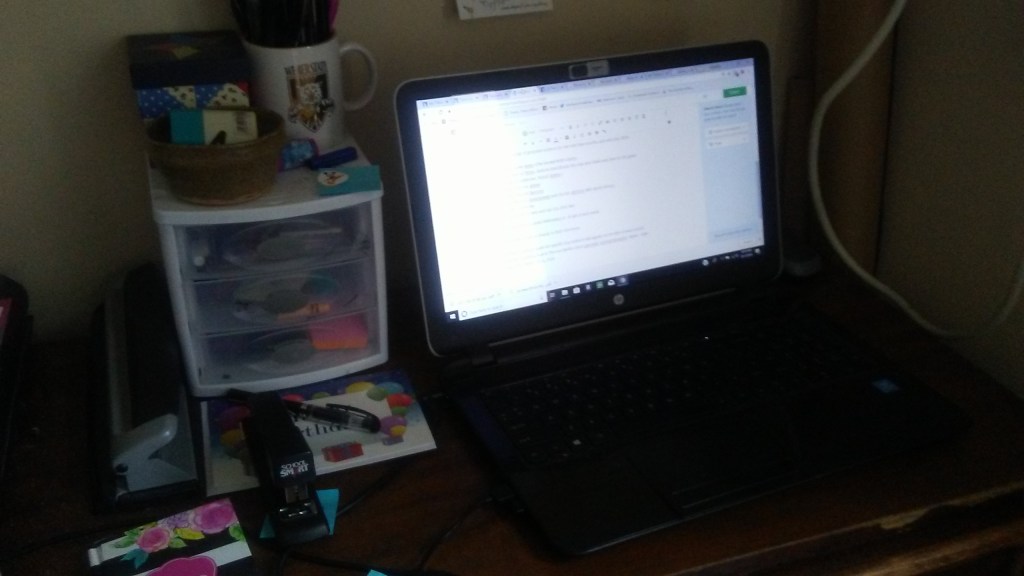
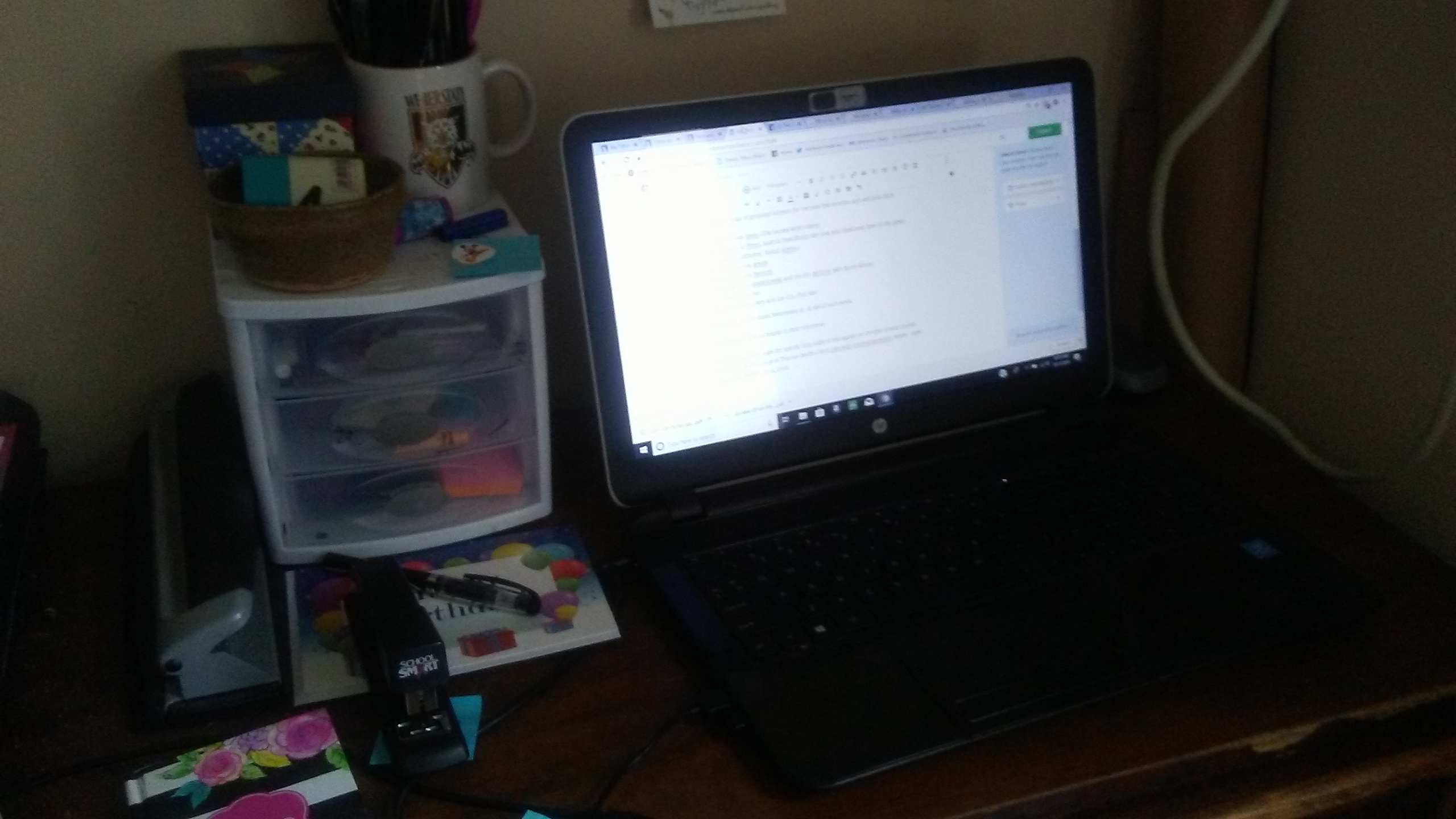
back at work ( I hope it’s true that a messy desk is a sign of a genius mind.)
Many of you are waiting for stories about your own ancestors, and if I told you I’d be writing about them, I WILL. In fact, I hope to be turning several of them into books. I’m getting started right away on at least one of them, but I consider this just the beginning, knowing it can only get better from here.
I don’t have a set priority list, with the exception of the story that started it all, and that will be The Second Wife’s Story. Mary Davis Skeen is the subject of my first book, so all of you Davis/Davies/Skeen progeny can look forward to getting the first read. I plan to publish the unedited book one chapter at a time. I’ve been planning to author a book for more than three decades now, so all I can say about that is it’s ABOUT time!
So here is my list of proposed subjects for the next few months and well into 2019:
Mary Davis Skeen (The Second Wife’s Story)
The Jews of Pitten, Austria (Specifically the ones who lived next door to my great-great-grandfather, Rudolf Abeles.)
Rosa Rebecca Abeles
Mary Rogers Damron
Sgt. Bernard Kwiatkowski and the WWII 5th Airforce 90th Bomb Group
new cemeteries
Kentucky slavery and the U.S. Civil War
Blog posts are scheduled Wednesday at 10 AM of each week.
Next Week: A special thanks to Ruth Contreras
Ancestor Landing pages for specific blog subjects will appear on the first of each month. October’s Landing page is Thomas Davies (1816 Llannelly, Carmarthenshire, Wales – 1899 Plain City, Weber, Utah, USA)
We interrupt your regularly scheduled blog post for this important announcement:
I am pleased to report that I have made a very special connection to family, friends, and neighbors who were lost in the Holocaust.
In the past few days a flurry of emails have gone back and forth between my parents, myself, and a new acquaintance from Austria.
It began with a message coming directly through this website. (Hooray for contact forms!) A woman in Austria has found my posts regarding my grandmother and my great-aunts who were members of the pre-holocaust Jewish community in Lower Austria. She wanted to know if I could put her in contact with surviving members of the Abeles family from Pitten, Austria.
Hey, that’s me!
Completely stunned, I had to read the message three times before I could comprehend that this woman not only knew of my family, but even had some information regarding my family that I did not yet have. I did not quite understand why she was contacting me, but the fact that she knew so much about my grandmother and great-great grandfather was enough to spur me to respond–right after making a very excited phone call to my mother in Utah.
It turns out that this Austrian woman seems just as excited to have gotten a positive response from me. You see, her family lived next door to my family before both families were sent fleeing from imminent Nazi threat. She was eager to know if there were survivors of her family’s old-time friends. The good news is yes, there were several survivors, and the fact that she was able to find me is evidence.
I. Am. Ecstatic.
As a result of my excitement over this new contact, I accidentally closed out all of the renewed pages I had open for research on this week’s new page and corresponding blog post. Once again, I am having to start over to gather resources for the page and article on Aucke Wikoff that was supposed to have been posted last week.
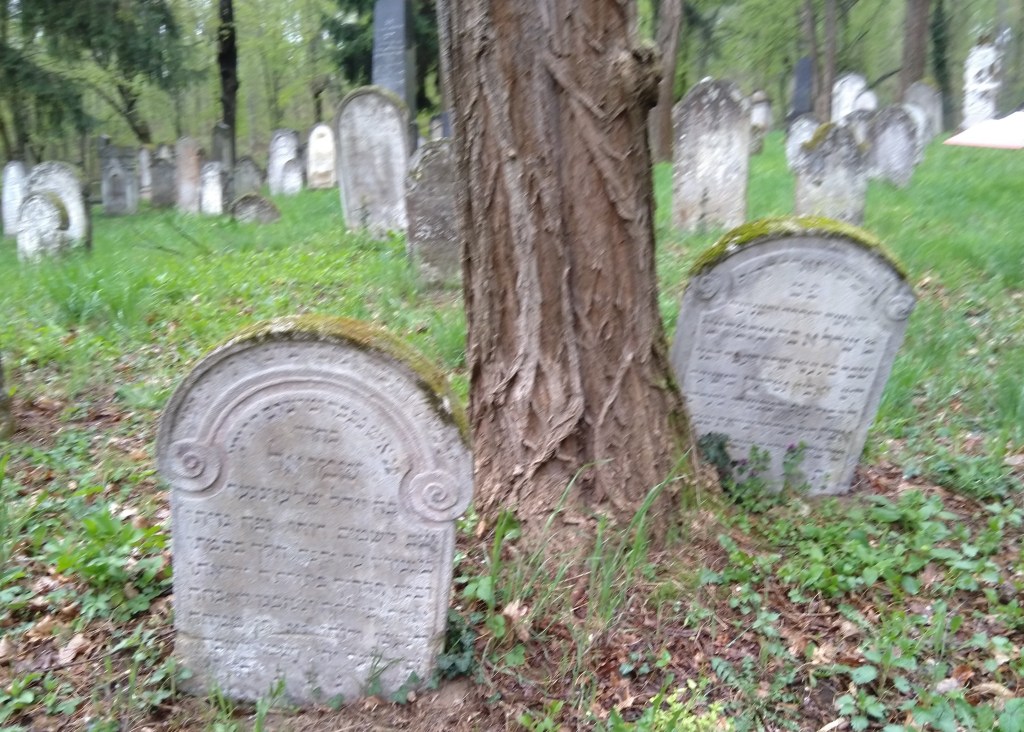
Thanks to this new information, my family was able to update existing family members and add another we were unaware of. On top of that, we now know where my great-grandmother was buried and have a photo of her grave. I think the new page and blog post are going to be put on the back burner for the next couple of weeks as I converse with my new family friend and sort out this new story from the past.
My great-grandmother, Franziska “Fanny” Abeles Daniel
The tombstone, finally identified.
Luckily, this new information came before the post I had planned for next week on the Daniel family. It looks like I’ll be doing something a little different now that I have new information that actually helps to clarify the blog post I had planned for next week. I am really looking forward to sharing all of this with you.
This isn’t a William Faulkner novel, it’s reality. It’s also not like it sounds. When your family has deep roots in the same area where you were born and raised, it’s bound to happen, and it doesn’t take much digging to find family members marrying family members. They probably don’t even know they were doing it.
This case is different because my cousin on my grandfather’s side, married a cousin from my grandmother’s side. They are not related at all to each other, but it’s not totally coincidental that it happened. All of my New York cousins come from my great-great grandfather who was born in Poland. Their roots are not nearly as deep in American soil, and they know who most of them are, so the chances of marrying one of the Kwiatkowski cousins are pretty remote. My grandmother’s genealogy can be traced well into pre-revolutionary America though. They settled in Pennsylvania, a wild and untamed frontier, approximately two generations before my Chuck’s grandfather and my great-grandfather arrived with their parents from Poland. (more…)
One thing I hate about Christmas–it takes over both months of November and December, and Thanksgiving tends to get thrown in as an afterthought. I love Thanksgiving because it reminds me to stop and think of all of the many reasons I have to be grateful.
This month I am busy being grateful for my talent. If you haven’t already noticed, I’m a writer. I have never written a full-length novel, and I am taking advantage of NaNoWriMo to get a good start on one. This means that I won’t be writing full posts in my blogs for a few weeks.
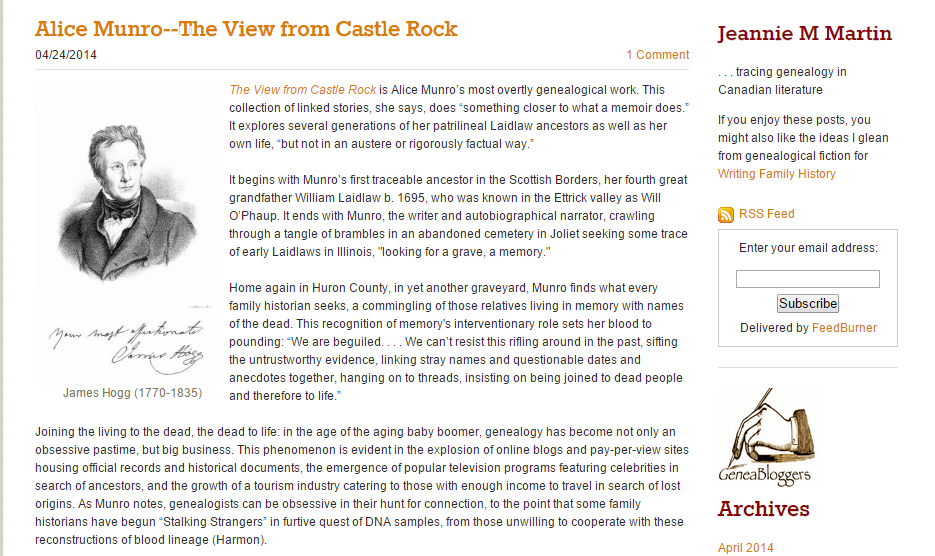
I have decided that this would be a great time to explore Geneabloggers and see what I can find that interests me. And for a genealogist and writer, nothing is more interesting than a good book about real people. Enter Literature and Genealogy by Jeannie M. Martin (http://www.literatureandgenealogy.com).
Check out Jeannie’s recent commentary on some great genealogical reads:
I missed posting on Wednesday. Writing about my Tante Rosa was important, but it took a lot out of me. By the time I had completed the post, I was emotionally worn down. I didn’t feel like I was just blogging about my aunt; I was writing for all of the families of the holocaust. As a parent and grandparent, I imagined being forcefully separated from my young children and grandchildren. From a child’s standpoint, I imagined the horror of discovery that the people whom I put my deepest faith in could not keep me from being snatched away from my family and sent to an unimaginable doom. It was tough and I needed a break. So Wednesday’s blog comes today.
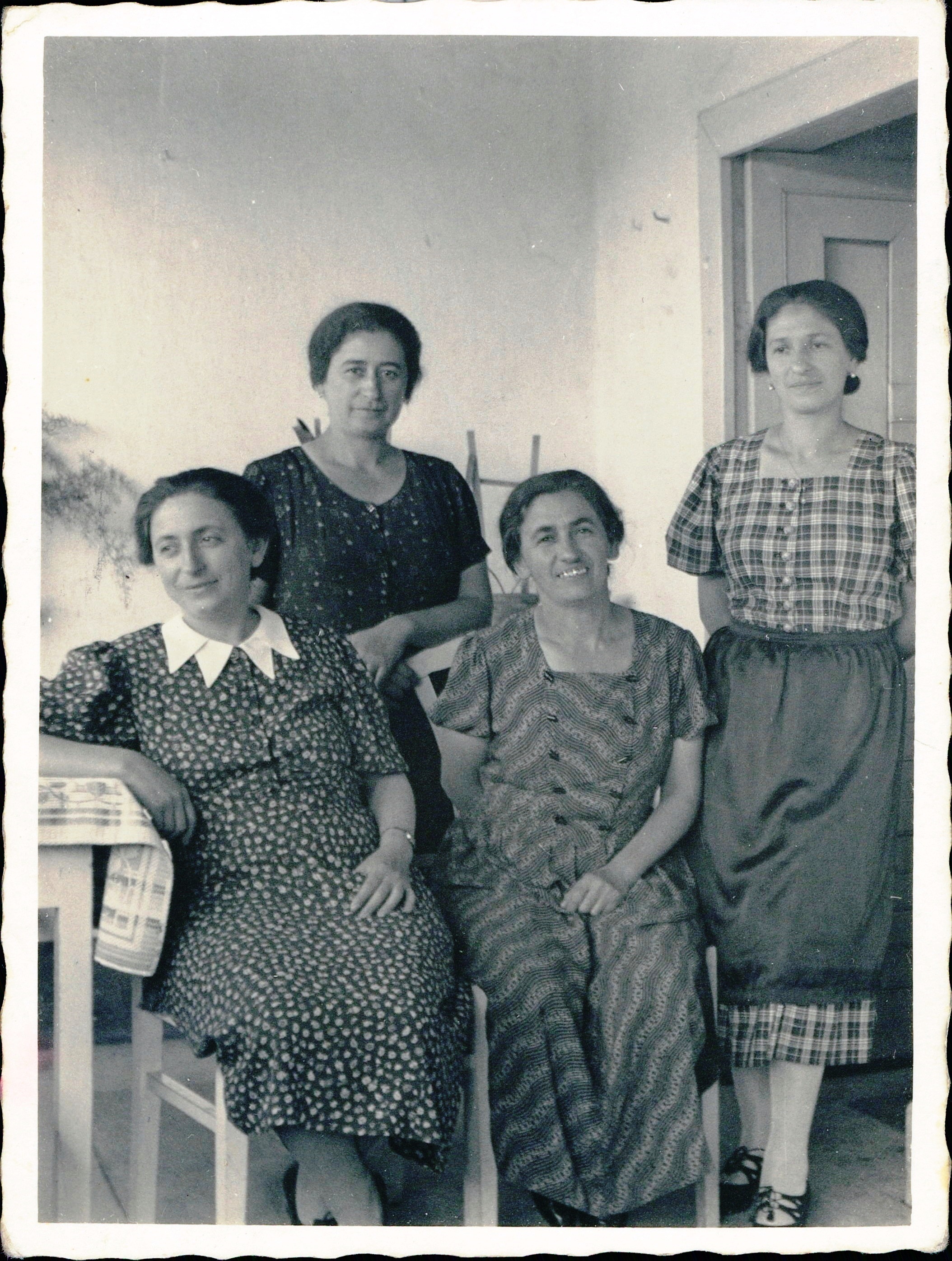
We are pretty sure that the woman on the left is Gisela. Standing in the back is Helene (we knew her). But the woman sitting to the right and the one in the doorway–we are unsure of . They are most likely Rosa and Sommer (Hermine?), but which is which?
I talked with my mother at length regarding September 3rd’s post (Why Grandma Cried). But memory is a fickle thing, coming and going without permission as we get older. From my childhood I remember mom talking about Grandma’s four sisters; but as I started putting records together and gathering photos, I was only able to find evidence of three. I told my mother this, and she began questioning her own memory. Together, we decided that our memory had failed us. We labeled the photo of the four women according to this discussion, despite Mom’s insistence that her mother had four sisters.
A few days after my post appeared I got a phone call. It was my dad. “Your Grandma Rothsprack had four sisters. The one that was missing was named Hermine.” Okay, now the story is starting to make more sense. I remember Mom saying that Grandma had four sisters. So I did a little more digging and sure enough, it came out of my own Grandmother’s mouth. My father had tape-recorded my grandma’s life story when I was just a baby and had made type-written transcripts for each of his children. This is what Grandma said:
“I am one of five girls in the family–no boys. [She lists them] Gisela who lives in Austria. Rosa: killed in Auschwitz (sic). Not Married. Helen: Lives in Graten [California]. Sommer – lives in Austria.”
Wait.
Didn’t dad say the other sister’s name was Hermine? This is confusing. Tante Leni didn’t have any children, I’ve never met my Austrian cousins, and Tante Leni and Grandma are not around to help us get it straightened out.
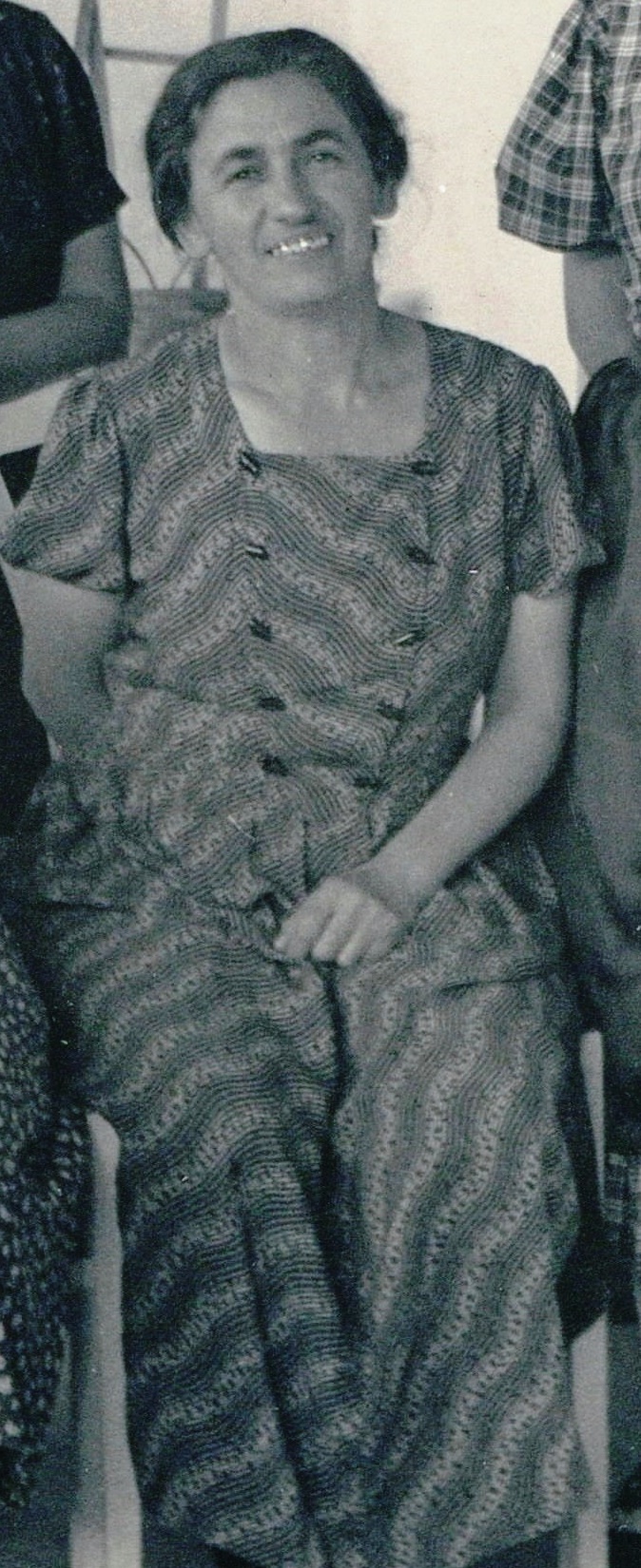
Same eyes, same nose, same smile, same tilt of the head. Even the same eyebrows!
As we were looking at the photograph I noticed something interesting.
She is either Rosa or Sommer (or Hermine?)
When I pointed it out to my husband he disagreed. I kept thinking about it, and I was pretty sure that he was wrong. Until last night. I was at our local family history library because I was trying to solve the mystery of the missing sister. I showed the genealogist my information and the photograph from my blog; as she looked at the photo, her jaw dropped open, her eyes got big, and she pointed at the photograph. “Do you see this woman?” She asked. I laughed with relief. She saw it too. We know it is my grandmother’s sister. Because Rosa and Giselle were the oldest, I think it is my Tante Rosa. And she looks like me!
For me, this is the most awesome thing about genealogy. I am living proof that I am related to this woman, and she is an integral part of my past. My dad tells me that he just uncovered several more photographs of Rosa. I can’t wait to get the copies and make the comparisons.








 As a result of my excitement over this new contact, I accidentally closed out all of the renewed pages I had open for research on this week’s new page and corresponding blog post. Once again, I am having to start over to gather resources for the page and article on Aucke Wikoff that was supposed to have been posted last week.




 StoriesFromthePast.com